
Albania has become a revealing test case for the balance of influence between Brussels and Washington in the Western Balkans.
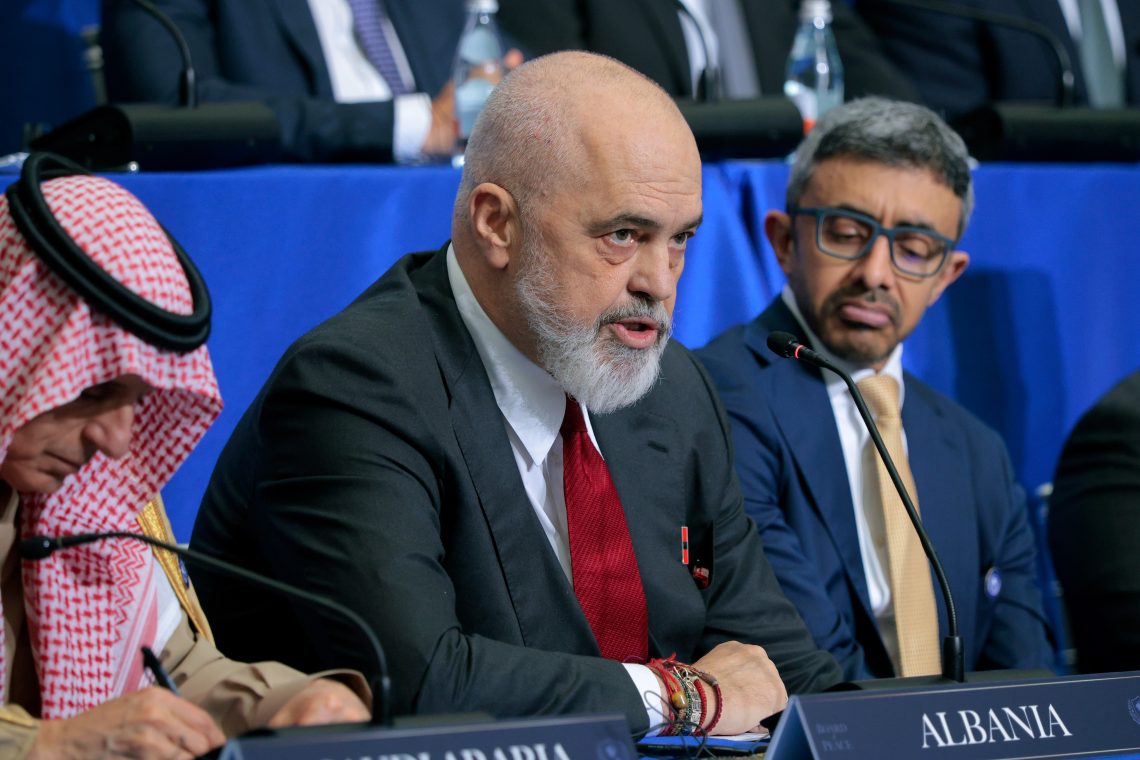 Albanian Prime Minister Edi Rama attends the inaugural meeting of the Board of Peace hosted by United States President Donald Trump in Washington, D.C., on Feb. 19, 2026. © Getty Images
- Albania increasingly sees Washington as its primary strategic anchor
- EU enlargement uncertainty is fueling frustration across the Balkans
- External powers are gaining influence as confidence in Brussels weakens
- For comprehensive insights, tune into our AI-powered podcast here
While formally committed to joining the European Union, Albania is growing closer to the United States and cultivating ties to other external powers, such as Turkiye. How Albania evolves politically and economically will not only shape the future of the Western Balkans, but also the credibility of the EU’s broader geopolitical project.
Albania’s shifting alignment
After World War II, communist Albania – established as a state in 1912 – had one close ally: the Soviet Union. When Moscow and Beijing split in 1960, Tirana turned to China for protection. However, that relationship ended around 1978, leaving the country isolated.
After abandoning communism in 1991, Albania plunged into unrest and political chaos when a series of fraudulent nationwide investment schemes collapsed in 1996-1997, wiping out the savings of many citizens. The country eventually stabilized and developed into a relatively conventional democracy dominated by two largely non-ideological parties – the Socialist Party (SP) and the Democratic Party (DP) – which alternated in government.
Since 2013, the SP and its leader Edi Rama, the former mayor of Tirana, have dominated Albanian politics, winning four consecutive elections while pursuing a liberal, low-tax economic policy.
The economy of the largely ethnically homogeneous country has grown by roughly 4 percent annually, driven by booming tourism and service sectors. However, Albania continues to face high youth emigration and unemployment, and its population of around 2.75 million is steadily declining.
Corruption and political favoritism remain persistent concerns despite sweeping judicial reforms and several high-profile arrests, including those of former president, Ilir Meta, and sitting Tirana mayor, Erion Veliaj.
Albania’s era of isolation (1978-1991)
- After severing ties with China in 1978, Albania lost its final major ally and entered a period of near-total international isolation.
- Communist ruler Enver Hoxha pursued an extreme Stalinist doctrine centered on autarky, ideological purity and fear of foreign influence.
- Albania withdrew from the Soviet-led Warsaw Pact in 1968 and later denounced both the Soviet Union and China as traitors to communism.
- The regime built an estimated 170,000-750,000 concrete bunkers across the country, fearing invasion by NATO, Yugoslavia or the Soviet bloc.
- Borders were tightly sealed, foreign travel was severely restricted and attempting to flee the country could result in imprisonment or death.
- In 1967, Albania declared itself the world’s first officially atheist state, banning religious practice and closing or destroying churches and mosques.
- Foreign media, Western music and outside cultural influences were heavily censored, while the secret police, the Sigurimi, maintained extensive domestic surveillance.
- Economic self-reliance led to chronic shortages, outdated industry and low living standards despite some gains in literacy and basic infrastructure.
- Political purges were common, including against senior communist officials accused of ideological deviation or foreign sympathies.
After Hoxha’s death in 1985, his successor Ramiz Alia cautiously eased some controls, but the system collapsed amid protests and economic crisis in 1990-1991.
Clearly defeated in the 2025 general elections, the main opposition DP, still led by 81 year-old veteran Sali Berisha, secured barely one-third of the vote – its worst result to date.
Despite their rivalry, both major parties remain firmly committed to the U.S., NATO and Albania’s long-standing goal of joining the EU as quickly as possible.
Factors influencing foreign policy
Albania has been a NATO member since 2009 and is fully aligned with the EU’s common foreign and security policy. Yet alongside Hungary, whose government recently changed, Albania also quickly joined U.S. President Donald Trump’s “Board of Peace,” an initiative intended to administer and stabilize Gaza. The move marked a notable departure from mainstream EU foreign policy and underscored a broader reality: When strategic priorities clash, Washington remains Tirana’s primary point of reference despite geography, and regardless of Albania’s ambition to join the EU.
Beyond the U.S. – whose importance is reinforced by the large Albanian diaspora there – Italy, France and Germany also hold significant influence. Prime Minister Edi Rama is considered personally close to France. Nevertheless, French politicians and public opinion have long been wary of Albanian immigration, which could complicate efforts to build support for Albania’s eventual accession to the EU.
Any future accession treaty would likely require ratification through a French referendum, since the country has special constitutional provisions related to EU enlargement. While a negative vote could theoretically be bypassed through qualified majorities in the French parliament, doing so would be politically difficult.
Serious concerns over Albania’s rule of law and efforts to combat corruption and drug trafficking continue to be raised by several EU member states, with the Netherlands and Sweden among the most outspoken critics.
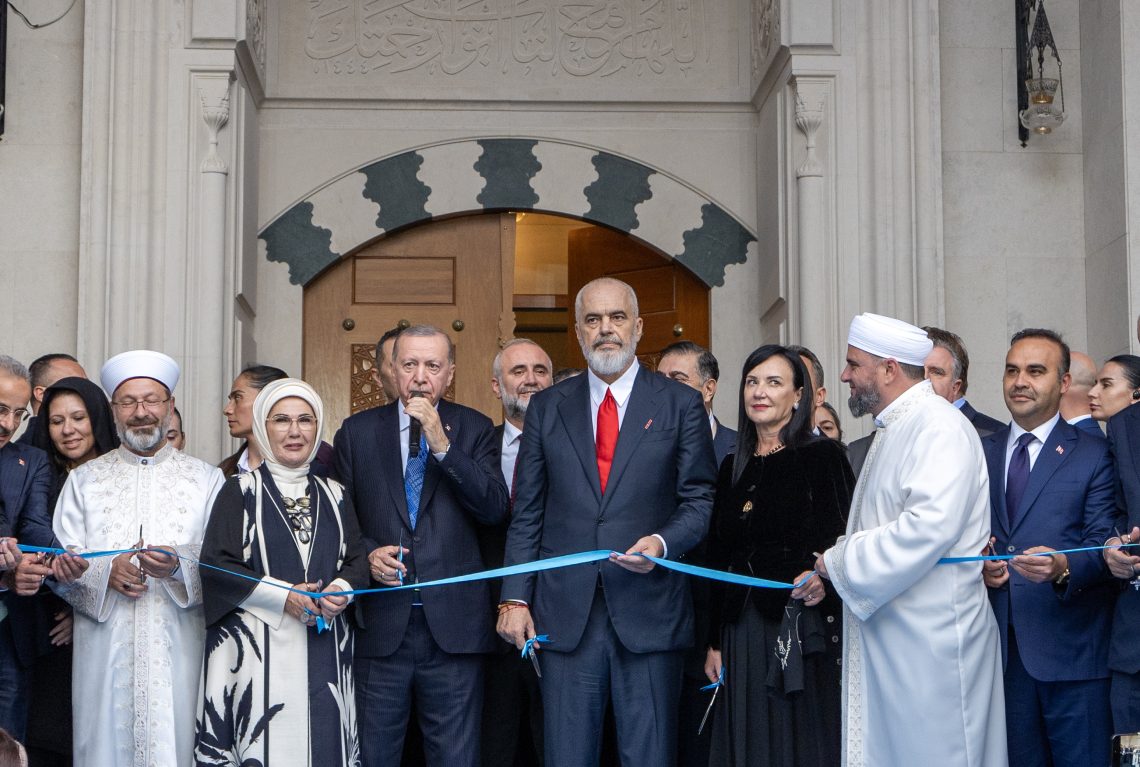 Turkish President Erdogan (center left) and Albanian Prime Minister Rama (center right) attend the opening ceremony of the Namazgah Mosque in Tirana on Oct. 10, 2024. Albania has been cultivating closer ties to Turkiye under the long tenure of both leaders. © Getty Images
At the same time, Albania faces few immediate security threats. The country has limited strategic weight, is firmly embedded within NATO and is surrounded by generally friendly neighbors. Occasional disputes, such as border demarcation issues with Greece, tend to be amplified more for short-term domestic political purposes than because they pose a serious risk of confrontation.
Five centuries of Ottoman rule left a lasting mark on Albania and the wider region, shaping both culture and the political outlook. Today, Turkiye – geographically close and home to an Albanian diaspora population comparable in size to Germany’s – remains an important reference point, as well as one of Albania’s leading foreign investors.
Not only has Prime Minister Rama consolidated his position during 13 years in power, he has also become one of Europe’s longest-serving leaders, surpassed only by figures such as Vladimir Putin, Recep Tayyip Erdogan, Aleksandar Vucic and Emmanuel Macron.
Albania’s relations with the Albanian-speaking leadership in Kosovo remain naturally close, but ties have at times been complicated by the abrasive style associated with leaders such as Albin Kurti and Vjosa Osmani. Their confrontational approach has strained relations with both foreign and domestic partners – particularly the Serbians – and contributed to the persistent deadlock in the EU-facilitated Belgrade-Pristina dialogue.
Against this backdrop, Prime Minister Edi Rama personally and publicly appealed to President Trump for the early release of former President of Kosovo Hashim Thaci, who has been held for nearly six years by the Specialist Chambers in The Hague on war crimes charges linked to the Kosovo conflict of the late 1990s.
Accession and integration
Prime Minister Rama and Serbia’s President Vucic, together with North Macedonia’s former leader Zoran Zaev, jointly initiated a more structured interstate cooperation framework (“Open Balkans”) between 2019 and 2021. On February 28, 2026, Prime Minister Rama and President Vucic co-authored an opinion piece in Germany’s Frankfurter Allgemeine Zeitung advocating a phased, partial accession formula for the Western Balkans countries, short of full voting rights. The proposal had weaknesses and did not receive much support, even at home. Yet it should be seen as a rare plea by the leaders of two long-waiting, frustrated and humiliated EU candidates.
The message can be interpreted as a response to similarly unrealistic proposals emerging from within the European Commission and several member states advocating full EU membership for Ukraine by January 2027. The proposal – which would effectively disregard the EU’s long-standing principle of gradual, merit-based accession – being seriously discussed in European media illustrates the extent to which the bloc’s enlargement strategy has fallen into disarray.
More by Klaus Wölfer
While a small country like Montenegro, having already achieved a high degree of alignment with EU standards, could likely be absorbed into the union relatively smoothly, Albania and Serbia present more complicated challenges – albeit for different reasons.
On the surface, Albania has made significant progress in cooperating with the EU and aligning itself with the behavior and policies expected of a member state. Yet important domestic and external obstacles remain unresolved. Some receive little attention in day-to-day debates or are temporarily dismissed as secondary concerns, including the severe demographic decline that has affected virtually every recent EU accession state. The pattern is visible in the Baltic nations, as well as in Romania, Bulgaria and Croatia.
For Albania, such trends would place even greater pressure on an already rapidly shrinking population. To offset labor shortages, the country has increasingly relied on foreign workers, primarily from Asian countries and Turkiye, particularly in the booming tourism sector, which reached record levels in 2025 with roughly 12 million visitors. Many migrant workers also bring their families, raising longer-term questions about how smoothly Albanian society – historically highly homogeneous – will absorb this new form of immigration.
Scenarios
Most likely: Albania continues to align with the U.S.
As long as the broader regional framework remains stable and the current political leadership stays in power, no major short-term disruptions are likely. At the same time, a decisive breakthrough in Albania’s accession process with the EU also appears improbable.
Beyond Albania’s declared commitment to EU membership and Brussels’ rhetoric about merit-based enlargement, there are what many in the region perceive as the EU’s tacit signals. For Tirana and much of the Western Balkans, that message has become increasingly discouraging. While the EU and Western Balkan states have spent years discussing the abolition of roaming charges, as yet to no avail, roaming fees between the EU and Ukraine were scrapped from January 1, 2026.
Such perceived double standards encourage Balkan states to diversify their strategic relationships and place greater emphasis on ties with the U.S. as well as powers such as Turkiye, China and Russia. This dynamic is visible not only in Albania, but also in Serbia. The likelihood of this scenario is 80 percent.
Less likely: Nationalist destabilization
A nationalist resurgence could be triggered by a combination of economic stagnation or crisis – for instance a downturn in tourism – leadership changes and growing frustration with what many in the region see as the EU’s unfulfilled 2003 Thessaloniki promise of rapid enlargement. A deeper economic or political crisis could in turn fuel broader destabilization and a renewed wave of nationalism across the Western Balkans.
The U.S. currently appears more distracted by other global priorities and less focused on its traditional role of containing nationalist tensions in the region. Albin Kurti, the most popular politician in Kosovo, has become increasingly active politically in Albania and North Macedonia, wagering on the further rise of Albanian nationalism. That trend is already generating stronger Slavic nationalist reactions in Skopje. The likelihood of this scenario is 15 percent.
Least likely: A decisive EU breakthrough
A transformed, decisive EU – perhaps following an unexpected change of its leadership and an effective peace treaty for Ukraine – could finally take action on enlargement. Brussels and the 27 members could draft and quickly apply a Thessaloniki follow-up action plan, enabling Montenegro’s accession by 2028 and Albania’s and North Macedonia’s before the decade ends. This would create a positive effect of renewed motivation for the rest of the Western Balkans. But even such a breakthrough would still leave out the most important and pivotal country: Serbia. The likelihood of this scenario is 5 percent.
Contact us today for tailored geopolitical insights and industry-specific advisory services.

Receive insights from our experts every week in your inbox.