
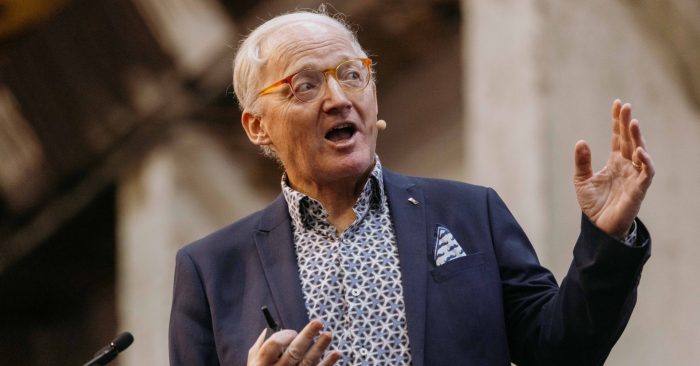
As AI celebrates its 70th birthday, Scientia Professor Toby Walsh surveys its longer-than-expected history and a few key points about its future.
Artificial intelligence began on the 18th of June 1956. That makes AI 70 years young.
You might be surprised that AI has a particular day on which it starts. Most scientific disciplines don’t start on a specific date. Artificial intelligence is different. Monday, 18 June 1956 was the first day of an eight-week-long workshop whose goal was to kick-start the science of artificial intelligence.
The workshop was held on the leafy campus of Dartmouth College, an Ivy League school in the pretty town of Hanover, New Hampshire. The workshop was organised by John McCarthy, a young assistant professor who I got to know several decades later who had an ambitious dream. His dream was ancient – to build a machine that could think.
McCarthy therefore invited a group of like-minded colleagues from the United States, Canada and the United Kingdom to New Hampshire to join him in building an artificially intelligent future. And he invented the phrase “artificial intelligence” to name what he wanted the group to build.
Funnily enough, 18 June is International Panic Day, which seems appropriate for the day humanity started working on building its successor. Fortunately for humanity, McCarthy’s dream proved harder to turn into reality than he imagined. He had promised the scientific agency funding the 1956 workshop that the group would make significant progress towards building artificial intelligence over the course of that summer. They failed.
So, 70 years later, where are we?
AI models like ChatGPT, Claude and Gemini are definitely very impressive in what they can do. Dario Amodei, CEO and co-founder of Anthropic has talked about having a “country of geniuses in a data centre”. And fields like mathematics and programming are starting to be transformed by these marvellous AI tools.
On the other hand, AI models are also impressive in some of the stupid mistakes they make. Let me give one example with this prompt:
What do you do if your fiancé(e) shows up at your wedding?
Google’s AI Overview offers some confused advice:
If your fiancé(e) shows up at your wedding, it’s a situation that calls for immediate and calm communication. The key is to understand why they are there and address any underlying issues. It could be a misunderstanding, a change of heart, or a deeper problem that needs to be resolved…
Artificial intelligence still, then, has some way to go to realise McCarthy’s dream of matching human intelligence. And it’s very hard to say whether that will take a few years. Or a few decades. But I doubt any of my scientific colleagues think it will take a few centuries.