

By Vinny Porco
Sports Administration faculty member Tim Wolz has taught at U of L for a decade, and has come to embrace Generative AI in the classroom in recent years.
From Sport Communication to Sport Sociology, Wolz brings decades of experience in the field coaching collegiate soccer to his nine offered classes with students of numerous future career paths.
Welcoming AI into the classroom
His coaching experience is not the only thing that makes him stand out, however. Made immediately apparent to students upon a reading of his syllabi, Wolz is a professor that not only allows, but encourages the use of Generative AI in coursework.
In a March 2026 interview with The Louisville Cardinal, Wolz explained his philosophy and boundaries when it comes to students’ use of Generative AI.
Wolz values a number of things in his teaching, all falling under his unique career-based ethos of professionalism. “My job isn’t to get them a job,” he said. “My job is to get them promoted once they get into a job.”
With this in mind, Wolz crafts his coursework with intention around both the process and creation of a product. He used his Sport Communication class as a primary example.
“In my Sport Communication class, they’re part of a communications team for an expansion professional team that I own,” Wolz explained.
In this class, he does not assign exams. Rather, students are responsible for weekly multimodal projects that replicate work expected by Sports Administration professionals. These assignments include press releases, promotional social media posts and even professional work emails.
Among his grading criteria and present in all of his assigned coursework is student use of technology. Wolz explained that assignments compel students to use different software, with Generative AI programs such as Microsoft Copilot and ChatGPT included.
Setting guidelines for AI use
In the ongoing conversation of Generative AI in higher education, Wolz has leaned in. He believes that jumping on the new wave will help maintain and even increase graduates’ viability in the professional world.
“AI’s not going anywhere,” he said. “We are doing students a disservice if we don’t teach them the proper way to use AI.”
In his optimism, Wolz embraces standing out from many other U of L faculty members. However, he is still careful to set clear expectations and boundaries around its use in his courses.
His Generative AI policy as found in the syllabus for the Spring 2026 section of his Sport Communication class is as follows:
- Academic misconduct is present in academic work wherever AI assistance has been used when unauthorized, or when authorized, has not been disclosed as required.
- The use of Generative AI may be used with prior instructor permission and appropriate attribution and citation.
- AI should be used to enhance and improve the assignment.
- This application should not be used to complete the assignment.
Generating a defense for AI use in academia
Wolz told The Cardinal he allows his students to use Generative AI for two primary functions when completing weekly assignments.
The first function is idea generation. He does not believe prompting a software like ChatGPT or Copilot for ideas undermines “creativity,” another part of his grading criteria, because he expects students to expand on AI-generated ideas using their own thinking.
“Your creativity kicks in and you say, ‘That’s a really great idea. How can I take this from point A to point B?’”
The second and more prevalent function of AI in Wolz’ classroom is refinement. He encourages students completing writing-centric and multimodal assignments to refine text using Generative AI. This even applies to his teaching of professional emailing towards the overall goal of creating a concise product.
“I’ll get emails from students. It’s one big, long paragraph that’s twenty sentences. And you’re like, ‘What the hell is this?’ I don’t even get past the first three sentences. It just bores me,” he remarked.
“Now let’s take the same paragraph,” he continued. “Let’s run it through AI and say, ‘Make this shorter and professional.’ Boom, there it is. Now it’s three sentences long, and we’ve summed up the whole thing.”
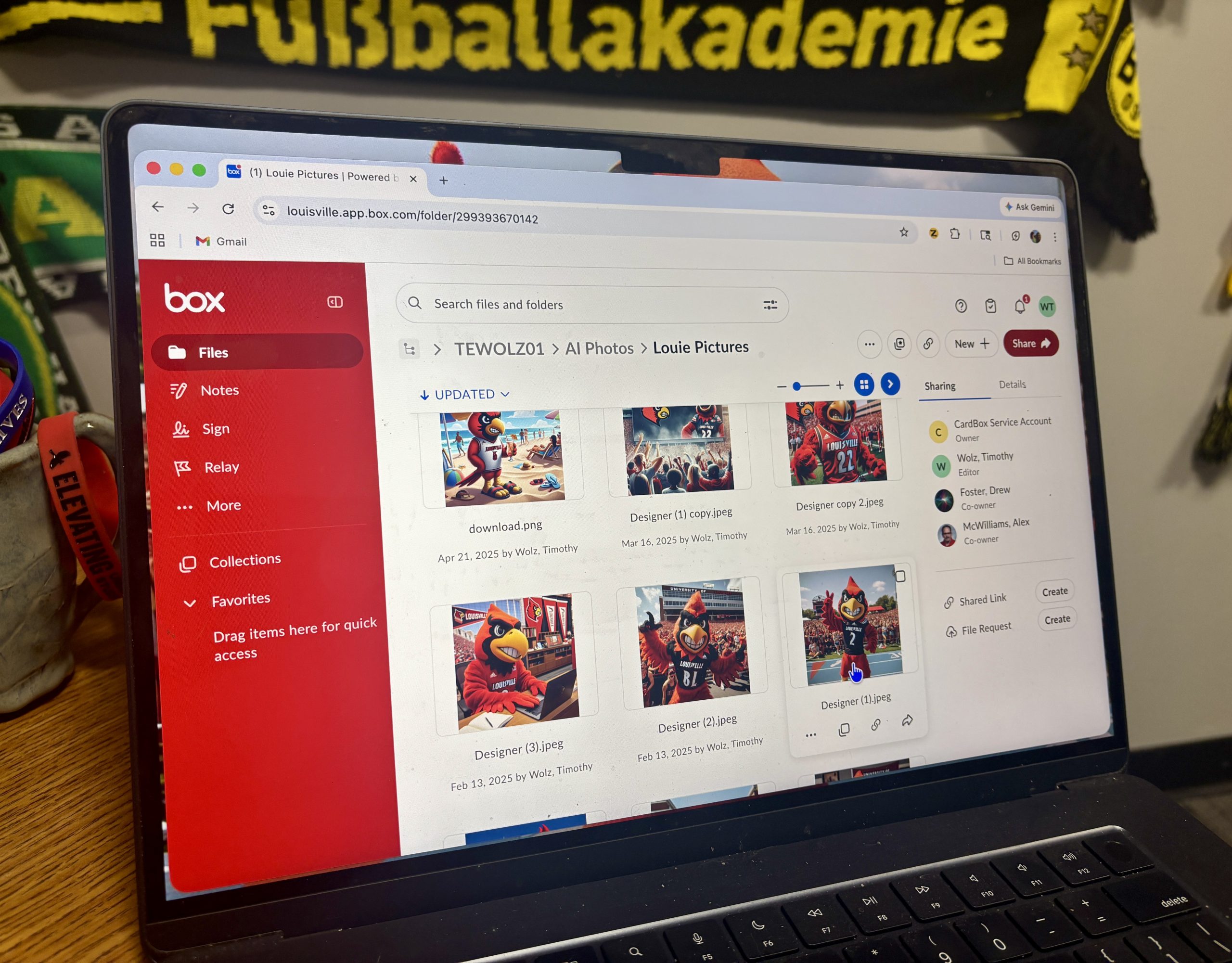
SPAD professor Tim Wolz shows off his folder of AI-generated images of Louie the Cardinal. (Photo by Vinny Porco / The Louisville Cardinal)
Wolz’s limits on AI
Wolz does not, however, allow the use of Generative AI to create or draft entire assignments. When asked by The Cardinal how he polices this, he echoed a sentiment he tells classes at the beginning of each semester, saying, “Keep your original copy.”
When academic honesty is in question, Wolz noted that he can easily call on students to produce a “pre-AI” copy of their work in order to show they only used it for the purpose of refinement.
Another way Wolz limits the overuse of Generative AI is by requiring the inclusion of lecture material in assignments.
He explained that requiring students to include lecture material in weekly assignments not only emphasizes class attendance, but also adds an element to them that Generative AI cannot replicate. “AI is not sitting in my lecture,” he said.
Overall, Wolz believes embracing the appropriate use of Generative AI is the best course of action for both the academic and professional future of his students. He considers his mindset to be “glass half-full,” and wants students to use the software to help produce work that will bolster their viability in Sports Administration job markets.
“AI is not going away,” he told The Cardinal. “Let’s teach how we can use it to make our world a better place.”
Feature Photo by Vinny Porco / The Louisville Cardinal