
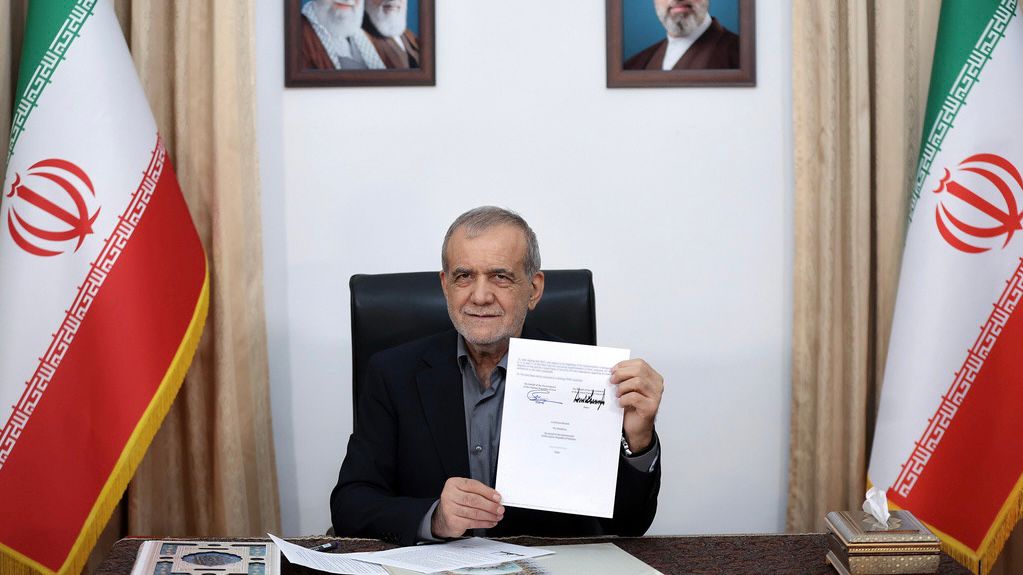
WASHINGTON — Lawmakers are questioning U.S. involvement with a $300 billion reconstruction fund for Iran that was part of the memorandum of understanding signed by President Donald Trump and Iranian President Masoud Pezeshkian this week aimed at ending their war.
The memorandum said the U.S. is committed to working with regional partners to develop a plan that provides $300 billion for Iran’s reconstruction and economic development but didn’t explicitly say which countries or companies would provide the funds.
According to the document: “The United States of America undertakes with regional partners to develop a definitive, mutually agreed plan with at least U.S.D. 300 billion for the reconstruction and economic development of the Islamic Republic of Iran. The mechanism for the implementation of this plan will be finalized as part of a final deal within 60 days. All required licenses, waivers and permissions needed for the relevant financial transactions will be granted by the United States of America.”
Lawmakers on both sides of the aisle are sounding alarms, including several Republicans.
“I have to know where that money is coming from because I don’t think my constituents are going to be really happy about it if that’s all U.S. taxpayer dollars,” Sen. Joni Ernst, R-Iowa, told reporters Thursday.
Asked if he is concerned about the $300 billion fund, Sen. Ted Cruz, R-Texas, told reporters Thursday: “I am. History demonstrates that giving billions of dollars to theocratic lunatics who want to murder us is an exceptionally bad idea.“
After acknowledging that the United States and Israel had inflicted at least $1 trillion of damage on Iran since launching their attacks Feb. 28, Trump said during a news conference at the G7 summit in France on Wednesday that the U.S. would not be one of the investors in the $300 billion fund.
On Thursday, the president reiterated his stance on Truth Social: “There is no 300 Billion Dollar payment to Iran by the U.S. That’s Fake News! All there is for the U.S. is Success, Lower Oil Prices, and Victory. Check out the Stock Market. Dumocrat propaganda at play!”
Sen. Roger Wicker, R-Miss., said in a statement Thursday that he has always supported Trump’s efforts to end Iran’s threat to the United States but was “concerned that the memorandum of understanding negotiates away the victories of Operation Epic Fury in ways that are completely out of step with the President’s goals.”
The $300 billion fund for Iran, Wicker said, “would make Iran’s payoff under President Obama’s 2015 deal look like a pittance by comparison.”
The 2015 Joint Comprehensive Plan of Action between Iran, the U.S., the United Kingdom, France, China, Russia and Germany provided sanctions relief to Iran in exchange for limits on its nuclear program. The deal unfroze about $50 billion in Iran’s foreign assets and provided $1.7 billion in cash, according to the Center for Arms Control and Non-Proliferation. The $1.7 billion came from $400 million that Iran had placed in a U.S. foreign military sales trust fund in the 1970s combined with $1.3 million in interest, a State Department official testified to Congress in 2016.
GOP Sen. Bill Cassidy of Louisiana, who lost his primary in May to a Trump-backed challenger, wrote on X on Wednesday: “Reagan is rolling over in his grave. Iran’s nuclear ambitions were not curbed, and they have learned that threatening the Strait of Hormuz works and will undoubtedly leverage it in the future. Now, Iran gets to build brand-new infrastructure under this deal.”
Like many lawmakers and analysts, Cassidy noted that the strait was open and Iran was suffering from debilitating U.S. sanctions prior to the war.
“This is the worst foreign policy blunder in decades,” he wrote.
U.S. sanctions on Iran date back to 1979, when President Jimmy Carter banned Iranian imports to the U.S. states and froze $12 billion in Iranian assets, according to the Atlantic Council. Subsequent administrations, including President Ronald Reagan’s, continued to ratchet up sanctions that have cost the Iranian economy about $50 billion annually in oil revenue alone, according to the U.S. State Department.
Under the memorandum signed this week, Iran is allowed to export crude oil and keep the revenue.
Vice President JD Vance said during a White House press briefing Thursday “not a single penny” of U.S. money “under any circumstances” would be paid to Iran. He insisted that Iran would not receive any of the $300 billion unless it fully complies with the agreement, but he did indicate possible sanctions relief.
After saying it’s impossible for a country like the United Arab Emirates to invest in Iran because of U.S. sanctions, he added: “What we’re saying is that if Iran behaves, and if the Emirates themselves want to build a power plant, then we will do the sanctions relief necessary to make that possible.”
Senate Minority Leader Chuck Schumer of New York said on X that Democrats will not help Trump send money to Iran.
“If Trump wants to send hundreds of billions of dollars to Iran, he’ll need to do it with Republican votes,” he wrote Thursday.