
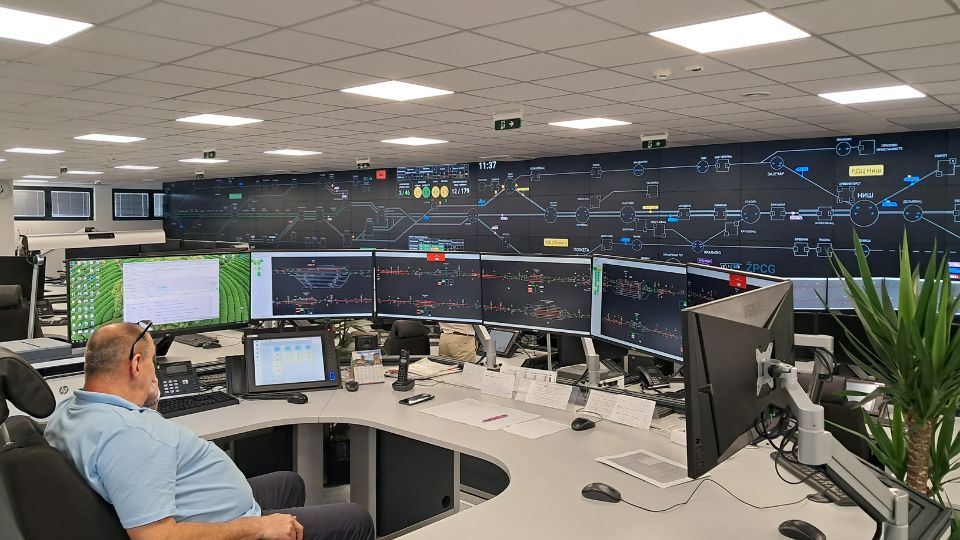
 Serbia has unveiled its new Unified Dispatch Center for rail traffic management, built near the Belgrade-Ranžirna station in Makiš. The project, valued at EUR 127 million, will use automation and artificial intelligence to centralize rail control and reduce the risk of human error.
The center is designed to serve as the main coordination hub for rail traffic in Serbia and will gradually integrate the national network as lines are modernized and connected to the new digital systems.
According to Serbian authorities, the investment amounts to EUR 127 million. The project is currently 83% complete.
The center will use modern digital technologies, including artificial intelligence and automation, with the goal of minimizing the risk of human error in rail traffic management.
540 km of lines currently managed
At present, the center is operated by 23 people and manages approximately 540 km of railway track.
Over the next 6–7 months, Serbian authorities plan to include the Belgrade–Subotica line in the center’s control system.
In the long term, the goal is for the new center to cover 3,357 km of railway lines and become the hub of Serbia’s entire dispatching architecture.
The center will be at the top of the hierarchy of all existing and future dispatching subcenters in the country.
All future railway projects will need to be compatible with this central system so that the modernized infrastructure can be integrated into the single traffic management platform.
Safety, Automation, and Punctuality
Serbian authorities are presenting the new center as an important step toward increasing safety, reliability, and punctuality on the railways.
The system aims to centralize traffic control, enable more efficient network monitoring, and reduce reliance on manual interventions.
In addition to traffic management, the center will also contribute to infrastructure monitoring. According to authorities, the railway network will be monitored using security cameras, including to prevent theft of cables and components, which can compromise traffic safety.
So far, approximately 500 km of fiber-optic cables have been installed to connect the railway network to the new dispatch system.
Project carried out in collaboration with Russian Railways
The project was carried out by Institut NIAS, a subsidiary of Russian Railways.
The presentation of the center was attended not only by Serbian officials but also by representatives of RJD International, the international arm of Russian Railways, as well as the Russian Ambassador to Serbia, Aleksandr Boțan-Harcenko.
In recent years, RJD International has been involved in several projects to modernize Serbia’s railway infrastructure.
Russian representatives stated that the company’s activities are integrated into the modernization of Serbia’s infrastructure and that Serbia remains one of Russian Railways’ priorities for the coming period.
Network Modernization Continues
The presentation of the dispatch center was also linked to discussions regarding the condition of certain rail lines in Serbia.
One of the lines mentioned is the Valjevo–Vrbnica line, part of the rail link to Montenegro, with a length of 210 km.
Serbian authorities have indicated that this section is in very poor condition, particularly on the stretch between Kosjerić and the border with Montenegro.
The complete modernization of the line could require investments of over 2 billion euros and take approximately 5–6 years to complete.
Share on: 


