
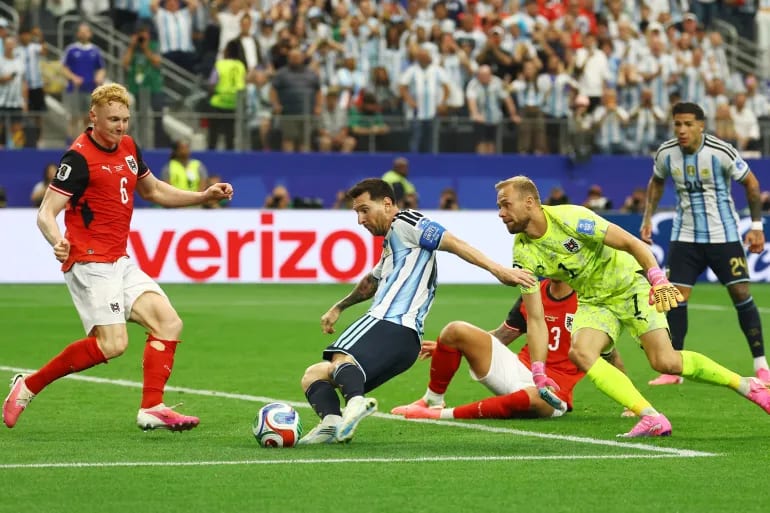
Argentina secured their place in the knockout stage of the FIFA World Cup 2026 with a 2-0 win over Austria on Monday at Dallas Stadium in Arlington, Texas — but the result was almost secondary to the history made by Lionel Messi, who became the all-time leading goalscorer in men’s World Cup history. Here’s a full breakdown of the key moments and a closer look at Messi’s performance on the night.
Match Result and Group Standings
Argentina’s 2-0 victory lifted them to six points from two matches in Group J, confirming their progression to the knockout rounds with a game still to play. Austria, despite the defeat, remain on three points and still have a chance to advance depending on how the final round of group matches unfolds. The winner of Group J will face the runner-up of Group H, which includes Spain, Cape Verde, Saudi Arabia, and Uruguay.
It was a measured, professional performance from Scaloni’s side against an Austrian team managed by Ralf Rangnick, who had opened their own campaign with an impressive 3-1 win over Jordan.
Key Moment #1: The Missed Penalty
The match began with high drama. Just five minutes in, Austrian defender Stefan Posch was penalized for bringing down Lautaro Martínez inside the box, and Messi stepped up with a chance to make World Cup history immediately. Instead, his attempt sailed wide — a rare, costly miss that kept the scoreline level and denied him an early record-breaking moment.
Austrian goalkeeper Patrick Pentz and the rest of the Austria backline survived the early scare, with David Alaba making several crucial defensive interventions to keep the match scoreless through the opening half-hour.
Key Moment #2: History Made in the First Half
Argentina didn’t have to wait long to make amends. In the 38th minute, Messi latched onto a cutback from Thiago Almada and finished first-time to put Argentina ahead — and in doing so, surpassed Miroslav Klose’s long-standing record of 16 World Cup goals to become the outright all-time leading scorer in men’s World Cup history.
The goal capped an extraordinary individual arc for the 38-year-old, who opened this tournament with a hat-trick against Algeria to draw level with Klose, before completing the record-breaking moment against Austria just days later — and two days before his 39th birthday.
Key Moment #3: Messi Seals It Late
Austria struggled to generate clear chances after the break, with Rangnick’s side largely unable to break down a well-organized Argentine defense. The game appeared destined to end 1-0 until deep into stoppage time, when Messi had an effort blocked before finally tucking home his second goal of the night — his 18th of the tournament overall — to put the result beyond doubt.
Messi’s Performance: The Full Picture
Messi’s night was a study in resilience as much as brilliance. The missed penalty in the opening minutes could easily have rattled a player half his age, yet he responded by scoring twice — including the goal that rewrote the World Cup record books. His movement off the ball, particularly in linking with Almada and Julián Álvarez, continued to demonstrate why, even at 38, he remains the focal point of Argentina’s attack.
Reaction from across the football world was immediate. Figures including Zlatan Ibrahimović and Thierry Henry publicly praised the achievement, with many framing it as a defining chapter in what has been described as Messi’s farewell World Cup campaign — a 20-year journey that began as an 18-year-old substitute against Serbia and Montenegro back in 2006.
What’s Next for Both Sides
Argentina will now turn their attention to their final group match against Jordan, with top spot in Group J and a favorable knockout draw still up for grabs. For Austria, the tournament isn’t necessarily over — they remain in contention for a first knockout-stage appearance since 1954, but they’ll need results to go their way in the final round of group fixtures.
Argentina’s win over Austria will be remembered less for the scoreline and more for the moment Lionel Messi rewrote World Cup history. A missed penalty that could have defined a lesser player’s night instead became the prelude to redemption, as Messi’s brace lifted him past Miroslav Klose and into a class of his own. For Argentina, the victory secures a place in the knockouts and keeps their bid for back-to-back titles firmly on track. For Austria, there’s still hope of reaching the knockout stage for the first time in over seven decades, but they’ll need help from elsewhere in the group.
But beyond the standings, the stats, and the storylines still to play out, Monday night in Dallas belonged to one man. It would have been easy to understand if a missed penalty in the fifth minute had cast a shadow over the rest of Messi’s evening — for almost any other player, it might have. Instead, he answered in the way he has answered every challenge across two decades on football’s biggest stage: with the ball at his feet and the moment in his hands.
This wasn’t just another goal. It was the 17th and 18th of a World Cup career that began in 2006, when an 18-year-old substitute first stepped onto this same stage against Serbia and Montenegro. Two decades, five tournaments, and one missing trophy later, that teenager has become the single most prolific scorer the World Cup has ever seen — surpassing legends like Ronaldo and Klose along the way, and doing it not in his prime, but at 38 years old, with the weight of a nation’s expectations on his shoulders every single match.
What makes nights like this one matter isn’t just the record itself — it’s the manner in which it arrived. Not gifted, not lucky, but earned through a sharp first-time finish and a composed, clinical second in the dying moments of the match. That’s the Messi story in miniature: setbacks absorbed, doubts answered, history made on his own terms.
Whatever happens in the knockout rounds ahead, this much is already certain — Lionel Messi has given football one more chapter worth remembering, in what increasingly looks like the final, fitting verse of the greatest World Cup story ever told.

Lionel Messi celebrates after becoming the all-time leading scorer in men’s World Cup history during Argentina’s 2-0 win over Austria in Dallas.
FOTO: Pinterest