
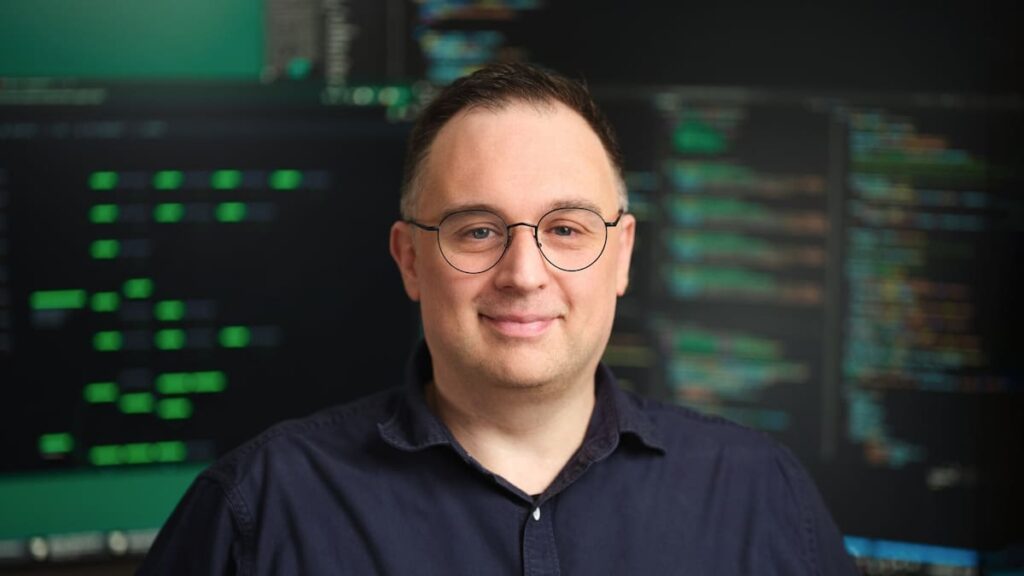
Atomic Tessellator founder Alain Richardt said his company was in the process of synthesising an alternative to the rare earth element, samarium, used for permanent magnets that maintain their properties at high temperatures, when it was selected for the Google for Start-ups Accelerator – a 10-week programme that provides mentoring, advice and a technical leg-up for early-stage firms.
Currently, China controls about 90% of the market for the various REEs used in permanent magnets, used in EV motors and much else. Today, China exports close to 100% of the raw supply of samarium – a market worth just under $1 billion per year.
Before joining the Google for Start-ups 2025 cohort, Atomic Tessellator was limited to a maximum of 44,000 atoms in a single simulation.
Google challenged them to cross the 100,000 threshold.
This rallied the Atomic Tessellator team and along with Google’s technical help – and some US$350,000 in compute credits on the tech giant’s AI platforms – they blew through their target to hit 680,000 atoms by the end of the programme, allowing the start-up to simulate materials at a nanometre scale with unprecedented accuracy, ensuring samarium was in the bag.
$13m raise, US govt spooks chip in
Richardt hit 2026 running, too. In April the firm raised $13 million at a $50m valuation.
The seed round was led by London-based Crane Venture Partners, with participation from In-Q-Tel (aka IQT), the US taxpayer-funded venture capital vehicle created by the CIA, plus New Zealand’s Icehouse Ventures, Global From Day One (GD1) and Outset Ventures (which numbers Sir Peter Beck on its investment committee).
The funds have been used to bump staff numbers from four to eight. Richardt says AI means his team can do the work of 30 scientists.
The start-up also has a virtual “AI scientist” running on a Google platform that works 24/7.
He says Atomic Tessallator was able to digitally synthesise an alternative to tantalum (a tough but malleable metal known for its extraordinary resistance to heat and corrosive acids) in a week.
Richardt says the traditional trial-and-error process of combining different chemicals in a lab would have taken five to seven years – if it had gone ahead at all.
“For decades, the pathway from a promising material candidate to a commercial-grade product has been expensive and uncertain,” Outset Ventures said in an investment note.
“Discoveries sit dormant on a researcher’s desk long after their theoretical performance has been demonstrated. By stunting before commercial adoption, this cycle just repeats and reinforces supply dependencies on single sources of critical inputs.”
Atomic Tessallator sent its virtual lab formula for a tantalum alternative to a physical lab and foundry in the US, which successfully produced a gram of the new substance this month.
Commercial production by year’s end
Richardt’s start-up has now synthesised 10 new materials, with 20 more in its pipeline.
He sees his firm working with partners to reach commercial levels of production, which he defines as “several hundred kilograms” of REE alternatives per month, by the end of this year.
China stranglehold to Australian foundaries
When the Herald spoke to Richardt, he had just held a meeting in Canberra – his sixth, in an effort to rally Australian Government support for a foundry across the Tasman.
The production location makes sense.
Atomic Tessellator’s AI-designed, samarium alternative, which it has called “vireon”, will be made from materials that are only mined in Australia.
It could completely recast geopolitics if China’s stranglehold on so many rare earth elements is replaced by cheaper alternatives synthesised and manufactured in other countries.
Richardt says he’s also held foundry talks with Government agencies here, but that they are at an earlier stage.
For a young firm (it was founded in May 2024), Atomic Tessellator has had a heavy element of accelerator success. In September 2024, it scored a spot on an Amazon accelerator (the Asia-Pacific cohort of the AWS Generative AI Spotlight programme), which came with US$100,000 in AWS credits.
Google wants Kiwis for its 2026 accelerator
Atomic Tessellator snuck on to the 2025 Google for Start-ups Accelerator Australia programme with a second Kiwi early-stage firm, Taranaki’s ThroughLine (used by Google, OpenAI, Anthropic and others to connect users with mental health services).
This year, it’s formally on the Google for Startups Australia and New Zealand programme, with Google hoping to boost the number of local participants. The total Australasian cohort will likely be in the 10 to 15 range.
Start-ups should be at the seed or series A level.
Its 2026 applications close on July 19, with the 10-week, non-equity programme starting on September 1. Apply here.
Chris Keall is an Auckland-based member of the Herald’s business team. He joined the Herald in 2018 and is the technology editor and a senior business writer.