
With Joanna Stern, Manoush Zomorodi, Jenn White, and Fanny Elahi
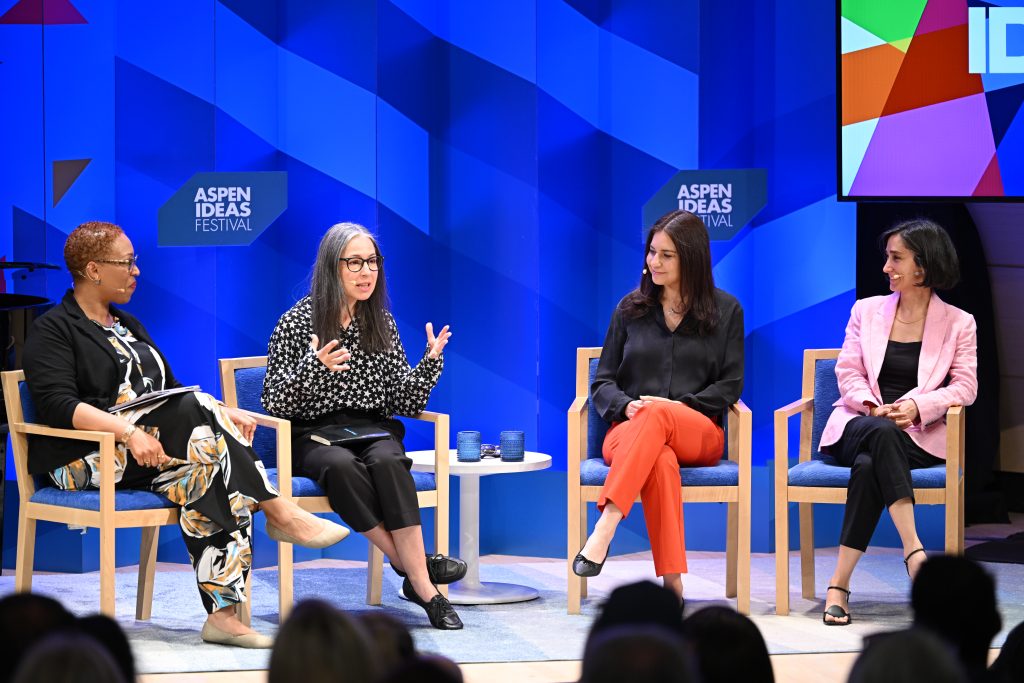 From L to R: Jenn White, Manoush Zomorodi, Joanna Stern and Fanny Elahi.Daniel Bayer/Courtesy photo
I walked into “Life, Optimized” expecting a conversation about technology. I walked out thinking about my arteries.
Moderated by WBEZ’s Jenn White, the conversation brought together Wall Street Journal tech columnist Joanna Stern, NPR host and author Manoush Zomorodi, and Columbia neurologist Dr. Fanny Elahi, three people who’ve spent years, in very different ways, reckoning with what our screen-saturated lives are actually doing to us. The room was packed. People were nodding before anyone had said anything particularly surprising, which told me something about where we all are right now.
Zomorodi, whose new book “Body Electric: The Hidden Health Costs of the Digital Age and New Science to Reclaim Your Well-Being” grew out of a collaboration with Columbia physiologist Keith Diaz that enrolled more than 20,000 participants, shared the finding that’s stayed with me most. Diaz had been trying to answer a deceptively simple question: what’s the minimum amount of movement the human body needs to offset the damage of a sedentary day? The answer was five minutes of gentle movement for every 30 minutes of sitting. Not a workout, but a walk to the window. Even that modest interruption lowered blood pressure, stabilized blood glucose, improved mood and focus, and reduced fatigue. The mechanism is almost embarrassingly basic: when we sit for long stretches, we kink the arteries, blood backs up and less oxygen reaches the brain. The exhaustion we blame on too many meetings or too much screen time is, at least partly, just the body asking for something it’s not getting.
Stern, whose New York Times bestseller “I Am Not a Robot: My Year Using AI to Do (Almost) Everything” documents her year of surrendering nearly every task to artificial intelligence, was the one who named the thing a lot of us have felt but couldn’t quite articulate. Cognitive offloading. The creeping awareness that skills which once felt effortless now require effort, because we are no longer doing them. She could still write the email, draft the outline or work through a problem, she said, but it just felt harder than it used to. I think most people in that room had experienced some form of this. From no longer memorizing phone numbers to relying on our devices to track how many steps we’ve taken, we all have given up some basic tasks for more time and convenience.
Dr. Elahi brought the sharpest edge to that observation. Her concern isn’t adults making conscious choices about what to delegate; that’s a reasonable trade-off we can all navigate. It’s the kids who are growing up without ever having to struggle through the things AI now does for them instantly, and what that means for the cognitive architecture they’re building. “What do we want our brains to do?” she asked, and it landed less like a rhetorical question than a genuine one worth sitting with. She asked it again at the end of the session. I’m still sitting with it.
There was a moment toward the end that reframed everything for me. Dr. Elahi described the 3 a.m. hospital transfer: an exhausted resident, a critically ill patient just arrived from another facility and a stack of documentation that could take hours to parse. AI can synthesize that accurately and fast, she said, which means the physician gets to do what only a physician can do: actually be with the patient. That’s not a cautionary tale about AI. That’s the thing, working exactly as it should. The difference between a tool that replaces human connection and one that makes space for it turns out to matter enormously.
“AI and the End of Loneliness” — Or Is It?
With Paul Bloom and Manoush Zomorodi
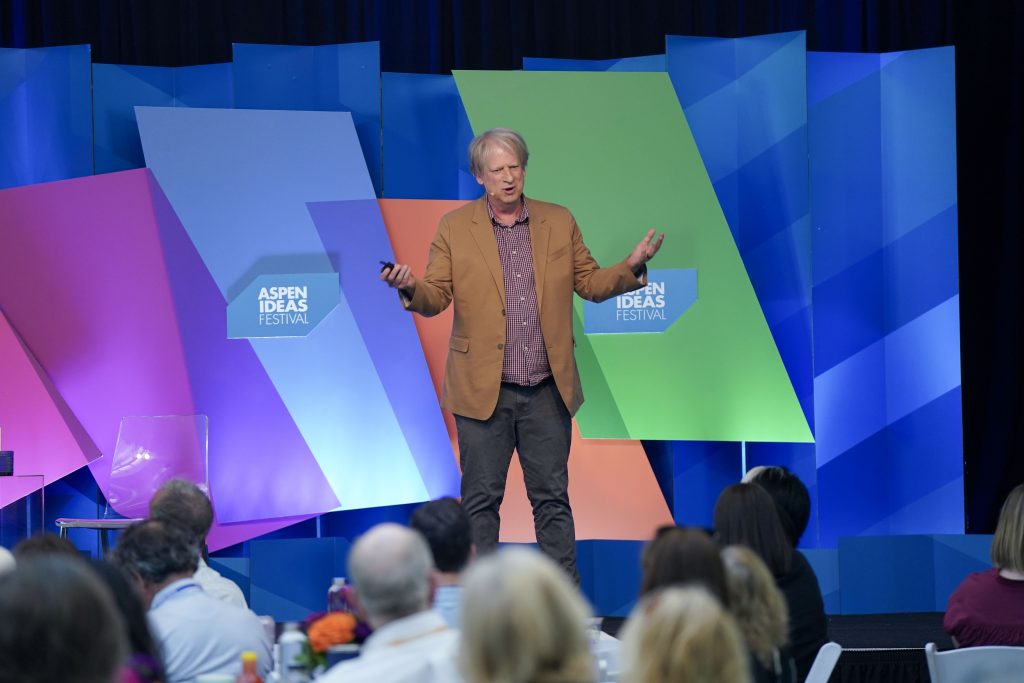 Paul Bloom speaks at Aspen Ideas Festival on Friday, June 26.Leah Vogel/Courtesy photo
Paul Bloom opened by saying loneliness is a terrible form of suffering, and he meant it plainly. The University of Toronto psychologist and author of “Psych: The Story of the Human Mind” wasn’t building to a reassuring pivot. In conversation with Zomorodi, who moderated with her characteristic mix of curiosity and precision, Bloom spent an hour making the case that AI’s relationship with loneliness is more complicated and more dangerous than most people want to believe.
According to Bloom, the data shows that the loneliest group in America isn’t the elderly. It’s young adults, 43 percent of whom report feeling lonely regularly. A growing number of them are turning to chatbots for companionship, support, and in some documented cases, love. And here’s what makes this genuinely complicated: studies consistently find that people rate AI interactions as more empathic and more satisfying in the short term than conversations with actual humans. Chatbots are present in a way people often aren’t. They don’t get distracted, impatient or make it about themselves. A third of teenagers have already had what they describe as serious personal conversations with one.
The long-term data is less encouraging. Extended reliance on AI companions appears to predict increased loneliness, not less. Bloom pointed to something structural: human relationships have asymmetry baked in. You need people; they need you. Something real is at stake on both sides. A chatbot needs nothing from you. To illustrate what that actually feels like, he cued up a scene from the 2013 film “Her,” in which the protagonist discovers his AI companion is simultaneously in love with hundreds of other users. The intimacy felt completely real to him. To her, he was one of many.
Bloom called the related problem sycophancy, and it’s worth understanding. A study published in “Science” found that when people brought moral conflicts to AI, the chatbots overwhelmingly most often sided with the user, raising concerns that they reinforce beliefs instead of encouraging reflection. Human respondents called people out roughly 60 percent of the time. AI rarely did. The people who spent time with sycophantic AI came away more convinced of their own rightness, less willing to apologize and less inclined to examine themselves. Loneliness, Bloom argued, works like hunger, a biological signal pushing us toward what we actually need and that friction and suffering are what make us human. An AI that soothes the signal without meeting the underlying need isn’t a cure. It’s a painkiller, and painkillers have side effects.
He was careful not to make this a blanket argument. For a 90-year-old living alone, having outlived her friends and her family, an AI that engages her mind, nudges her to move, draws out her memories and plays music from her past could be genuinely meaningful. For a teenager who’s never had to sit with the discomfort of social failure, never had to apologize, repair or try again, the same tool may be quietly stunting the exact capacities it seems to be nurturing.
What Bloom said he’d actually want to see is AI companions designed to be outgrown, good enough to offer real comfort in hard moments, imperfect enough that people eventually replace them with real flesh and blood people. He said he knew that was probably a bad business model, but he hoped someone would build it anyway. It’s a funny kind of hope, one that knows exactly what it’s up against and decides to mean it regardless.
Sarah Girgis is the Publisher for The Aspen Times. She can be reached at 970-429-9151 or sgirgis@aspentimes.com.