
From changing climates to disappearing insect species, experts offered a peek at the science behind phenomena in nature at the annual Living With Lakes seminar.
The annual event at Rogers Lakewood Park, sponsored by the Valparaiso Chain of Lakes Watershed Group, increases awareness of ecosystems and threats to them.
Ever notice there are fewer bugs on your windshield than there used to be? That’s anecdotal evidence of the disappearance of insect species, said Desiree Robertson, research coordinator for the Midwest Climate Adaptation Science Center.
Robertson remembers when she was a kid, the Ind. 49 bypass had just opened, and bugs hit the windshield. “My dad would make me get out and scrub the windshield,” she said.
“How we perceive the past, that’s not real science,” she said. “That in itself is not evidence of the decline.”
However, she cited a number of studies that show insect species are disappearing rapidly.
That’s a problem for humans as well as insects.
“Insects are what make ecosystems work. That is the crux of it. That is what is so cool,” Robertson said.
“You know that one in three bites of food you take is due to an animal pollinator.”
Bees and butterflies get a lot of good publicity as pollinators, but they aren’t the only ones. “There’s some wonderful flies that are important pollinators as well,” Robertson said.
 Desiree Robertson, research coordinator for the Midwest Climate Adaptation Science Center, discusses the need for insect species diversity during the Living with Lakes seminar Saturday, June 27, 2026. (Doug Ross/for the Post-Tribune)
Insects spread pollen to make plants grow. Insects prey on each other. Insects feed birds, frogs and other animals. Insects also eat dead things.
“They break down organisms and other organic material and recycle them into the ecosystem,” Robertson said. They’re key components in the life cycle of flora and fauna, including humans.
“Imagine this place, what it would be like without insects,” she said, prompting attendees to look around them at the barn swallow nesting in the rafters of the pavilion above them, at the lily pads in the lake and in the trees. Bullfrogs spoke up for themselves.
Without insects, attendees volunteered, there would be no birds, no flowers, no trees, no fish, no food, no coffee, no mosquito bites.
“My goal at any of these talks is to put insects in your life a little bit,” Robertson said.
Over 1 million insect species are described, but possibly millions more are unnamed, she said.
There are about 1.4 billion insects for every person on Earth, she added.
“We’ve got specimens in the museums, at the Field Museum,” that are still being identified and described, Robertson said.
“Right here in the Midwest, in Indiana, in Porter County, is also a great place to be if you’re interested in insects,” she said. “We have this diversity of landscapes, this diversity of ecosystems.”
Some insects are the equivalent of a canary in a coal mine. They’re omens of trouble that could affect humans.
Stoneflies need cold, oxygenated water, so they’re one of the first to go when there’s a disturbance, she said.
The federally endangered Karner blue butterfly once lived in the Indiana Dunes, but are now gone, Robertson said.
Their caterpillars only eat wild blue lupine, and the butterflies are such terrible fliers that they don’t even cross roads.
In 1999, they were the second most abundant butterfly in the Indiana Dunes, she said. But in 2012, there was a false spring. With trees leafing out early, Karner blue butterflies’ eggs hatched. “Let’s get this party started. Let’s eat this lupine,” Robertson said.
But the lupine is on a different clock and wasn’t blooming to provide the food source the caterpillars relied on. That doomed the first brood that year. Then it was a hot, dry summer. “All the lupine had dried up and there was really nothing for that second brood to survive on,” Robertson said.
The decline in insect populations has many causes, including loss of habitat to deforestation and urbanization. “You can’t say it’s any one cause,” she said. “It’s death by a thousand paper cuts.”
Butterflies are in rapid decline across the United States.
One study looked at almost 77,000 different surveys in which 12.6 million individual butterflies were counted by 36 monitoring programs.
“They found that over 20 years, 2000 to 2020, they saw a 22% decrease in the number of butterfly species in that time,” Robertson said. “That’s a pretty significant decline.”
A study on insect species in a pristine area in Colorado helped determine the effect of climate change on the decline in insect species, she said.
That study found a 72% decline over 20 years linked to increasingly warm summers, year after year, Robertson said. Climate can rewrite insect life cycles because their development depends on temperatures.
Climate change is also changing where insects live.
Lone star ticks were common in southern Indiana 15 years ago, and now their range has spread to northern Indiana.
Several species of stoneflies are predicted to lose almost all their suitable habitat by 2070. “They’re already moving to higher latitudes,” but will run out of space, Robertson said.
“Heat waves can directly, physiologically impact insects,” Robertson said. Drought increases stress on individual insects, while storms and flooding impact their habitat.
“Climate scrambles ecological timing,” she said, with flowers and pollinators becoming out of sync.
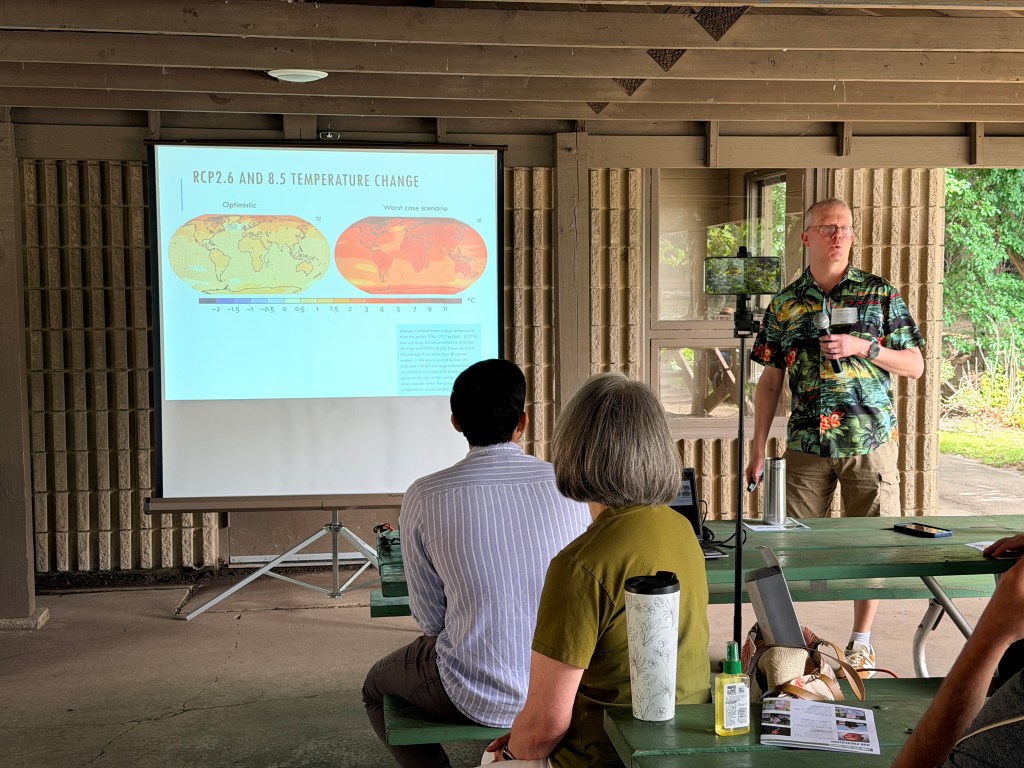
Valparaiso University meteorology professor Craig Clark offered his predictions for future climate change after exploring the changes throughout the Earth’s history.
 Valparaiso University meteorology professor Craig Clark explains the science behind climate change and what to expect in the future during the Living with Lakes seminar Saturday, June 27, 2026. (Doug Ross/for the Post-Tribune)
Until the 1970s, when the Clean Air Act was passed and implemented, the release of sulfates mitigated some of the effects of carbon dioxide and other greenhouse gases, he said. Sulfates reflected some of the solar radiation in the upper atmosphere.
“Things really ramp up fast” without those sulfates emitted at high levels in the last half century, Clark said.
Some have suggested cranking up sulfates into the upper atmosphere. “It would work if done to scale,” he said, but not without bad side effects. “The problem is it might really mess up climate patterns, which would mess up agriculture.”
“This is bad, but mass starvation would have other problems,” Clark said.
And climate change is more complicated than that. “Solar radiation and all other things simply can’t explain the global warming that has occurred in my and your lifetime,” he said.
June has been a wet month with severe storms, but freakish months tell us nothing about climate change, he said. It’s looking at the longer range that offers a better perspective.
“You see the warming over time” when you look at climate data for the entire planet, he said.
El Niño’s weather patterns have increased global temperatures. Brace yourself. “We have another El Niño brewing. In fact, it’s supposed to be a really big one,” Clark said.
“If we went through a decade without a meaningful El Niño,” he said, we could easily go a decade without a global temperature record.
But the fact is that climate change is occurring. “How dire will it be? We shall see.”
“There’s a pretty big range of what might happen,” Clark said, based on uncertainty about how high the levels of carbon dioxide and other greenhouse gases will get. Will technology be developed that will solve the problem and possibly even reverse the effects seen so far?
“There are nerds in basements all over the place working on technological things,” Clark said, but even if a solution is found, how quickly could it be scaled up? Will it slow the rate of increase? Will the population continue to grow, or will the decline in the birth rate seen in Indiana and the United States become a global phenomenon and make a difference?
Clark predicts the answer will be somewhere in the middle of the extreme predictions, with carbon dioxide growing from 400 to 450 parts per million to about 600 by the end of the century.
Clark predicts warming of 2 degrees Celsius hotter than now, which would be 3 degrees warmer than the pre-industrial era.
“Arctic sea ice has been plummeting, especially in the summer,” Clark pointed out. Not in his lifetime, but in his son’s lifetime, there will be essentially no ice in the northern seas in summers, he predicted.
Doug Ross is a freelance reporter for the Post-Tribune.