
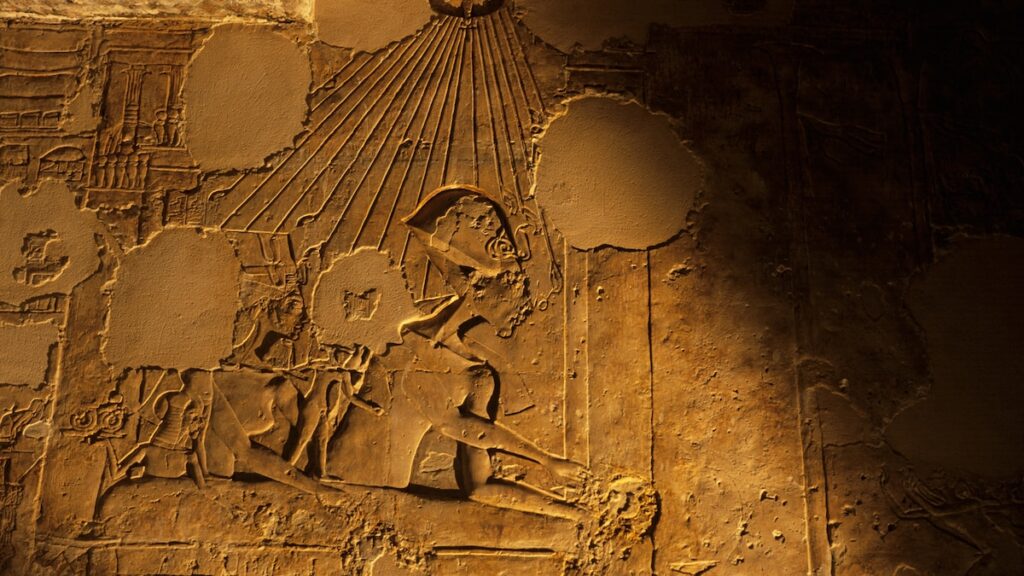
It wasn’t just the spiritual world of the Egyptians that would experience such a seismic shift. Akhenaten relocated the superpower’s capital north from Thebes to an empty plot of desert. Almost overnight, a city rose in an area we now call Amarna. For roughly three decades it attracted dignitaries from all over the world to a metropolis in the middle of nowhere.
GRAPHIC: FERNANDO G. BAPTISTA, LIZ SISK, NGM STAFF. ART: ROCIO ESPIN; JOSE DANIEL CABRERA PEÑA. SOURCES: PETER F. DORMAN, AMERICAN UNIVERSITY OF BEIRUT; BRETT MCCLAIN, UNIVERSITY OF CHICAGO; BARRY KEMP, AMARNA PROJECT.
Three millennia later, hundreds of tablets from what was briefly the most important city in Egypt were discovered in and around Amarna (a fascinating and controversial story in its own right that we’ll maybe get to someday). They document diplomatic relations between Egypt and the major power players of the ancient world. But far from being stodgy diplomatic texts about grain or taxes, they tell of petty rivalries, snarky monarchs, a missing Babylonian princess, ostentatious displays of wealth, and accusations of fraudulent gifts. Assyriologist Selena Wisnom, author of the recent book The Library of Ancient Wisdom: Mesopotamia and the Making of History, called them “the Wikileaks of the Bronze Age.”
Behind the letters sent by monarchs and vassal kings is the unseen world of the scribes and emissaries who wrote and delivered the letters and who formed the backbone of ancient diplomacy. Now, new evidence shines a light on their work, shows how they helped avert political disasters, and (!!) suggests that at least one of them was a foreign agent.
The Amarna Letters form the bulk of a collection of 380 clay tablets that were discovered in or not far from Tell el Amarna, on the east bank of the Nile roughly halfway between the north (Memphis, near modern-day Cairo) and south (Thebes, now Luxor) of ancient Egypt. The tablets date to the 14th century B.C., spanning the end of the reign of Amenhotep III (1399-1350 B.C.), the reign of his son Amenhotep IV/Akhenaten (1349-1332 B.C.), and the early years of Tutankhamun. The letters give us a glimpse into the rich political world of this period, revealing tense and complex relationships.
GRAPHIC: FERNANDO G. BAPTISTA, LIZ SISK, NGM STAFF. ART: ROCIO ESPIN; JOSE DANIEL CABRERA PEÑA. SOURCES: PETER F. DORMAN, AMERICAN UNIVERSITY OF BEIRUT; BRETT MCCLAIN, UNIVERSITY OF CHICAGO; BARRY KEMP, AMARNA PROJECT.
“These are not announcements polished for public release, but the unfiltered complaints, demands, hopes, and requests of rulers all over the Near East as they write to the king of Egypt, the superpower of the day,” explained Wisnom when I caught up with her over a video call. In fact, you can read them and recognize patterns that continued into the modern era. “Less powerful states in the Levant asked for protection from threatening neighbors in return for their loyalty…while the giants of Assyria and Babylonia demanded to be treated as equals and complain when they are not. Marriages are an especially sore point—although it was common to send princesses abroad to marry foreign royalty, the king of Egypt never sends his daughters to anyone, which the others see as a slight.”