

Two former NATO secretaries general and Sweden’s prime minister have delivered pre-summit assessments signaling that the Ankara gathering must achieve concrete results on burden-sharing, Ukraine and defense industry, or risk deepening the alliance’s internal fractures.
Former Secretary General Jaap de Hoop Scheffer said Türkiye’s hosting role at the July 7-8 summit has been long overdue, and carries clear meaning. “It was high time that Türkiye again assumed the role of host,” de Hoop Scheffer said.
“This is a recognition of the seriousness, the political and military weight that Türkiye carries,” he added.
‘NATO is moving toward NATO 3.0’
De Hoop Scheffer spoke to state-run Anadolu Agency (AA) after a panel titled “From The Hague to the Ankara Summit: The Future of NATO in a Transformed Global Security Environment,” co-organized by Türkiye’s Presidency of Communications, the Turkish Embassy in The Hague, and the Clingendael Institute.
He traced the alliance’s evolution from its Cold War origins, through its post-Berlin Wall “expeditionary” phase, to its current state.
“Today, NATO operates in the environment of hybrid warfare and artificial intelligence, and must prepare for hybrid warfare,” he said, adding, “So right now, NATO is moving toward NATO 3.0.”
De Hoop Scheffer said the Ankara summit must deliver a consensus on financial commitments, adding that allied defense spending would again be reviewed, as it was at The Hague.
He also said the ongoing war in Ukraine and developments in the Middle East would be on the agenda, adding, “Direct involvement in the Middle East is not part of NATO’s mandate, but the indivisibility of global security cannot be denied.”


Former NATO Secretary General Jaap de Hoop Scheffer speaks to a reporter during an interview with Anadolu Agency on July 3, 2026. (AA Photo)
‘NATO will not fall apart,’ but Europe must do more
Responding to predictions about the alliance’s collapse, de Hoop Scheffer was direct.
“NATO will not fall apart. Throughout its history, NATO has been declared gravely ill or dead many times,” he said.
He said the alliance would remain “alive and active,” but set a clear condition.
“In my view, NATO will survive and remain active only if European allies take on a very large responsibility for the alliance’s defense spending. On this issue, from any angle you look at it, President Trump is right,” he said.
De Hoop Scheffer identified the Eastern flank as NATO’s highest priority, while warning that the Southern flank must not be neglected.
“The southern flank is important for Türkiye, and therefore important for NATO,” he noted.
He also outlined his vision for the alliance’s structural direction, stating, “The scenario within NATO must be one based on consensus, where European NATO allies assume more responsibility. President Trump is right on this. As European allies, we must do much more. Therefore, I see a Europeanization of NATO’s command structure. We will see more Europeans.”
“Europe must, and must be able to, defend itself without direct U.S. military support. This is only possible if the ultimate nuclear guarantee provided by the alliance remains in force. I have full confidence that this guarantee will continue,” he said.
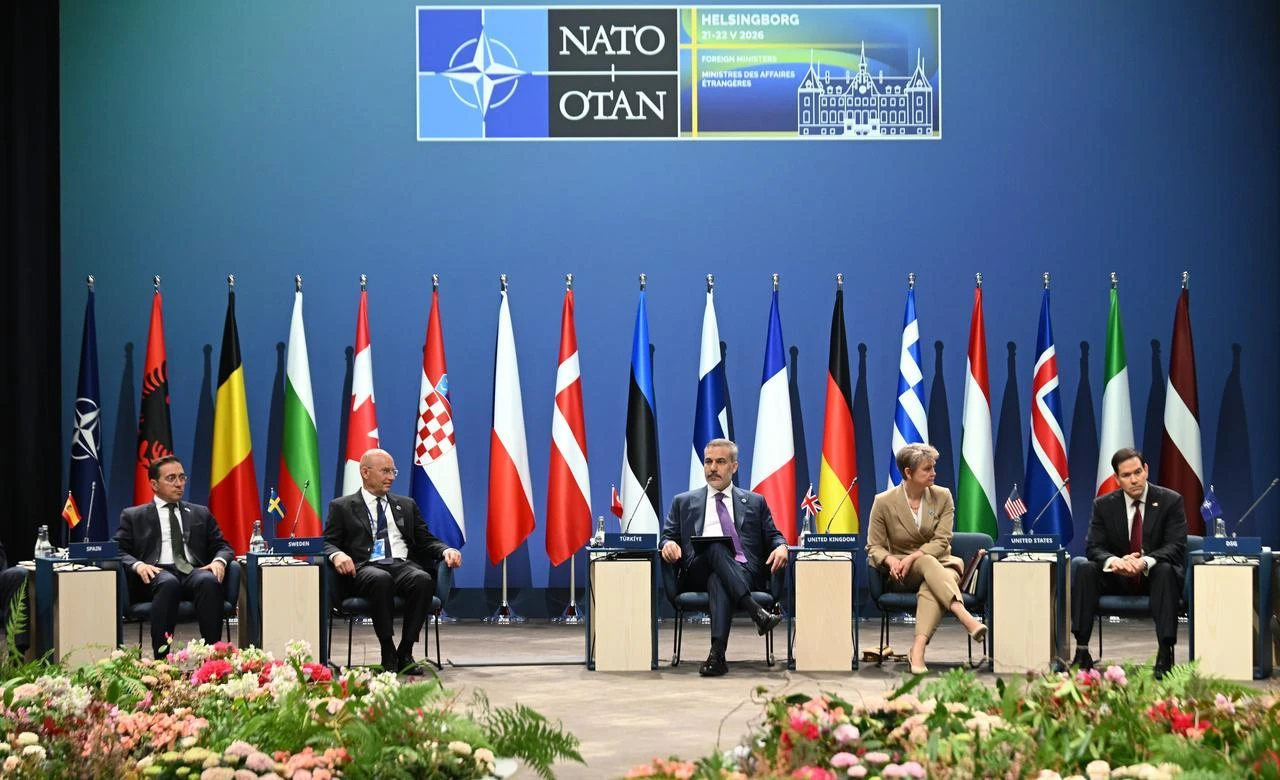
Turkish FM Hakan Fidan (C), Spanish Minister of Foreign Affairs Jose Manuel Albares Bueno (L), UK Foreign Secretary Yvette Cooper (2nd R), and US Secretary of State Marco Rubio (R) attend the North Atlantic Council Foreign Ministers Session during the NATO Foreign Ministers Meeting in Helsingborg, Sweden, May 22, 2026. (AA Photo)
Finland and Sweden accession ‘most proud decision’
Former Secretary General Jens Stoltenberg, now Norway’s finance minister, told Anadolu Agency his primary expectation from the Ankara summit was a clear message of unity.
“My core expectation is for the summit to deliver a message of unity,” Stoltenberg said.
“Even though there are differences and disagreements among NATO allies on trade, Iran, climate and some other issues, I expect the summit to make it clearly evident that all allies in North America and Europe are standing together, that we protect each other and that we are safer together than we are apart,” he added.
Stoltenberg said continued support for Ukraine was of key importance, “because we live in a more dangerous world and in this environment we need a united and strong NATO.”
He described Finland and Sweden’s accession as the decision he is most proud of from his tenure as secretary general, and credited the Turkish president directly, noting, “This was not an easy or self-evident process.”
“Despite this, the accession of these two countries to NATO was a major achievement for both the alliance and for Finland and Sweden. We were able to take this decision thanks to the discussions we held and the agreements we reached with President Erdogan,” Stoltenberg said.
On the alliance’s current security priorities, Stoltenberg pointed to Ukraine above all, saying, “The reason is that the war is happening in our neighborhood, very close to us, and it involves Russia, which has been NATO’s core security challenge for decades.”
He added that predicting where the next crisis will emerge is very difficult.
“Instead of trying to predict the unpredictable, we must be prepared for the unpredictable. The best way to be prepared for any crisis or conflict is to maintain the strong alliance between North America and Europe,” he said.
Stoltenberg said the Ankara summit will be critical.
“This will be a very important summit, and I wholeheartedly believe it will go extremely successfully, thanks to Türkiye’s strong commitment to the alliance,” he said.

NATO Secretary-General Jens Stoltenberg, Finnish FM Pekka Haavisto, and Swedish FM Ann Linde speak at a press conference after their meeting at NATO headquarters in Brussels, Jan. 24. 2022. (AFP Photo)
‘Ukraine support is Sweden’s top foreign policy priority’
Swedish Prime Minister Ulf Kristersson described the summit as taking place in a “turbulent time,” saying Ankara will feature a clear primary message from Stockholm.
“Support for Ukraine is Sweden’s most important foreign policy goal. This is a real investment in European security and Sweden is playing a leading role on this. This will probably be our most important message in Ankara,” Kristersson said.
He listed the three main priorities for the summit as:
- Burden-sharing, including follow-up on the 5% GDP commitment made at The Hague
- A stronger defense industrial base, to be addressed at the Defense Industry Forum
- Long-term support for Ukraine.
Kristersson noted that Russia’s offensive has failed to make significant progress but pointed to the central uncertainty facing allied leaders.
“The biggest question the whole world is asking ahead of the Ankara Summit is: what does a Russia that doesn’t want to negotiate but also doesn’t seem capable of winning do?” he said.
On defense spending, Kristersson said Sweden’s defense expenditure more than doubled between 2021 and 2025, and that the government’s ambition is to reach the 5% target by 2030.
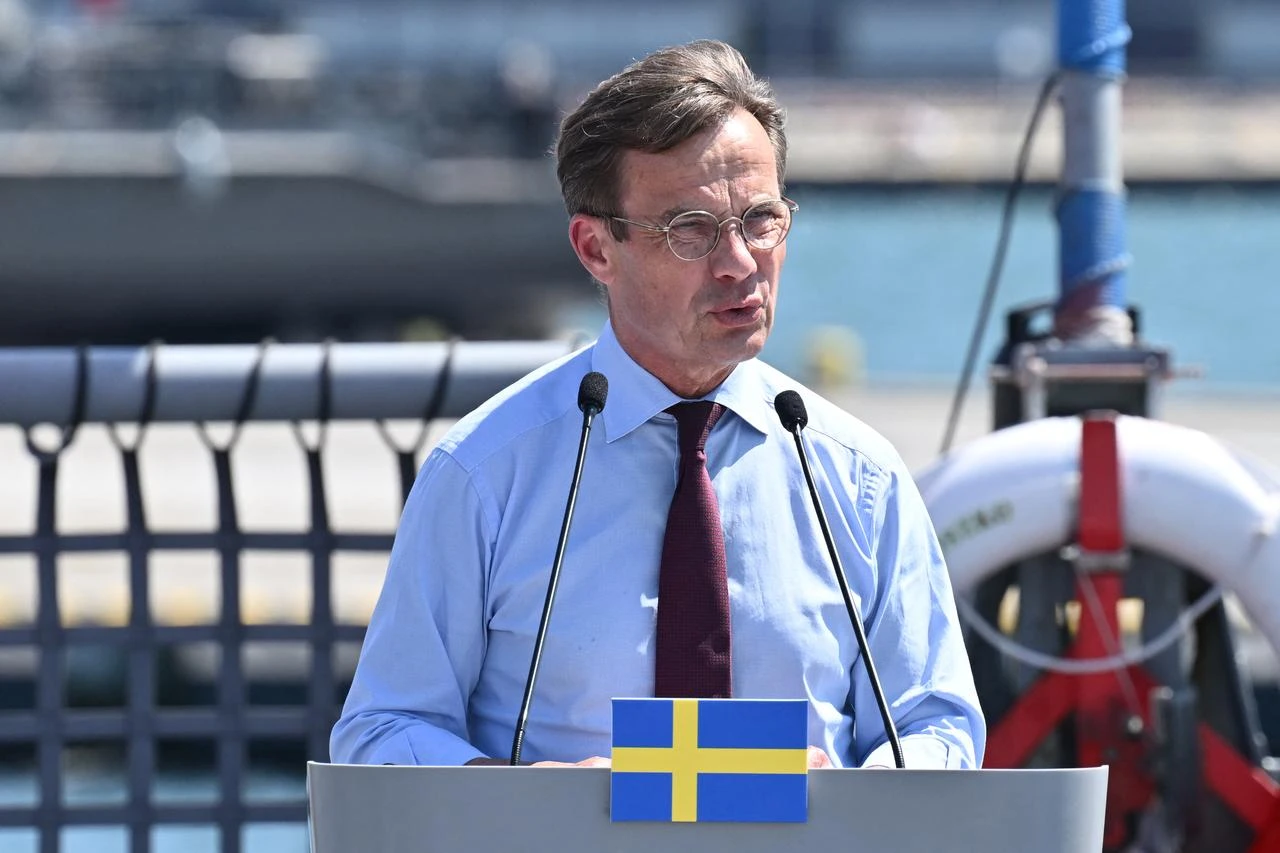
Sweden’s Prime Minister Ulf Kristersson addresses a press conference with Poland’s Prime Minister in Gdynia, Poland, on June 29, 2026. (AFP Photo)
Sweden’s defense exports up 70% under current government
Kristersson outlined a sharp rise in Swedish defense industry exports, saying his government had achieved a 70% increase.
He noted Sweden has sold a new version of 16 Gripen fighter jets to Ukraine, three A26 submarines to Poland and has begun discussions with Canada for six GlobalEye early warning and control aircraft.
“As NATO structures its own defense, this process is being built to an increasing extent by Swedish hands. This is quite remarkable,” Kristersson said, adding, “Defense industry is no longer seen as an unsustainable sector that struggles to be financed in the markets, on the contrary, it is accepted as an essential resource for defending democracy in our geography.”
Swedish Foreign Minister Maria Malmer Stenergard said the summit comes at a critical moment and stressed the need for unity.
“The alliance needs to send a strong signal of unity in long-term support for Ukraine and as an important signal to Russia,” Stenergard said.
She said Sweden would hold a NATO-Ukraine Council format meeting on the margins with Ukrainian Foreign Minister Andrii Sybiha and EU foreign policy chief Kaja Kallas, as well as meetings with Istanbul Cooperation Initiative partners from Bahrain, Kuwait, Qatar and the United Arab Emirates.
“Ukraine is contributing not only to its own security but to our security as well,” Stenergard said, noting, “We all need to draw lessons from the innovation capacity and war experience that Ukraine so generously shares.”

July 03, 2026 04:13 PM GMT+03:00