

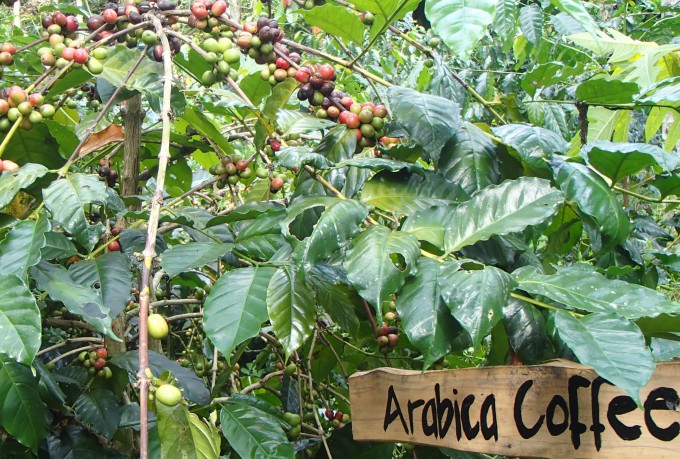
Arabica coffee trees are extremely vulnerable to high temperatures and drought caused by climate change because even a rise of just a few degrees Celsius can worsen their growth or kill them. Getty Image Bank
As rapid climate change threatens the production of coffee, a beverage loved worldwide, scientists are making various efforts such as strengthening the environmental tolerance of major coffee varieties, domesticating wild species, and maximizing the extraction of coffee compounds.
On June 30 (local time), the international journal ‘Nature’ introduced the current state of research aimed at sustaining coffee production threatened by climate change.
The roughly 10 million tons of coffee beans consumed worldwide each year are mostly produced from two species: Arabica (scientific name Coffea arabica) and Robusta (scientific name Coffea canephora). Arabica suffers reduced growth or dies with even a slight rise in temperature, while Robusta requires a lot of water and its yield plummets during droughts. In other words, they are highly vulnerable to heat waves and droughts caused by climate change.
If temperatures rise, coffee farms may have to be moved to higher altitudes to grow Arabica in cooler environments. For smallholder farms, this is practically difficult.
The Ethiopian government, in the homeland of Arabica, is creating protected areas to preserve the genetic diversity of Arabica. The Ethiopian Biodiversity Institute and agricultural research institutes are cultivating more than 12,000 living coffee trees.
These coffee trees provide genetic resources needed to breed or genetically engineer Arabica varieties that can withstand high temperatures and drought. Kassahun Tesfaye, a professor at Addis Ababa University in Ethiopia, said, “I believe we have sufficient genetic resources to confront climate change.”
There are also attempts to domesticate wild coffee species that are relatively tolerant of high temperatures and require less water, such as Liberica (scientific name C. liberica) and Excelsa (scientific name C. excelsa). Some analyses suggest that coffee produced from Excelsa or from the ‘Rivex’ hybrid, created by crossing Excelsa and Liberica, can achieve a flavor so similar that even professional coffee cuppers find it difficult to distinguish from Arabica.
Ultimately, it is important to produce coffee products that consumers want. A single cup of coffee contains more than 2,000 types of organic compounds, and its composition and flavor vary greatly depending on the growing region and roasting method. This means that technologies are also needed to objectively evaluate the quality of climate-resilient varieties.
A research team led by Christopher Hendon, a professor in the Department of Chemistry and Biochemistry at the University of Oregon in the United States, is studying methods to extract more compounds from the same amount of beans. Their approaches include adding moisture to the beans before grinding to reduce static electricity that causes particles to clump together, and grinding the beans less while applying a pressure of 7 bar, lower than the approximately 10 bar used in standard espresso machines.
– doi.org/10.1038/d41586-026-01965-z
Copyright ⓒ DongA Science. All rights reserved.