
The German women’s junior handball team defeated Denmark to reach the top of the world.
The German women’s junior team won the final of the 25th World Women’s Junior Handball Championship held at Jinjung City Gymnasium in Shaanxi Province, China on the 5th, beating Denmark 33-26.
This marks Germany’s second career championship in 18 years since the 2008 tournament. In particular, Germany, which beat Denmark in the 2008 final, once again lifted the trophy against Denmark, marking the birth of a new golden generation.
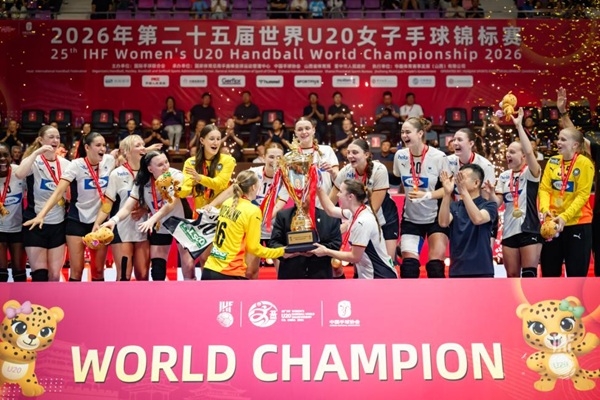 사진 확대
사진 확대 Germany Wins 25th World Women’s Junior Handball Championship Photo Source = International Handball Federation
Denmark, on the other hand, tried to win their third career championship, but finished second. Denmark has won two championships, four runners-up and three bronze medals, winning its ninth medal of its career so far.
The final was a showdown between the two teams, who had been undefeated throughout the tournament. It was expected to be a fierce match because it ranked at the top of the offensive power side by side and also had a great goalkeeper’s strength.
Denmark got off to a good start. Kristine Emilie Hoppe, the leading scorer in the tournament, scored three goals in the first five minutes of the match to lead Denmark to a 5-2 lead.
Germany struggled with its initial attack efficiency. Left back Marlene Tucholke suffered from missing a series of shots, but the mood changed as Denmark began to make mistakes.
Left wing Chiara Rohr led the attack with all four shots, and Germany tied it 7-7 within 12 minutes of the match. Since then, the two teams have been engaged in a fierce battle, continuing a fast-tempo battle.
In the first half goal, Danish goalkeeper Freja Ponseca Nielsen stood out. He made nine saves in the first half alone, showing a 41% ERA, while German goalkeeper Lena Marie Lindemann made only two saves by the 26th minute of the game.
However, the economic trend gradually leaned toward Germany. Germany, which trailed 10-12 around the 17th minute, scored five goals and conceded only one goal in the next 10 minutes to turn the tables 15-13 and finished the first half with a 15-14 lead.
In the second half, Denmark held out with a series of good saves by Freya Fonseca Nilsen. As of the 39th minute of the game, he made 14 saves and a 45% ERA, keeping the goal firmly.
However, Germany won the game with a thicker player base and physical strength. Towards the end of the game, the power of the Danish attack decreased as Hoppe’s physical strength fell on Christine Emily, and Germany did not miss it. With Lena Marie Lindemann’s consecutive saves, Germany went 21-18 in just three minutes. Denmark trailed with 3-0 consecutive points to tie the score at 21-21, but errors at every key moment held back.
Germany successively scored empty goals by effectively targeting Denmark’s 7-6 attack situation, and again took a 23-21 lead to secure the victory. In the end, Germany widened the gap at the end of the game with a solid defense and efficient attack, and confirmed the championship with a 33-26 complete victory.
Germany led the attack with eight goals by Kiara Roar and five by Ruslana Litvinov, while goalkeeper Lena Marie Lindemann played a key role in the victory with a series of decisive saves in the second half.
Germany, which became the world champion after the European champion, proved that this generation has established itself as the next powerhouse by dominating Europe and the world at the same time.
[Kim Yongpil, MK Sports Reporter]