Company Logo
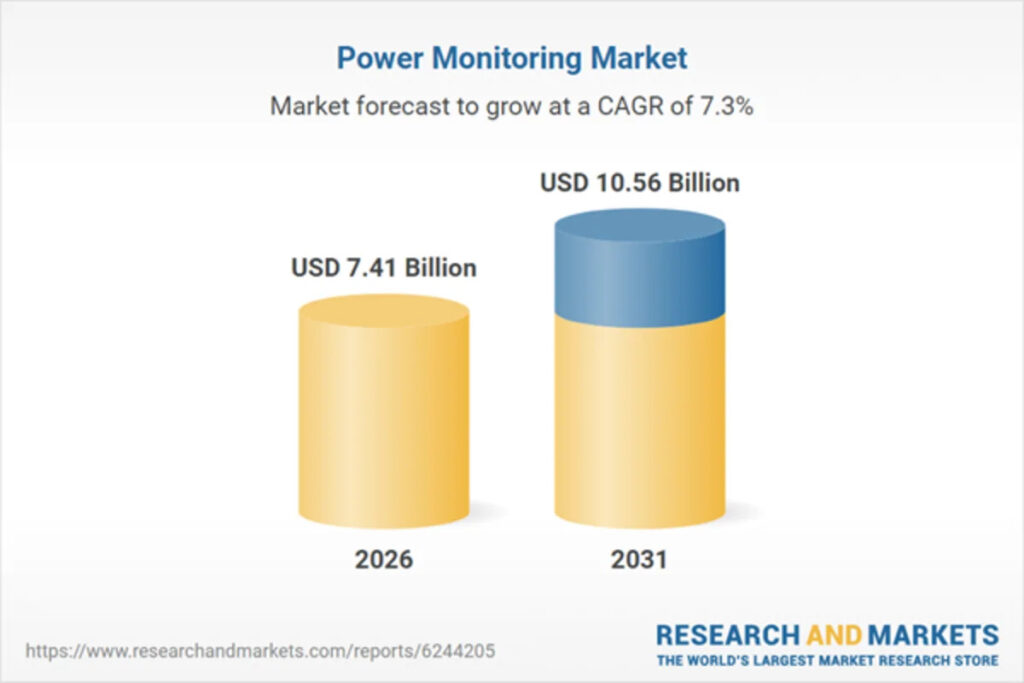
The power monitoring market is projected to expand from USD 7.41 billion in 2026 to USD 10.56 billion by 2031, driven by a 7.3% CAGR. Key growth factors include increased demand for advanced power monitoring solutions across data centers, healthcare, and telecommunications due to the expansion of infrastructure in major economies and concerns over grid stability. Key technologies employed are IoT-enabled sensors, smart metering, and advanced analytics, offering real-time energy management and operational efficiency. North America and Asia Pacific are anticipated to be significant contributors to the market’s growth, with building automation and data centers identified as major application segments. Leading players such as Schneider Electric and Siemens are driving innovation with IoT and AI integrations, elevating market competitiveness.
Power Monitoring Market
Power Monitoring Market
Dublin, July 06, 2026 (GLOBE NEWSWIRE) — The “Power Monitoring Market by Component, Application, End-Use, and Region – Global Forecast to 2031” has been added to ResearchAndMarkets.com’s offering.
The power monitoring market is projected to expand from USD 7.41 billion in 2026 to USD 10.56 billion by 2031, at a CAGR of 7.3% during this period. This growth is driven by the rapid development of data centers, healthcare facilities, telecommunications infrastructure, manufacturing plants, and commercial buildings, which is putting a strain on aging power grids. The solution lies in adopting advanced power monitoring systems to provide real-time visibility, power quality assurance, and energy optimization.
Power monitoring systems are increasingly used in industrial facilities, commercial complexes, data centers, and utilities. These systems encompass smart metering, power quality analyzers, IoT-enabled sensors, advanced analytics, and more, offering features like predictive maintenance and remote diagnostics. The demand is propelled by supportive policies for smart grid deployments and energy efficiency programs across major economies like the US, China, and India.
The adoption of power monitoring technologies integrated with IoT, AI-driven analytics, and edge computing is accelerating, particularly in Europe and Asia Pacific. The industry is evolving to meet the challenges posed by frequent power quality issues and extreme weather events, aiming for operational resilience, energy cost savings, and sustainability goals.
The building automation segment is anticipated to dominate the market during the forecast period. This segment benefits from its application in commercial and institutional facilities where the need for energy management and critical equipment protection is paramount. It integrates seamlessly with building management systems and supports energy efficiency mandates exemplified by LEED and BREEAM certifications.
Furthermore, the segment is witnessing robust growth from new construction and retrofits in commercial sectors, driven by electricity costs and sustainability targets. Power monitoring solutions offer user-friendly dashboards and detailed energy reporting, enabling managers to optimize energy use and maintain compliance with energy codes.
The data center segment is poised for the highest growth as an end user during the forecast period. This is attributed to the explosive expansion of hyperscale facilities and cloud computing infrastructure. Advanced power monitoring solutions are being adopted to manage high power densities, ensure reliable power quality, and integrate seamlessly with building management systems and SCADA platforms.
The modern systems offer modular architectures, cloud-based dashboards, and AI-driven analytics, which aid in optimizing performance and integrating renewable energy sources and battery storage systems.
North America is estimated to be the second-largest market during the forecast period. The growth is fueled by infrastructure modernization and the heightened need for power quality management in the US and Canada. This includes implementing smart monitoring technologies supported by government policies aimed at enhancing grid resilience and energy efficiency.
Challenges related to high renewable energy penetration necessitate sophisticated power monitoring systems to manage issues like harmonic distortion and frequency variations efficiently. North American utility companies and end users are increasingly implementing these advanced systems to ensure operational reliability and resilience.
Additionally, in-depth industry interviews highlight key market drivers like energy efficiency mandates, smart grid investment, and urbanization, alongside challenges such as system costs and aging infrastructure. Key players in the market include Schneider Electric, Siemens, ABB, Eaton, and Honeywell International, with detailed analyses of their market strategies and developments.
Research Coverage: The report offers comprehensive coverage of the global power monitoring market by various segments and regions, accompanied by qualitative and quantitative analysis. It examines market dynamics, estimates values, and forecasts trends. It provides insights into factors influencing market growth, opportunities, challenges, and a competitive assessment of key industry players.
Key Benefits of Buying the Report:
-
Understand market drivers, restraints, opportunities, and challenges.
-
Gain insight into regions offering lucrative growth prospects.
-
Explore market diversification, including product innovations and untapped geographies.
-
Access competitive assessments and growth strategies of leading market players.
-
Benefit from insights into product innovation and development trends.
Key Attributes:
|
Report Attribute
|
Details
|
|
No. of Pages
|
369
|
|
Forecast Period
|
2026 – 2031
|
|
Estimated Market Value (USD) in 2026
|
$7.41 Billion
|
|
Forecasted Market Value (USD) by 2031
|
$10.56 Billion
|
|
Compound Annual Growth Rate
|
7.3%
|
|
Regions Covered
|
Global
|
Key Topics Covered:
Market Dynamics
-
Drivers
-
Growing Emphasis on Energy Efficiency to Meet Strict Compliance Requirements
-
Increasing Investment in Smart Grids to Enable Predictive Analytics
-
Rapid Urbanization, Electrification, and Hyperscale Data Center Expansion
-
Restraints
-
Opportunities
-
Challenges
Company Profiles
-
Schneider Electric
-
Abb
-
Siemens
-
Eaton
-
Honeywell International Inc.
-
Socomec
-
A. Eberle GmbH & Co. KG
-
Carlo Gavazzi
-
Bender GmbH & Co. KG
-
Eastron Electronic Co. Ltd.
-
Pq Plus GmbH
-
Gmc-Instruments
-
Kbr Energymanagement GmbH
-
Kmb Systems, S.R.O
-
Elmeasure
-
Lumel SA
-
Janitza Electronics GmbH
-
Schweitzer Engineering Laboratories, Inc.
-
Circutor.Com
-
Satec Group
-
Elspec Ltd
-
Powerside
-
Rayleigh Instruments Limited.
-
Jiangsu Elecnova Electric Co. Ltd
-
Algodue Elettronica Srl
-
Lovato Electric
-
Mikronika Sp. Z O.O.
-
Ct Lab (Pty) Limited
-
Unipower Ab
-
Entes.Com.Tr
-
Secure Meters Ltd.
-
Cet Inc.
-
Accuenergy Inc.
For more information about this report visit https://www.researchandmarkets.com/r/wy9ene
About ResearchAndMarkets.com
ResearchAndMarkets.com is the world’s leading source for international market research reports and market data. We provide you with the latest data on international and regional markets, key industries, the top companies, new products and the latest trends.
Attachment