

Neticia Blunt-Waldron is the matriarch of her family at age 44.
Each of the three women who held the title before her died of chronic disease. Two years ago, Blunt-Waldron lost her mother, 63, and her maternal grandmother, 77, within six months of each other. When Blunt-Waldron was 16, her paternal grandmother died of a heart attack two days shy of 60.
“Those are layers of support that don’t exist anymore in my life,” Blunt-Waldron said. “So that puts a lot more weight on my shoulders. Generationally, it’s a big impact, and those are phone calls I can’t make.”
Spurred by the pain and disruption of unexpected loss as a teenager, Blunt-Waldron has devoted the rest of her life to caring for others. A career healthcare administrator, she formerly served as director of a remote patient monitoring program in Cook County. In 2021, she turned her focus toward addressing hypertension, or uncontrolled high blood pressure, among Evanston residents.
Blunt-Waldron’s proposed solution is the Pathway to Wellness program, an independent initiative aiming to reduce hypertension in vulnerable populations. The program would involve community blood pressure screenings, community-based medication management, and fitness and wellness coaching to improve lifestyles.
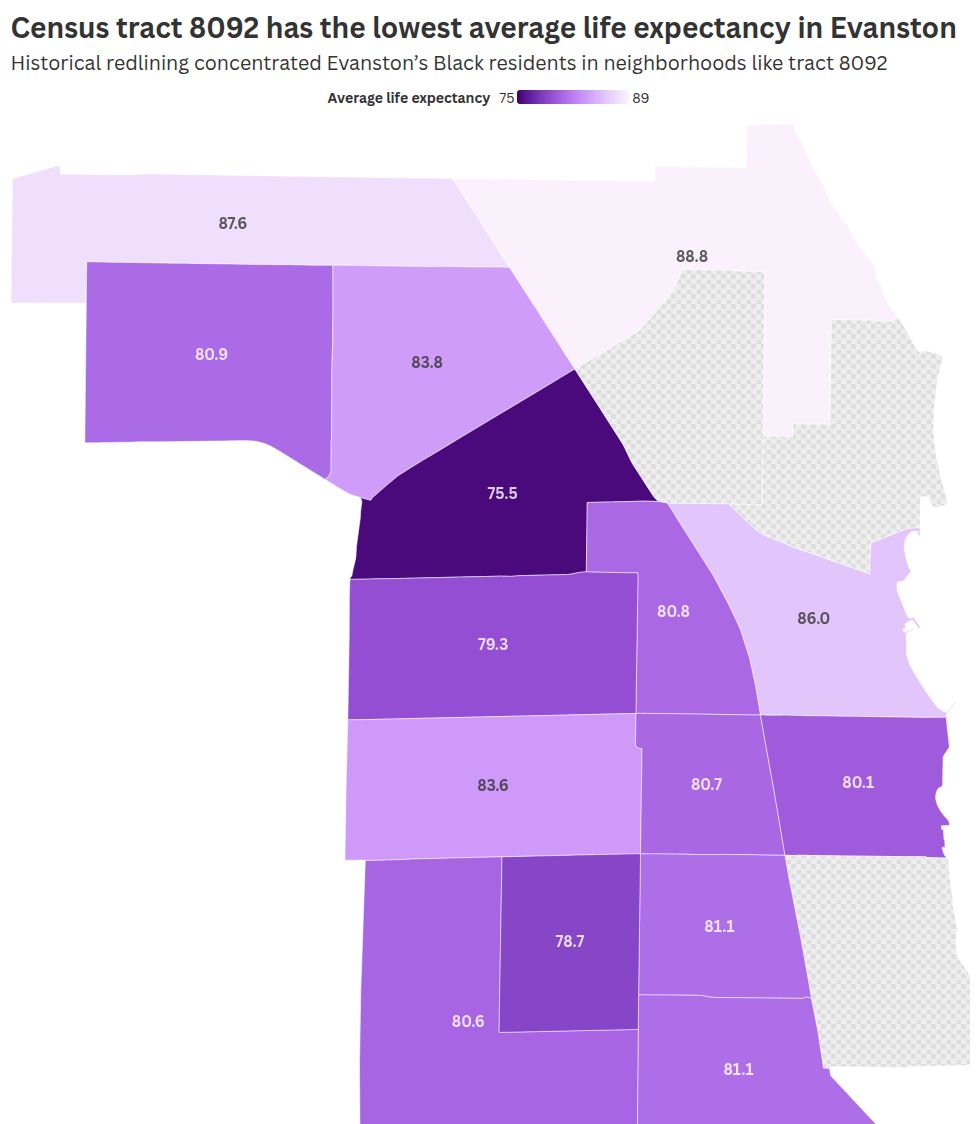
Blunt-Waldron designed Pathway to Wellness to address disparities revealed by the 2022 Evanston Process for the Local Assessment of Needs, which demonstrated an alarming 13-year life expectancy gap between local census tracts.
In tract 8092, located in the historically Black 5th Ward, the average life expectancy is 75.5 years. Mere minutes away in northwest Evanston lies the predominantly white, affluent tract 8088, where the average rises to 88.8 years.
For Blunt-Waldron, the data is evidence that the gap is preventable.
“Our counterparts, who live less than three minutes away from us on Central Street, are living to 90,” Blunt-Waldron said. “So when I talk to Council, I’m like, ‘We want 90th birthdays in the 5th Ward.’”
Tract 8092 Tract 8088
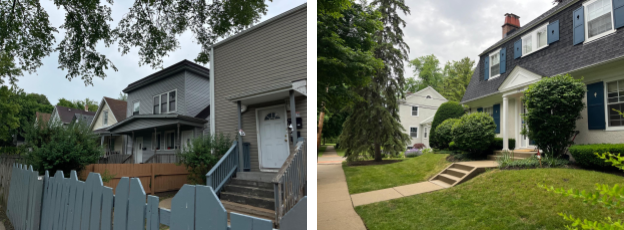 Residential blocks of Jackson Avenue in census tracts 8092 and 8088 show stark differences in size and green space. Larger homes on tract 8092’s Jackson Avenue contain two or three apartment units, despite being similar in size to the average single-family home in tract 8088. (Kieran Fults/The Daily Northwestern)
Tract 8092 Tract 8088
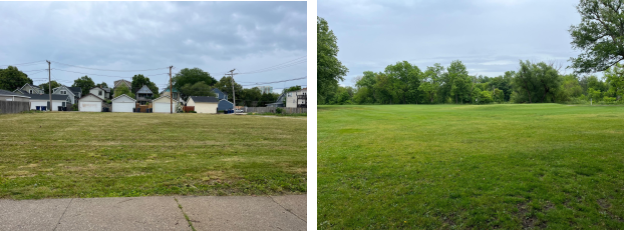 Grassy areas inhabit a south corner of each tract’s Jackson Avenue block, shown in photos taken on the same day. The Evans at Canal Shores winds through tract 8088, while a corresponding area in tract 8092 lacks trees and healthy grass. (Kieran Fults/The Daily Northwestern)
Funding challenges
In an effort to measure Pathway to Wellness’ success, Blunt-Waldron’s team heavily advocated for including a research component. But the cost of research has proved a barrier to implementing the program. The program initially received $400,000 in city-allocated federal funds, $56,000 of which has been used on program design.
The money was allocated to Blunt-Waldron’s wellness business, Whole Woman Fitness, which serves as an independent contractor to the city, allowing Blunt-Waldron to use public funds to run Pathway to Wellness.
In June, the Human Services Committee rejected Pathway to Wellness’ revised request for an additional $408,000 to fund the program’s research component. Blunt-Waldron’s team had previously requested more than twice that amount. The committee generally agreed that external sources would be a better source of funding than limited city dollars.
Dr. Stephen Persell, a chronic disease management researcher at Northwestern Medicine, agreed with the Human Services Committee’s rationale. As an Evanston resident, Persell said a stronger focus on delivering services to the community would be more beneficial than spending money on research that already exists.
Even so, he said Pathway to Wellness is a strong solution for narrowing Evanston’s life expectancy gap, as “hypertension is one of the main things that cause preventable disease and death.”
Still, addressing the many factors that make an individual vulnerable to hypertension is complicated, Persell said.
He identified three categories: social determinants of health, health behaviors and healthcare.
“All these factors, you put them together, you get a 13-year life expectancy difference between two different demographic groups,” Persell said. “But it’s very hard to say it’s this or that. Because it’s probably all of these things acting together in a variety of ways.”
Social determinants of health
Defined by the World Health Organization as the “conditions in which people are born, grow, live, work and age,” social determinants of health are significant nonmedical factors in hypertension treatment, Persell said.
Persell added that stress caused by experiencing racism or feeling unsafe in an environment can have lasting health outcomes.
“Childhood stress, chronic stress as an adult, these can all interfere with our sympathetic nervous system, our endocrine system,” he said. “And that can feed into hypertension. It can feed into other negative health effects.”
The EPLAN found that the percentage of adults experiencing frequent mental distress is second highest in the 5th Ward’s census tract 8092, only behind Northwestern University’s tract, where many students reside.
Economic distress is also present. In tract 8092, where the median income is $44,458, half of residents spend more than 30% of that income on housing, according to the EPLAN.
Blunt-Waldron said the effects of such disparities are generationally cyclical.
“If you only have a one parent household, you can just about guarantee that that parent is going to be working probably two jobs, so those kids are going to be under-supervised,” Blunt-Waldron said.
Health behaviors
Improved lifestyle habits, a key focus of Pathway to Wellness, can also reduce the risk of developing chronic disease, according to Persell.
The program offers participants weekly structured exercise sessions through Whole Woman Fitness as well as nutritional and behavioral support.
“Things like hypertension, overweight, obesity and diabetes — which are extremely powerful drivers of cardiovascular disease and other metabolic health problems — are related to patterns of diet, physical activity, other exposures,” Persell said.
He added that exposure to tobacco and pollution also influence chronic disease risk.
Individuals can control these factors to some extent, but historic redlining practices created systemic disparities that make it harder for marginalized communities to lead healthy lifestyles. Tract 8092 lies directly within an area deemed “hazardous” for mortgages by the Home Owners’ Loan Corporation in 1935.
The city’s January Environmental Equity Investigation report found that Black and brown residents are more exposed to pollutants, a result of old zoning ordinances that situated western Evanston residences around large industrial and commercial areas.
EPLAN data also revealed that 94.5% of residents in tract 8092 live farther than a half mile from a large grocery store, limiting access to healthy food options. The same residents also reported lower physical leisure time activity and significantly higher rates of smoking.
Healthcare
While the development of chronic diseases can be mitigated through lifestyle interventions, plenty of individuals have already been diagnosed and need treatment. Nearly 40% of tract 8092 residents reported high blood pressure diagnosis, though this is likely an underestimate, according to the EPLAN.
And getting treatment is often difficult. Persell raised questions about insurance affordability and care accessibility, concerns that Ald. Bobby Burns (5th) said he hears firsthand from his constituents.
“They either assume or they’ve experienced their inability to get the type of treatment they need if they’re uninsured or underinsured,” Burns said. “That comes up a lot.”
EPLAN data shows that 13.2% of tract 8092 residents under age 65 are completely uninsured, and the tract has the lowest percentage of seniors who are up to date on core clinical preventive services.
There’s also the matter of trust, as the United States’ long history of race-based medical malpractice illustrates an inequitable healthcare system, Blunt-Waldron said. That’s something Pathway to Wellness wants to get ahead of.
“We are making sure that people have providers that look like them,” Blunt-Waldron said. “I’m a Black woman. Our clinician is a Black woman. There’s a lot of distrust in the African American and Hispanic communities when it comes to the healthcare system because of the misuses that have happened in the past.”
Burns said when primary care doesn’t feel like an option, individuals might not seek treatment until emergency care is required.
Rates of emergency room visits are nearly 10 times higher for hypertension, Type 2 diabetes and asthma among Black adults in Evanston than their white counterparts, according to the EPLAN. The study determined that two in five emergency room visits in Evanston “would have been more appropriately addressed in a primary care setting.”
A history of discrimination
These patterns are not new. Archives curated by Shorefront Legacy Center, an Evanston nonprofit dedicated to preserving the North Shore’s Black history, reveal a century-long roadmap of racialized health disparity.
Six years before its closure in 1980, Community Hospital identified the trend in a forward-looking anniversary article.
“More and more patients are seeking, and receiving, primary care at hospital emergency rooms — a very expensive way to reach this crucial first step in the health care structure,” the article read.
Community Hospital first opened in 1914 as the Evanston Sanitarium, becoming the only hospital in Evanston to readily accept Black patients until the 1950s.
Dr. Arthur Butler and Dr. Isabella Garnett, two Black physicians, first opened the 14-bed hospital in their own home on Asbury Avenue. Prior to its opening, patients had to travel to the South or West Sides of Chicago to receive treatment.
 Community Hospital first opened in 1914. (Photo courtesy of Community Hospital of Evanston Collection, Shorefront Legacy Center)
Historically, preventable health issues have caused a disproportionate number of early deaths among Black Evanston residents.
Shorefront funeral records dated 1937 to 1939 document cause of death for just over half of the recorded names. Approximately 32% of those deaths were related to cardiovascular health, including hypertension, heart disease, myocarditis and “heart trouble.”
That number may actually be higher — hospital records were lost with the demolition of the Penn House building, where Community Hospital moved in 1930.
The ages of those documented individuals ranged from 30 to 68, meaning Blunt-Waldron’s experience of prematurely losing relatives to preventable disease is not unique.
Despite Pathway to Wellness’ inability to get additional public funding, Blunt-Waldron is committed to implementing the program with or without its research element. She expressed confidence that her team’s solution can narrow the life expectancy gap and extend Black Evanston residents’ lives.
“The way that you close that gap is you put them in community,” Blunt-Waldron said. “And provide them with the support that they need to make sure that they have somewhere to go to move their bodies, the education to eat differently and the support to take their medication.”
She doesn’t want to waste any more time getting there.
“It’s life and days on Earth,” Blunt-Waldron said. “You can’t put a price on that.”
Email: [email protected]
Related Stories:
— Council approves Pathway to Wellness for Evanston low-income areas
— Northwestern Medicine announces $35 million grant for new community health institute
— Everything Evanston: Health Hub expands community access to medical screenings