
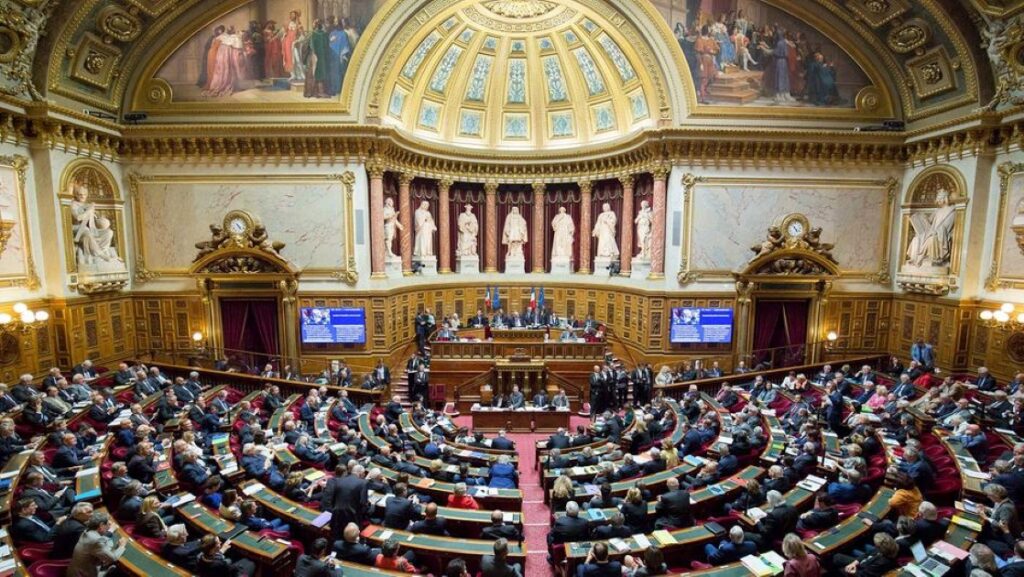
PARIS — A delegation from the French Senate is set to travel to Syria as part of a parliamentary fact-finding mission examining the country’s reconstruction and political future following the collapse of Bashar al-Assad’s dictatorial regime, highlighting France’s growing engagement with Syria’s new leadership despite persistent concerns over security, governance and minority rights.
The mission, announced on 9 July by the French Senate’s Committee on Foreign Affairs, Defense and Armed Forces, will be led by Senator Olivier Cigolotti and include Senators Étienne Blanc, Nicole Duranton and Michelle Gréaume. The delegation is expected to hold meetings with Syrian officials and a broad range of political, religious and civil society representatives to assess the country’s post-war trajectory and the prospects for renewed Franco-Syrian relations.
According to the Senate Committee, Syria now stands at a decisive crossroads after the dramatic collapse of the Assad government in late 2024, an event that reshaped the geopolitical balance across the Middle East.
For more than a decade, Assad’s Syria served as a central pillar of Iran’s so-called “Axis of Resistance,” alongside Hezbollah Militia in Lebanon, Iraqi militias, Hamas and Palestinian Islamic Jihad, and the Houthi movement in Yemen. The Senate noted that the weakening of Hezbollah significantly contributed to Assad’s military downfall, ending Iran’s most important state ally in the Levant.
The report describes the emergence of Syria’s new leadership under President Ahmad al-Sharaa as one of the region’s most significant political transformations. Once associated with jihadist movements, al-Sharaa has sought to reposition Syria through regional diplomacy and international engagement while avoiding direct confrontation with Israel. His government has also received support from Turkey and several Gulf states, while France became one of the first Western countries to establish high-level political contacts after President Emmanuel Macron welcomed al-Sharaa to the Élysée Palace in May 2025.
And on 6 July 2026, Macron arrived in Syria for talks with President Ahmed al-Sharaa, in the first visit by a leader from western Europe since Syria’s former dictator, longtime President Bashar al-Assad, was ousted from power in 2024.
His visit was accompanied by two huge explosions struck near the hotel where French President was scheduled to stay during the visit, highlighting the persistent security risks facing the country as it seeks to rebuild after years of conflict.
Despite these diplomatic developments, the Senate cautioned that Syria’s transition remains deeply fragile.
The report argues that although the new authorities have introduced a Constitutional Declaration and partially democratic institutions, political power remains highly centralized around al-Sharaa and his inner circle. It also points to a widening gap between official rhetoric promoting national unity and continuing episodes of sectarian violence.
Among the Senate’s principal concerns are the mass killings of more than one thousand Alawite civilians in March 2025 and the deadly attacks against Druze communities in July 2025, incidents that have raised serious questions about the government’s ability—or willingness—to protect vulnerable populations and enforce accountability.
The report also highlights uncertainty surrounding the integration of former armed factions into Syria’s security institutions, noting that while Daramsuq (Damascus) has formally abandoned jihadist ideology, individuals previously classified as extremists continue to serve within military ranks.
Another key issue identified by French lawmakers is the future of northeastern Syria, where local authorities continue to exercise significant influence despite the ceasefire and political agreement signed with Daramsuq on 30 January 2026. While the Syrian government has pledged greater inclusion and offered assurances regarding Kurdish institutions and cultural rights, the Senate Committee stressed that those commitments must ultimately be measured by concrete implementation rather than political declarations.
The report further draws attention to the future of Syria’s Christian communities, whose numbers have declined dramatically after years of war, displacement and emigration. It notes that protecting Syria’s religious and ethnic diversity will be one of the defining tests of the country’s reconstruction and long-term stability.
The Senate said its mission aims to provide French policymakers with a clearer understanding of Syria’s political transition, humanitarian needs and reconstruction priorities while exploring the foundations for a future relationship between France and Syria.