
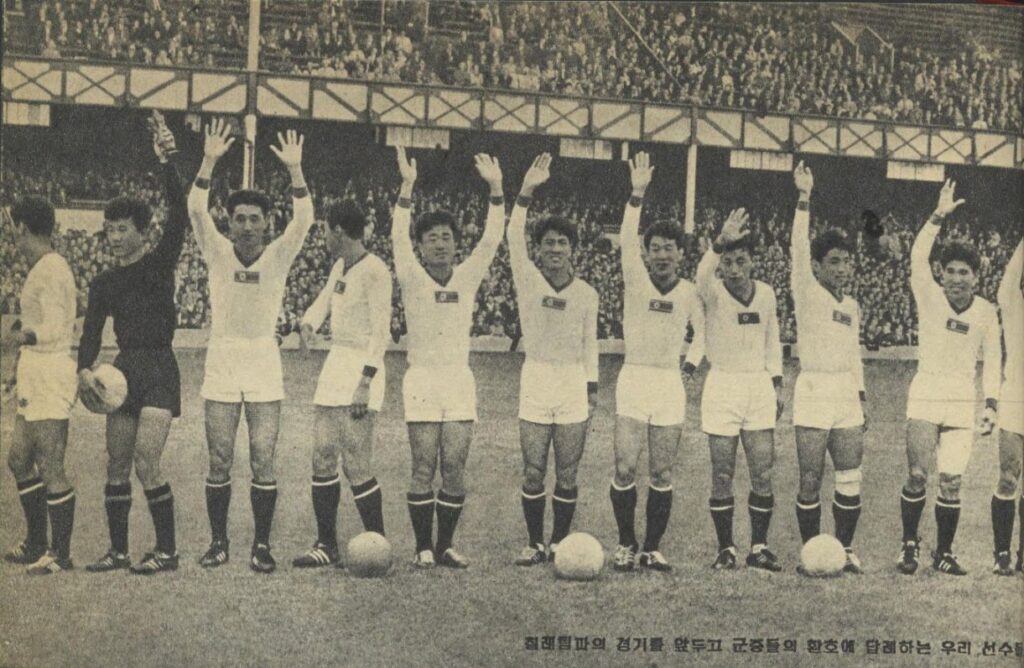
(The following is a post by Jack Davey, Korean reference librarian, Asian Division.)
The 1966 World Cup is well-remembered as the first and only World Cup victory for England, but the tournament (also hosted by England) was the setting for another important milestone in the history of football: the participation of the national team for the Democratic People’s Republic of Korea (North Korea) and their unlikely success in advancing to the quarterfinals. By doing so, North Korea became the first Asian team in World Cup history to make it to the knockout round; an accomplishment that wasn’t matched until Saudi Arabia made it to the round of 16 in the 1994 tournament.
This improbable success story—clinched by a stunning goal from Pak Tu-ik (Park Doo-ik) in the first half of a match against Italy—gained the North Korean team worldwide attention. The players were a particular sensation among fans in the city of Middlesbrough, where the team’s matches with Chile and Italy took place.
But how was this story told in North Korea? The North Korean Serials digital collection at the Library of Congress offers us a window into the 1966 World Cup from the perspective of the North Korean team itself and shows us how the tournament was received in the “Hermit Kingdom”.
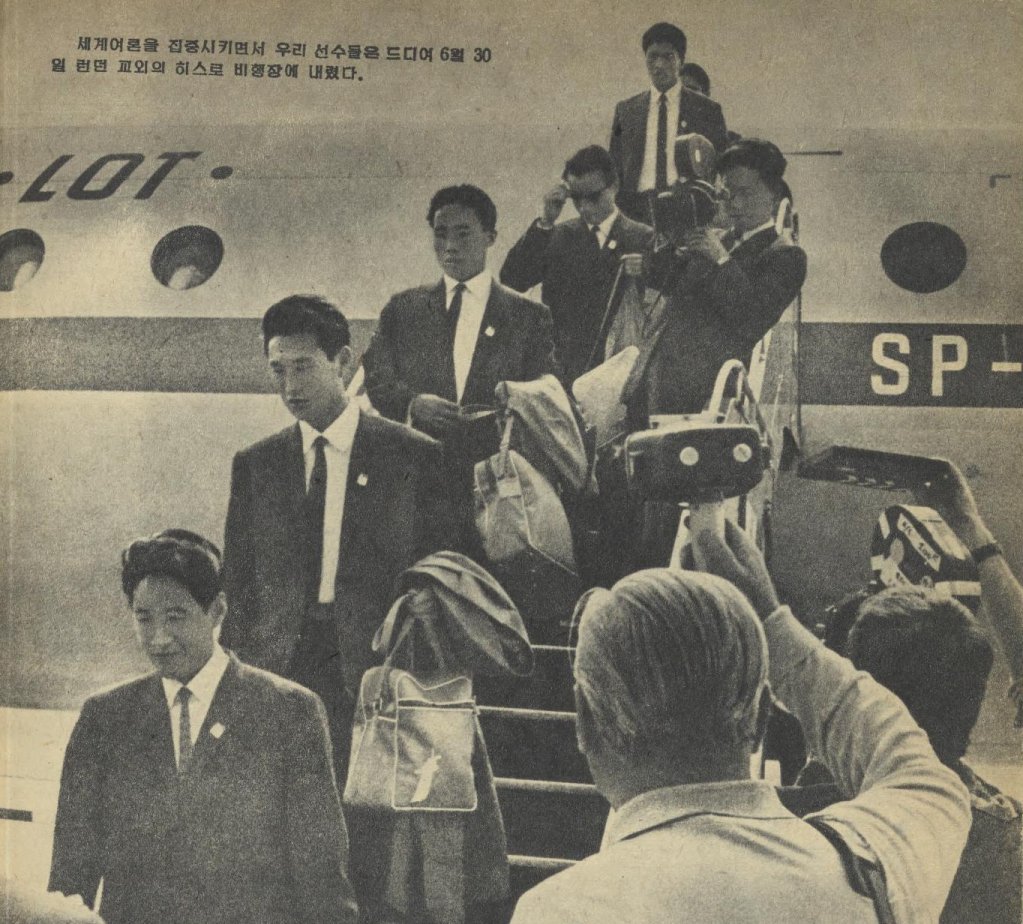 The original caption reads, “With the eyes of the world upon them, our players at last stepped off the plane at London’s Heathrow International Airport on June 30.” Chŏllima. September 1966 issue. Library of Congress Asian Division.
The lead-up to the tournament and its surprising results were covered in several articles in Chŏllima, a monthly general-interest magazine with a wide readership in North Korea. The team’s matches against Chile, Italy, and Portugal are breathlessly described in a September 1966 article titled “The Pride of Chosŏn, a demonstration of Asian soccer” (조선의 영예, 아세아 축구의 시위). A short profile of team captain Sin Yŏng-gyu describes his role in the team’s contest with Chile:
“In the match with Chile, Captain Sin Yŏng-gyu advanced to attack in the 42nd minute of the second half. After a hard-fought battle with the Chilean defenders, the captain at last headed the ball to Pak Sŭng-jin, allowing him to score a goal. Sin Yŏng-gyu, the iron wall defender, stood out as the player who guided the team’s play whether defending or attacking. FIFA president Stanley Rous judged him to be ‘truly world-class level’.”
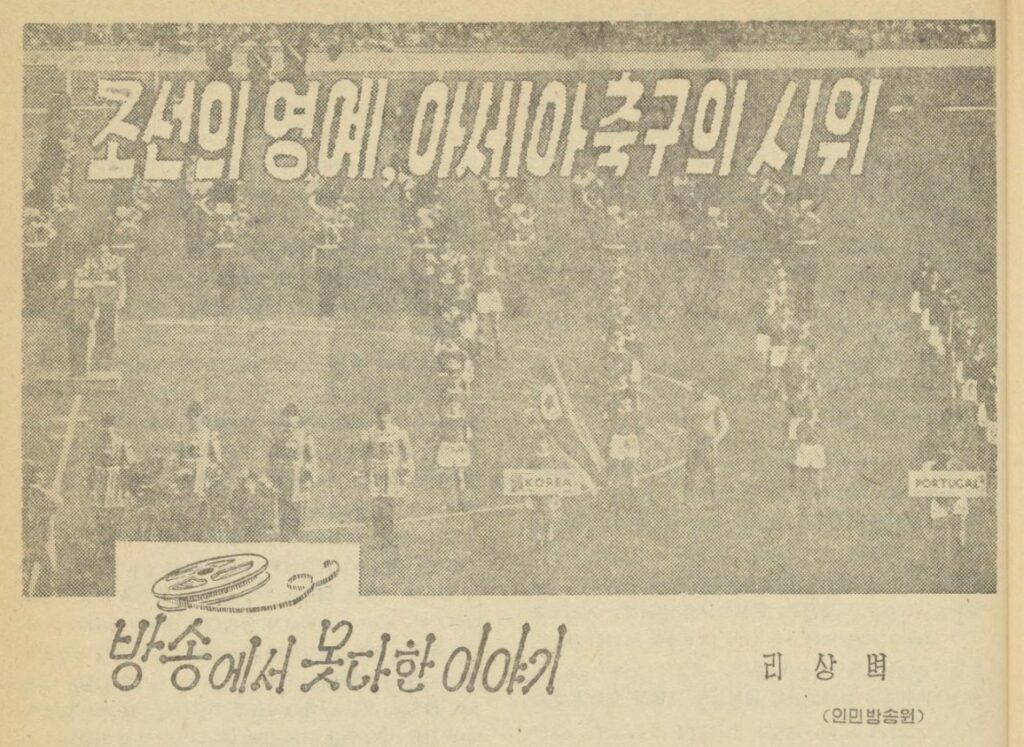 Ri Sang-byŏk, “The Pride of Chosŏn, a demonstration of Asian soccer,” Chŏllima. September 1966. Library of Congress Asian Division.
Chŏllima gives us an intimate portrait of the team itself. As detailed in the May 1966 article “Before that day” (그날을 앞두고 ), a Chŏllima reporter had direct access to players and recounted interacting with them during practice, mealtime, and while relaxing on the night before their first match (joining a group of players listening to Beethoven on the radio). From this we learn that future goal-scorer Pak Tu-ik raises goldfish back home and team captain Sin Yŏng-gyu’s four-year-old son is also a budding soccer player who had already lost at least a dozen balls.
 Profiles of four team members. From left, Pak Tu-ik, Pak Sŭng-jin, Sin Yŏng-gyu, and Ri Ch’an-myŏng. Chŏllima. September 1966. Library of Congress Asian Division.
Chŏllima is not just an important source for the 1966 World Cup. Articles published in 1965 also show us what soccer and soccer culture were like in North Korea. An article from March 1965 titled “Soccer then and now” (축구의 어제와 오늘) explains the history, rules, and positions of the modern game for a general audience. In addition, the author makes the extraordinary claim that soccer had already been a part of North Korean culture for more than 700 years. The evidence? A citation from the twelfth century text “Samguk yusa” that details an episode of future king of the ancient Korean kingdom of Silla Kim Ch’un-ch’u and legendary military commander Kim Yu-sin playing a soccer-like ball game in their youth.
For soccer scholars, the same article also reveals some interesting particularities of terminology. For instance, in North Korea, the term for “goalkeeper” is revealed to be munjigi 문지기, literally “gatekeeper,” likely based on the term for goalkeeper introduced to the Korean peninsula when the sport was popularized during the Japanese colonial period (1910-1945). South Korea today uses the English loanword “goalkeeper,” kolk’ip’ŏ 골키퍼.
The North Korean Serials digital collection is part of the Korean Collection at the Library of Congress and can be accessed freely online. For reference inquiries, appointments, and access to the Asian Division’s extensive North Korean collection, please contact Korean reference staff via the Ask a Librarian service. For more details about North Korean materials at the Library as a whole, please consult the North Korean Collection research guide.