
Today’s post is about science: what you can do now to protect it from unprecedented threats, and how your action is the first half of a long-term program that Congress must take up next.
Let me start with describing the embryonic state of science advocacy. There are many well-meaning organizations: the American Association for the Advancement of Science, Research!America, and subject-specific organizations such as the Society for Neuroscience and the American Physical Society. Their general approach is to emphasize the common good: the remarkable value that science and innovation have provided to all Americans.
However, these organizations are offering an incomplete solution.
Before I start, a preliminary: If you already know about the threat, go ahead and weigh in with OMB at this link. Ideas about what to say come from Research!America and the American Physical Society. You have until Monday, July 13 at 11:59pm Eastern. Then come back here and read the rest of this post. Finally, get in touch with whoever is likely to be your next member of Congress in 2027.
The onslaught of attacks on science is accelerating. It’s not just cuts to grants, which was the last battle. That battle is not done yet, but there is a new and worse threat.
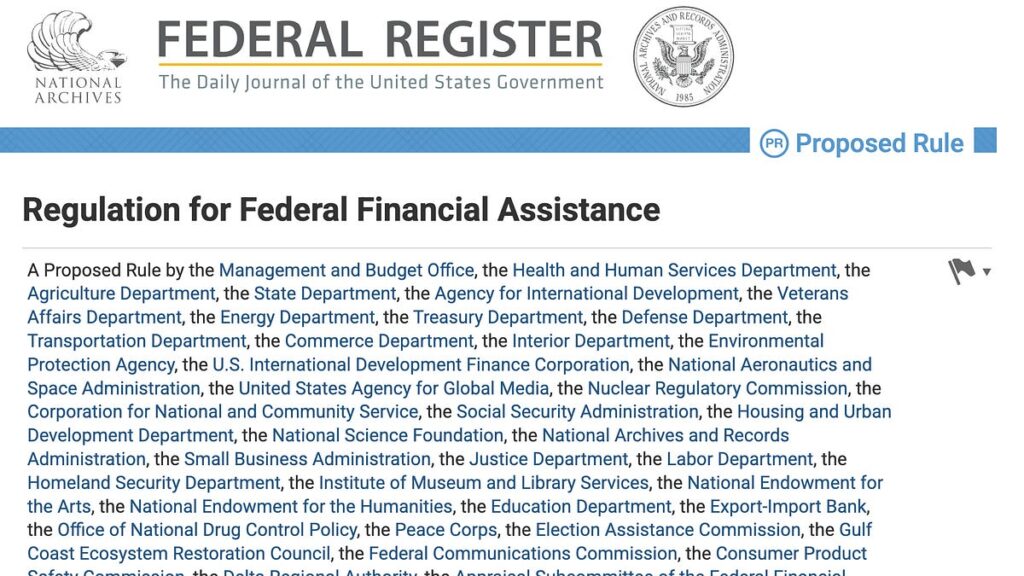
Now comes a proposed public rule from the Office of Management and Budget. The rule would take decision-making power over grants away from experts and put it into the hands of political appointees. Former NIH official Elizabeth Ginexi wrote an excellent summary of what OMB is trying to do, which is codify the executive branch’s ability to award or terminate grants, for arbitrary cause or no stated cause.
Since World War II, a necessary step in scientific grant-making has been consideration of scientific merit. This approach has made America into a dominant scientific superpower, the envy of the world. Of course, political considerations do come into the mix. The proposed rule tilts the balance dramatically away from merit.
Many people have difficulty comprehending why Russell Vought and OMB would want to damage science in this way. If you’re a working scientist, you are likely to be particularly uncomprehending. Who would hurt an activity so self-evidently good?
The answer is: this is part of the program to replace the rule of law with a personalist regime. OMB Director Russell Vought, a Christian nationalist, would like to implement what legal scholars call a “unitary executive,” and what I would call a dictatorship. Or if you like, a personalist authoritarian regime.
I am a working scientist. This rule will debilitate my research. It may chill the speech of scientists for speaking freely in the public sphere. It is a form of personalizing power and decision-making within the executive branch. In short, it sacrifices science in the service of tyranny.
To Russell Vought, a decrease in the quality of science might be an acceptable cost. He might even consider it an added benefit to weaken a pillar of soft U.S. power based on knowledge and skepticism.
The nonprofits are asking you to make public comment. Public comment is like building the first half of a bridge.
Before implementation, OMB is compelled by law to have a period of public comment. Rules have to be consistent with the law and the Constitution. They express the federal government’s stance toward how those laws will be implemented. When a presidential administration works in good faith, these public comments are used to inform their eventual action, and sometimes mitigate it.
The comment period reflects our First Amendment right to petition our government. The executive branch is then supposed to take those comments into account – completing the bridge between us, the people, and our government.
Project 2025 seeks to take away the second half of the bridge. We have to replace it.
Organizations like AAAS, Research!America, and SfN are partly right. You should certainly comment. Their core model is earnest: if enough of us make noise, then we will achieve change. This idealistic point of view is offered in good faith.
That point of view is also currently bullshit.
The fundamental reason is that the federal rulemaking process has two parts:
-
There has to be a period of public comment.
-
OMB makes the final rule…but is free to disregard public comment.
Oops. That’s a loophole.
However, not all is lost.
Congress has enormous power. That power suggests a roadmap for how to proceed.
This lawless administration is still going to issue that rule. Nonetheless, your comments still play an essential role. Here are two steps you can take.
Step 1: Send your comment to your Representative and Senator. Whether they are Democrats or Republicans, many of them support science. Whatever you wrote as public comment in the Federal Register, also send it to your member of Congress. You can include information about jobs in your district or state by looking at Joshua Weitz’s ScienceMatters interactive map. Call the U.S. Capitol switchboard at (202) 224-3121 and give your town, zip code, or state, then deliver your message.

Step 2: Politicize the hell out of science. You heard me, politicize it as an issue.
We hear a lot from the old scientific establishment about science being nonpartisan. This is obsolete, sentimental thinking. Under normal conditions, it was true. But we can no longer make that assumption. We can keep on pretending, but we’re putting science at risk.
There is a way forward. Rules are subordinate to the law…and Congress makes laws. Therefore Congress can step in.
In this fall’s election, it is likely that Democrats will retake the House of Representatives. That puts at least one chamber of Congress in the hands of Democrats. They are far more inclined than the current Congress to investigate and legislate.
This opens a path to undoing the damage. It also creates a permission structure for pro-science Republicans to find a way back from the brink. We have to encourage them.
In the House, every district is up every two years. In your district, contact both of the major party candidates. If your state has a Senate race, contact those candidates too.
Specifically mention the proposed OMB rule. Ask for two things:
-
For this year’s appropriations process in August and September, ask that amendments be added to stop the implementation of the new rule. Those amendments should support peer-reviewed science and stop political interference.
-
Looking ahead to next year, ask the Congressman/Congresswoman/Senator to work to hold hearings in 2027 on the importance and benefits of peer-reviewed science for health and prosperity.
Congress can use its investigatory power to summon heads of agencies and the director of the OMB. That will allow fact-finding regarding the consequences of this rule.
Congress can override the rule through the appropriations process. They can write into statute a requirement to follow peer review and best scientific practices. In this way, Congress can stop the attacks on science.

Now I have a request for you, to help me. As many of you know, I ran for Congress in order to save democracy and science. Although I did not win, that battle continues by other means.
I met and heard from thousands of supporters both here in New Jersey and nationally. I learned that pro-science, pro-democracy activists have the potential to become a much greater force. In the weeks and months ahead, I will be building ways to harness that energy. I will be announcing those plans soon.
In the meantime, an important step is to wind down the Congressional campaign, which has a few remaining bills to pay. Please help me retire that last debt.
