
Ambassadors of the Peace Implementation Council (PIC) Steering Board, a body supervising the implementation of the Dayton Agreement that created Bosnia and Herzegovina in 1995, failed to agree on a permanent successor to former High Representative Christian Schmidt on Tuesday, 14 July, meaning that the position remains vacant with no new deadline announced.
Meeting in Sarajevo, the envoys did not reach consensus on whether US-backed Italian diplomat Antonio Zanardi Landi or EU-backed French diplomat René Troccaz should succeed Schmidt in the position, which carries broad powers over BiH’s political system and legislation. Danish diplomat Peter Sørensen was discussed as a compromise but was ultimately not formally proposed.
The failure leaves US diplomat Louis J Crishock in charge indefinitely—and exposes a larger dispute. Schmidt left on 1 July, when Crishock became acting High Representative. He says he holds the office’s full authority, including the Bonn Powers, and will remain until the PIC decides otherwise.
Washington wants a narrower OHR, pointing to the end of American-backed ‘nation-building’ projects in Europe. European governments, however, fear that weakening the OHR prematurely would remove the final external restraint on Bosnia and Herzegovina’s centrifugal politics, most likely strengthening sovereigntist and secessionist efforts in the long run.
High Representative: Dayton Guardian or Foreign Governor?
Those fears are well-founded, and they arise from what many describe as one of the most complex political systems of our day, created by Dayton. The 1995 agreement ended a war that killed about 100,000 people by preserving Bosnia and Herzegovina as one state while distributing most power between Serb-majority Republika Srpska and the Bosniak–Croat Federation. Brčko District is self-governing, while the Federation has ten cantons.
The state presidency is shared by a tripartite body comprising one Serb, one Croat, and one Bosniak member, while legislation must pass through two chambers, entity voting, and ethnic veto mechanisms. The system’s principal purpose is to prevent any one constituent people from dominating the others and to reduce the risk of renewed conflict among ethnic groups with a long, shared, and often troubled history.
In practice, however, this extraordinarily complex structure also turns major decisions into prolonged negotiations between entities, frequently producing deadlocks that cannot be resolved. Partly as a result, Bosnia and Herzegovina has remained persistently fraught with political tension.
‘The OHR is one of the most contested parts of Dayton’
The High Representative was meant to keep that negotiated state functioning. Annex 10 established the office to oversee civilian implementation; the later Bonn Powers allowed its holders to impose laws, annul domestic acts, and remove officials.
The OHR is one of the most contested parts of Dayton: supporters call it a constitutional safety valve; opponents see an unelected foreign governor overriding voters and parliaments. In the past 30 years, High Representatives have reshaped entity constitutions, strengthened state institutions, restricted contested property transfers, and altered criminal and electoral law.
Schmidt changed Federation representation and government formation, then made defiance of High Representative decisions punishable. His predecessor, Valentin Inzko, criminalized the denial of genocide, crimes against humanity, and war crimes—two of the most controversial decisions since the OHR was established.
Dodik, Čović United Against the High Representative
While Washington and Europe struggle to elect Schmidt’s successor, opponents of the OHR are moving to exploit the situation to weaken the office.
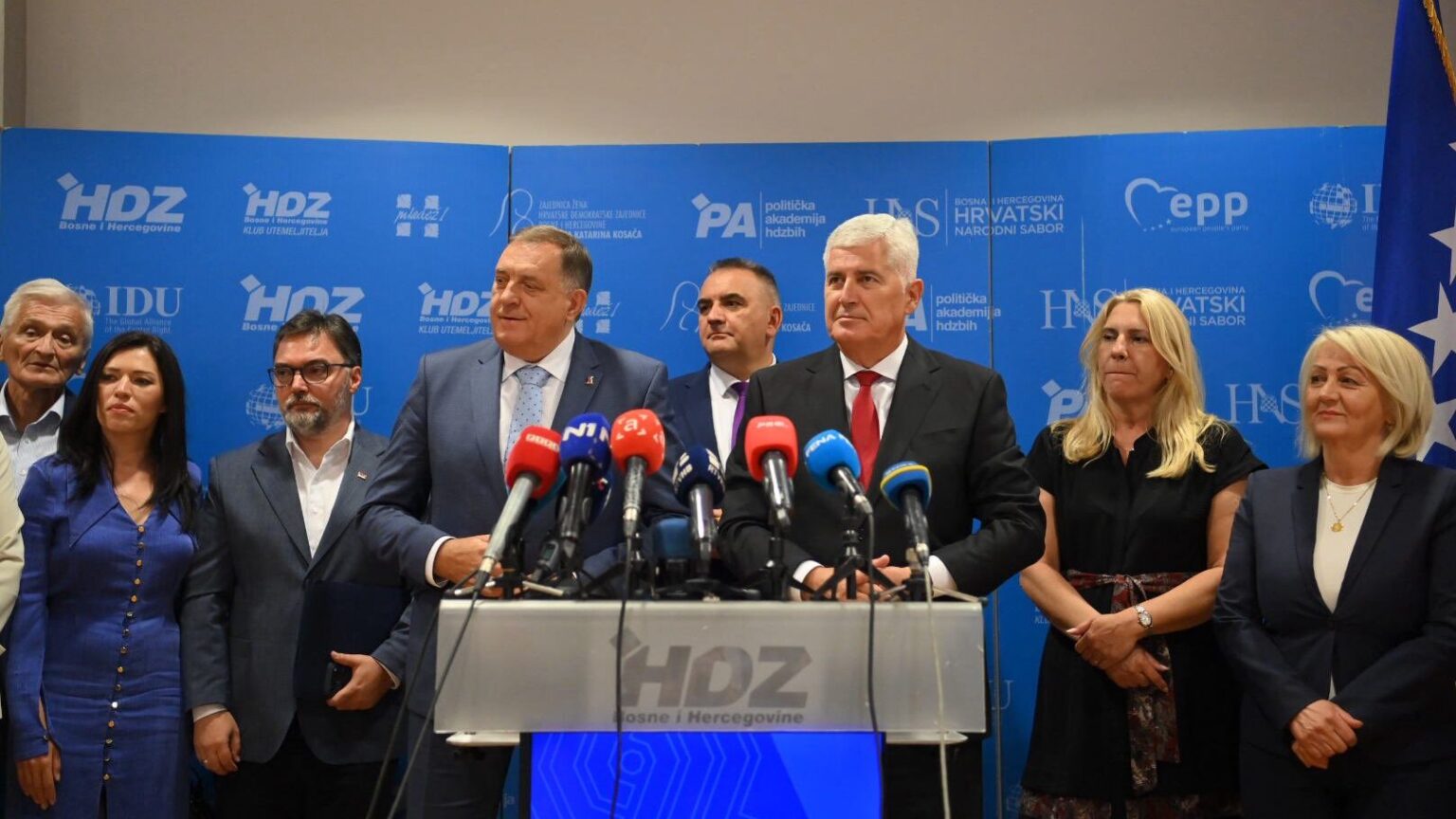
A day before the PIC vote, on 13 July, HDZ BiH leader Dragan Čović, head of the main Bosnian Croat party, met former Republika Srpska president and SNSD leader Milorad Dodik in Mostar, and the two called for the annulment of previous OHR decisions. They also supported a separate Croat electoral unit, recalling an earlier HDZ BiH demand for ‘legitimate representation’, preventing the more numerous Bosniak electorate from determining the Croat Presidency member. Čović and Dodik promised coordination on the issue, mostly informally.
What drove the two together was the intersection of their political interests. Dodik seeks to restore or expand the sovereignty he argues Republika Srpska possessed under the original Dayton settlement, while Čović wants stronger electoral representation and fairness for Croats within the Federation.
Croats are the smallest constituent people and, unlike Serbs, lack an entity of their own. Željko Komšić’s repeated election to the Croat Presidency seat with substantial Bosniak support has exposed a genuine weakness in collective representation.
Moreover, for Dodik, erasing the OHR legacy is inseparable from his own downfall. The former president was convicted of refusing to implement Schmidt’s 2023 decisions. His prison term was converted into a fine, but a six-year office ban remained, and his mandate was terminated. He still dominates the SNSD, which controls RS legislation and the executive.
In a 2025 interview with Hungarian Conservative, Dodik called the OHR an ‘evil organization’, said the crisis would be resolved ‘through political and legal means’, and claimed Republika Srpska was defending both its own sovereignty and that of Bosnia and Herzegovina under Dayton. Yet he also envisaged Republika Srpska becoming a ‘legally and politically independent’ country, which placed him at the centre of criticism from Sarajevo and Western officials.
The Mostar meeting similarly met with condemnation from Bosniak-led parties, which mostly rejected the blanket repeal of OHR decisions and a Croat electoral entity within the Federation. Narod i Pravda accused Čović of damaging BiH’s Euro-Atlantic course by moving closer to Dodik.
Will Dayton Survives?
Bosniak-led and civic parties interpreted the Mostar meeting as a reciprocal bargain. Narod i Pravda rejected the blanket repeal of OHR decisions and a Federation-only Croat constituency, saying Čović’s alliance with Dodik damages Bosnia and Herzegovina’s Euro-Atlantic course. Željko Komšić’s Democratic Front accused both parties of working towards weakening or dismantling the Bosnian state, while civil-society critics argued that creating another exclusive electorate fuels ethnic and residence-based discrimination.
The PIC, nevertheless, straightforwardly instructed Crishock to preserve previous High Representative decisions—the institutional opposite of the Mostar demand.
Bosnia and Herzegovina’s two crises therefore feed each other. International disagreement weakens the authority expected to defend Dayton, while domestic leaders use that weakness to press competing visions of sovereignty and representation. Dayton ended the war, preserved territorial integrity, and protected three constituent peoples from domination, but also entrenched ethnic division, overlapping government, and dependence on an international official with quasi-sovereign power.
‘Bosnia and Herzegovina’s two crises therefore feed each other’
Its survival for more than 30 years is a major achievement, but it does not guarantee that the system can endure indefinitely. The United States, which helped broker Dayton, is now divided from its European partners over both the leadership and future powers of the OHR. That split makes reform harder and gives domestic leaders more room to press competing constitutional demands.
The immediate threat is not a joint Serb–Croat plan for secession—none was agreed in Mostar—but that Dodik’s campaign for greater Republika Srpska sovereignty and Čović’s demand for stronger Croat electoral control could reinforce each other while the international powers responsible for protecting the integrity of Dayton remain deadlocked.
Related articles:
At a time when public debate is increasingly polarized and superficial, Hungarian Conservative remains committed to depth, intellectual honesty, and independent conservative thought.
Producing high-quality journalism requires resources. Your contribution helps us expand our coverage, reach new audiences, and keep our content accessible.

Please consider supporting our mission.