
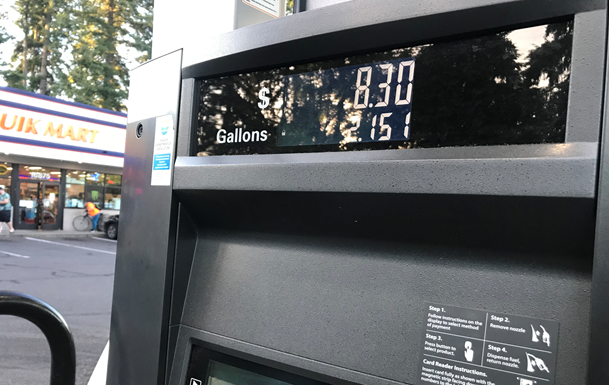
Oregon and three other West Coast states are still seeing gas prices move lower, but prices are climbing in all other states this week. Crude oil prices have jumped to their highest prices in a month after a new string of attacks between the U.S. and Iran and a drop in shipping activity in the Strait of Hormuz. Pump prices had been steadily decreasing since late May. For the week, the national average for regular gasoline jumps seven cents to $3.86 a gallon. The Oregon average loses five cents to $4.50 a gallon.
Crude oil prices have jumped to their highest prices in a month as fighting intensifies in the Middle East and markets react to renewed fears of tightening global oil supplies. Earlier this month, West Texas Intermediate, the U.S. benchmark for crude, fell back to pre-conflict prices but is now back around $80 per barrel, the highest price since June 15. WTI was at $67 per barrel on Feb. 27, the day before the U.S. and Israel launched strikes against Iran.
“Gas prices in Oregon and three other West Coast states haven’t started to increase yet. But with crude oil prices soaring, gas prices here and across the U.S. are poised to rise. Crude oil is the main ingredient used to produce gas and diesel, and when crude oil prices rise, pump prices usually follow suit,” says Marie Dodds, public affairs director for AAA Oregon/Idaho.
Gas prices are significantly more expensive than they were before the conflict with Iran began. The National average for regular gas was $2.98 and Oregon average was $3.92 on Feb. 28, the day the U.S. and Israel launched airstrikes against Iran.
Crude oil prices remain volatile, with dramatic swings driven by concerns of how the conflict with Iran impacts global oil supplies. Since the conflict with Iran started, prices for West Texas Intermediate, the U.S. benchmark for crude, have ranged between $68 and nearly $113 per barrel. Crude was at $67 per barrel on Feb. 27, the day before the conflict began.
In general, every $1 increase in the price of crude oil leads to a 2.4- to 2.5-cent increase in the price of gasoline.
Shipping traffic in the Strait of Hormuz has fallen off again, due to the renewed tensions in the Middle East. In the last few weeks, more ships had been passing through the Strait of Hormuz, but numbers were well below the 100 to 130 ships that passed through the waterway each day before the conflict began. Normally, about 20% of the world’s oil and refined products flow through the Strait of Hormuz, which is the narrow passageway of the Persian Gulf and is bordered by Iran. Tankers traveling through the Strait of Hormuz carry oil from major producers in the Middle East including Saudi Arabia, Kuwait, Bahrain, UAE, Qatar, Iraq and Iran. Any disruption in the straight can impact global oil supplies and send crude oil prices higher.
The Oregon average for regular gas began 2026 at $3.42 a gallon. The highest price of the year so far is $5.353 on May 20. The lowest price of the year so far is $3.33 on January 20. The record high for the Oregon average is $5.548 set on June 15, 2022.
The Washington average for regular gas began 2026 at $3.86 a gallon. The highest price of the year so far is $5.789 on May 20, which is the record high for Washington. The lowest price of the year so far is $3.79 on January 14.
The national average began 2026 at $2.83 a gallon. The highest price of the year so far is $4.564 on May 21. The lowest price of the year so far is $2.795 on January 11. The record high for the national average is $5.016 set on June 14, 2022.
Demand for gasoline in the U.S. gasoline decreased from 9.13 million b/d to 8.85 million for the week ending July 3. This compares to 9.16 million b/d a year ago. Total domestic gasoline supply decreased from 214 million barrels to 212.1 million. Gasoline production decreased last week, averaging 9.7 million barrels per day, compared to 10 million barrels the previous week.
In addition to the conflict in the Middle East, pump prices are also impacted by the normal seasonal factors. Gas prices typically rise starting in mid-to-late winter and early spring as refineries undergo maintenance ahead of the switch to summer-blend fuel, which is more expensive to produce and less likely to evaporate in warmer temperatures. The switch occurs first in California, which is why pump prices on the West Coast often rise before other parts of the country. The East Coast is the last major market to switch to summer-blend fuel. Most areas have a May 1 compliance date for refiners and terminals, while most gas stations have a June 1 deadline to switch to selling summer-blend. Switch-over dates are earlier in California with some areas in the state requiring summer-blend fuel by April 1. Some refineries will begin maintenance and the switchover in February.
Gas prices usually drop in the fall, due to the switch from summer-blend to winter-blend fuel, which costs less to produce. The switch starts in September. Many areas, including Oregon, can sell winter-blend fuel starting September 15. However, Northern and Southern California require summer-blend fuel through October 31. Prices usually decline to their lowest levels of the year in late fall and early winter before increasing again in the late winter and early spring.
The U.S. price of crude oil (West Texas Intermediate) fell sharply a month ago to between $75 and $80 per barrel, as markets reacted to the preliminary peace deal between the U.S. and Iran. WTI dipped below $70 for several days in late June and early July, the lowest prices since the start of the conflict.
WTI is trading around $80 today, compared to $70 a week ago and $67 a year ago. In 2025, West Texas Intermediate ranged between $80.04 (January 15) and $57.46 (October 16) per barrel. In 2024, WTI ranged between $66 and $87 per barrel. In 2023, WTI ranged between $63 and $95 per barrel. WTI reached recent highs of $123.70 on March 8, 2022, shortly after the Russian invasion of Ukraine, and $122.11 per barrel on June 8, 2022. The all-time high for WTI crude oil is $147.27 in July 2008.
Crude prices are determined in international markets, based on global supply and demand, and are impacted by economic news as well as geopolitical events around the world including the conflict with Iran and disruptions in the Strait of Hormuz, economic uncertainty, the situation in Venezuela, tensions over Greenland, sanctions on Iran’s oil, unrest in the Middle East, the conflict between Israel and Hamas, and the war between Russia and Ukraine. Russia is a top global oil producer, behind the U.S. and Saudi Arabia.
In addition, moves by OPEC+ impact crude oil prices. Production cuts by the cartel in previous years tightened global crude oil supplies, which continued to impact prices. But in 2025, the cartel boosted production which put downward pressure on crude oil prices. For the first quarter of 2026, OPEC+ said it would not have production hikes in the first quarter of this year due to lower demand. Then oil production in the Middle East plunged due to the Iran war. However, at its meeting on March 1, OPEC+ said it would boost oil production this spring and summer; However, oil production in the Middle East plunged due to the Iran war, according to OPEC data. On Sunday, some OPEC+ countries said they would increase production by a total of 188,000 barrels per day in August.
Crude oil is the main ingredient in gasoline and diesel, so pump prices are impacted by crude prices on the global markets. On average, about 57% of what we pay for in a gallon of gasoline is for the price of crude oil, 21% is refining, 8% distribution and marketing, and 14% are taxes, according to the U.S. Energy Information Administration.
Meanwhile, crude oil production in the U.S. remains at or near record highs. The U.S. Energy Information Administration (EIA) reports that crude production in his country is at at 13.86 million barrels per day for the week ending July 3. Production has been at 13.5 million barrels per day many times since October 2024. The U.S. has been the top producer of crude oil in the world since 2018 and has been increasing its oil production since about 2009.
Quick stats
Oregon is one of just four states with lower gas prices this week. Ohio (+22 cents) has the largest week-over-week jump in the nation. Alaska (-6 cents), Oregon (-5 cents), Washington (-4 cents) and Hawaii (-2 cents) are the only states with week-over-week declines. The average in Michigan is flat.
Hawaii ($5.45) has the most expensive gas in the nation for the third week in a row. California ($5.38) is second. These are the two states with averages at or above $5 per gallon. This week there are seven states and the District of Columbia with averages at or above $4 a gallon, and 42 states have averages in the $3-range. No state has an average in the $2 range this week.
The cheapest gas in the nation is in Indiana ($3.22) and Texas ($3.41). No state has had an average below $2 a gallon since January 7, 2021, when Mississippi and Texas were below that threshold. At the time, the COVID-19 pandemic drove significant declines in crude oil and gasoline demand in the U.S. and around the world.
The difference between the most expensive and least expensive states is $2.23 this week, compared to $2.41 a week ago.
Oregon is one of 47 states and the District of Columbia with lower prices now than a month ago. The national average is 22 cents less and the Oregon average is 50 cents less than a month ago. Oregon has the second-largest month-over-month drop in the nation. Washington (-54 cents) has the largest. Maryland (+3 cents) has the largest month-over-month increase.
All 50 states and the District of Columbia have higher prices now than a year ago. The national average is 71 cents more, while the Oregon average is 50 cents more. New Mexico (+$1.06) has the largest year-over-year jump in the nation. Indiana (+17 cents) has the smallest.
West Coast
The West Coast region continues to have the most expensive pump prices in the nation with six of the seven states in the top 10. It’s typical for the West Coast to have six or seven states in the top 10 as this region tends to consistently have fairly tight supplies, consuming about as much gasoline as is produced. In addition, this region is located relatively far from parts of the country where oil drilling, production and refining occurs, so transportation costs are higher. And environmental programs in this region add to the cost of production, storage and distribution.
Diesel
Oregon is one of 12 states and the District of Columbia with lower diesel prices this week. Florida (+45 cents) has the largest week-over-week jump. Michigan (-7 cents) has the largest week-over-week decrease, while Oregon (-7 cents) has the second-largest decline.
For the week, the national average adds 11 cents to $4.88 a gallon. The record high is $5.816 set on June 19, 2022.
The Oregon average falls seven cents to $5.30. The record high is $6.47 set on July 3, 2022.
A year ago the national average for diesel was $3.71 and the Oregon average was $4.50.
Source: AAA