
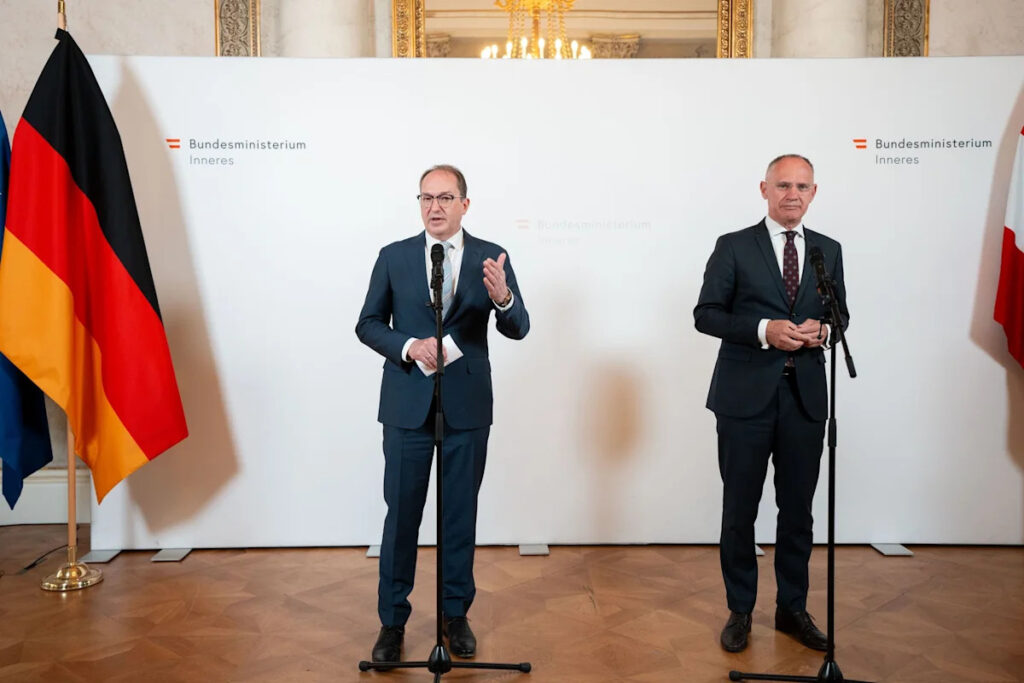
Germany and Austria want to encourage the voluntary return of Syrian asylum seekers and refugees, German Interior Minister Alexander Dobrindt said in Berlin on Wednesday after talks with Austria’s Interior Minister Gerhard Karner.
Dobrindt said voluntary return, alongside forced return and the prospect of remaining for well-integrated people from Syria, should be promoted more actively.
Karner said Austria had launched a time-limited programme offering additional financial incentives to Syrians still going through the asylum process. Karner praised Dobrindt as a “driving force” at European level when it comes to reducing irregular migration.
Since 2012, deportations from Germany to Syria had been suspended due to the dangerous situation during Syria’s civil war.
On December 23 last year, a convicted criminal from North Rhine-Westphalia was flown to Damascus on a scheduled flight, the first such deportation. In total, there have been four deportations of Syrian convicted criminals to their country of origin to date. On July 3 last year, Austria deported a Syrian to his home country for the first time in 15 years.
The Austrian deportations followed a joint trip to Syria by Karner and then-German Interior Minister Nancy Faeser in April 2025.
Chancellor Friedrich Merz invited the Syrian interim President Ahmed al-Sharaa to Germany in November – partly to discuss deportations. He promised German support to help stabilize Syria and expressed confidence that many Syrians would return voluntarily.
Several German state interior ministers welcomed the fact that the federal Interior Ministry has once again made it possible to deport individual offenders to Syria. However, some impatience is now evident, as there have been no deportations to the country since January.
Many Syrians who came to Germany as refugees between 2013 and 2017 now meet the requirements for naturalization. These include knowledge of the German language and gainful employment. According to the federal government, 65,574 Syrians became German citizens last year.
Karner and Dobrindt also discussed the planned so-called return hubs. These are deportation centres to be set up outside the European Union. Irregular migrants who have not been granted protection status in Europe but who, for various reasons, cannot be deported to their countries of origin are to be taken there.
When asked whether offenders would also be deported there, Dobrindt replied that no information could yet be provided regarding that.