

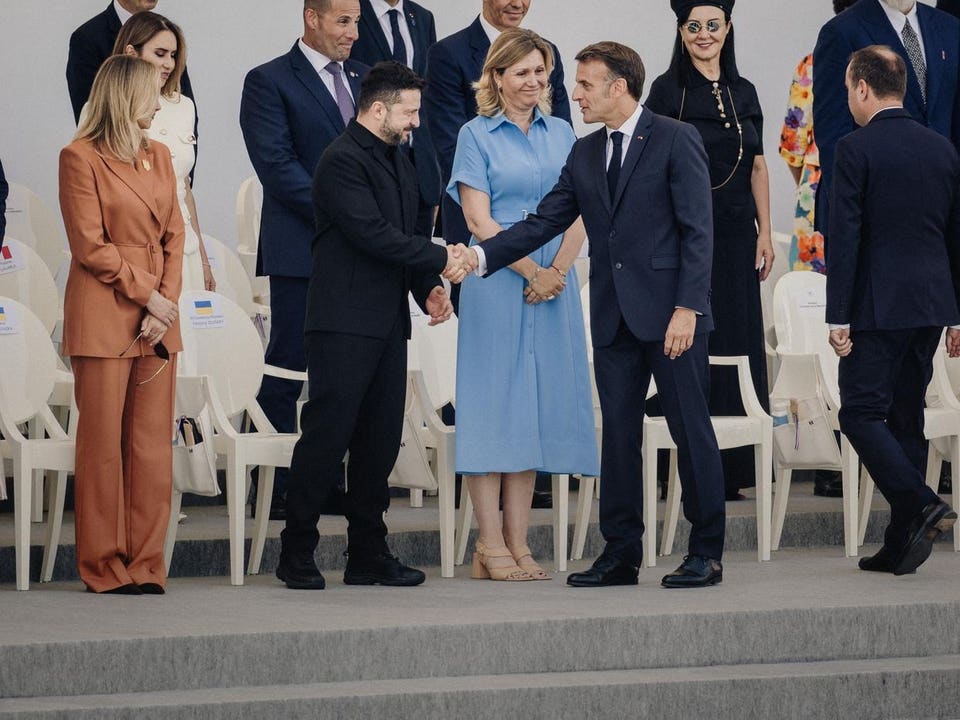
Emmanuel Macron President of the French Republic shakes hands with Volodymyr Zelensky President of Ukraine in front of Yael Braun Pivet President of the French National Assembly during the annual Bastille Day military parade on the Champs Elysees avenue in Paris France on July 14, 2026. (Photo by Bastien Ohier / Hans Lucas / AFP via Getty Images)
Hans Lucas/AFP via Getty Images
Dispatches from Ukraine. Day 1603.
Government Shake-Up
President Volodymyr Zelensky dismissed Mykhailo Fedorov as Ukraine’s defense minister on July 15 as part of his administration’s latest government overhaul. Fedorov confirmed his dismissal in a social media post later in the evening, saying it was “a great honor to serve the Ukrainian people as Defense Minister.”
Less than a year after appointing Yuliia Svyrydenko as Ukraine’s second woman Prime Minister, President Volodymyr Zelenskyy is preparing to reshuffle his government once again. On July 12, he announced that Svyrydenko was asked to “lead a new significant direction in relations with a key partner [the U.S.].” Ukraine’s Parliament voted on her dismissal on July 14, opening the door to the second cabinet reset in years.
In her resignation speech, Svyrydenko, her voice occasionally wavering, said her overriding goal had been to help Ukrainians enduring the hardships of war. “No matter how long the war lasts or how great the destruction, we must continue to… live with dignity,” she remarked.
The revamp appears to be driven by Zelenskyy’s desire to bring new people into the government.
Senior officials familiar with the discussions shared with Forbes Ukraine that Serhii Koretskyi, chief executive of Naftogaz, Ukraine’s state-owned oil and gas giant, is the leading candidate to replace Svyrydenko. Until recently, Zelenskyy was also considering Defense Minister Mykhailo Fedorov, former Prime Minister Denys Shmyhal, and Kharkiv Mayor Ihor Terekhov.
Svyrydenko, predicted to become Ukraine’s next ambassador to the U.S., leaves office with several notable achievements. During her tenure, Ukraine secured a record $52.4 billion in external financing in 2025 and secured a new $8.1 billion program from the International Monetary Fund. Her government recently launched the Drone Deal, a new mechanism that allows Ukrainian defense manufacturers to export weapons while channeling proceeds into a dedicated fund for the domestic arms industry.
Zelenskyy Visits France
More than 25 heads of state gathered in Paris on July 13 for a summit of the Coalition of the Willing, a Franco-British initiative bringing together countries prepared to provide military support and security guarantees for Ukraine. French officials said the summit came at a “powerful moment of renewed transatlantic convergence and unity” and would show that “there is absolutely no sign of fatigue” among Ukraine’s supporters.
The gathering produced fresh pledges. During a joint press conference with Volodymyr Zelenskyy, Friedrich Merz, and Keir Starmer, President Emmanuel Macron said France would transfer 16 Rafale fighter jets to Ukraine in 2028-29 and begin training Ukrainian pilots in the coming months. He also said France would grant Kyiv licenses to produce Aster-30 (surface-to-air missiles) for the SAMP/T air-defense system and SCALP cruise missiles with a range of 155 miles.
The formal launch of an Anti-Ballistic Coalition, bringing together Ukraine and nine European countries to develop a European-wide missile shield, took place during the summit. “We believe that the protection of Europe requires a global solution of integrated missile defense architecture to deter and defeat future missile threats — developed through collective effort, technological openness, and trusted industrial cooperation,” the joint statement declared.
Russia’s Attacks on Ukraine
Russian attack on Odesa kills three people. On July 15th, Several people were killed in Russian attacks on port infrastructure in Odesa and Mykolaiv, while Ukrainian authorities said it launched drone strikes on 20 Russian vessels as the warring sides escalated their battle over the Black Sea and key trade routes.
Early on July 14, Russia launched another ballistic attack on Kyiv (its fifth this month), firing eight missiles and 137 drones. Ukraine’s Air Force intercepted five ballistic missiles, the highest success rate recorded in weeks, after officials warned that Patriot stockpiles were running low. No casualties were reported in the attack, but falling debris ignited warehouse fires in Kyiv’s Holosiivskyi district and damaged a boarding school in Darnytskyi district.
The attack followed the two deadliest strikes on Kyiv this year, which killed almost 60 people on July 2 and July 6 after ballistic projectiles punched through Ukraine’s depleted air defenses.
On July 13, Russian drones hit the southeastern city of Zaporizhzhia, setting apartment buildings on fire. Two residents were killed, and 13 people were injured in the attack. In the southern Odesa region, Russia also struck a foreign commercial vessel, killing five crew members and injuring 10 others.
Two days earlier, on July 11, Russia dropped three glide bombs on the northeastern city of Sumy, killing five civilians, including a child, and injuring more than 40 others.
Ukraine’s Attacks on Russia
Overnight on July 14, Ukraine struck two major oil refineries deep inside Russian territory. Fires broke out at Gazprom Neftekhim Salavat in Bashkortostan (some 800 miles from Ukraine) and at the Afipsky refinery in southern Krasnodar Krai. Together, the two plants process nearly 20 million tonnes of crude oil a year.
Ukraine also said its drones struck transport infrastructure around the Sea of Azov. Robert Brovdi, commander of Ukraine’s Unmanned Systems Forces, said his units had hit 14 vessels from Russia’s shadow fleet overnight on July 14, bringing the total to 116 over the previous nine days.
Earlier in July, Ukraine defended its right to strike Russia’s shadow fleet. According to the Financial Times, in a letter to the International Maritime Organization, Ukraine’s Deputy Prime Minister Oleksiy Kuleba rejected Moscow’s accusations of “terrorism,” claiming that the vessels are “critical to the generation of budget revenues for the Russian Federation and the continuation of its war effort.” He also accused Russia of attacking 59 merchant ships since the start of its full-scale invasion.