

On 15 July, experts from Europa Nostra issued a Statement on the European Architectural, Cultural and Historical Significance of the British Barracks at Fort Chambray, Gozo, Malta, selected among Europe’s 7 Most Endangered heritage sites for 2026. The statement was prepared following an urgent mission to Malta last May, prompted by the recent decision of the Maltese authorities to approve the demolition of the site.

The statement concludes that the British Barracks are of outstanding European architectural, cultural and historical significance. It highlights their evidential value as an exceptionally well-preserved component of Fort Chambray and of Europe’s military heritage; their architectural value as a rare example of Anglo-Maltese colonial design; their historical and societal value through their roles in military and civilian healthcare; and their symbolic importance within Gozo’s cultural landscape. The statement warns that the demolition of the British Barracks at Fort Chambray would result in the irreversible loss of a unique heritage asset with no meaningful equivalent elsewhere in the Mediterranean.
The statement is the outcome of meetings and consultations held during the mission at Fort Chambray, as well as in Valletta, organised in the framework of the 7 Most Endangered Programme, run by Europa Nostra with the support of the European Investment Bank Institute. One of the programme’s key interventions is an expert mission, during which an international team of specialists visits the site, engages with the relevant stakeholders, and prepares an independent expert assessment to support the safeguarding of the threatened heritage.
Safeguarding the British Barracks at Fort Chambray: Summary of the Emergency Mission
By Graham Bell, Member of the Board of Europa Nostra and one of the experts who participated in the mission
One of the 7 Most Endangered 2026 is the British Barracks at Fort Chambray on Gozo. A mission visit took place months earlier than planned because of the urgent real and present danger posed to them. The clue is in the name: British Barracks, Gozo. This is a building of international historical and architectural significance with stories to tell that should have earned a secure future during times of peace. Unfortunately, the next chapter is less than reassuring: the mission by the 7 Most Endangered Programme is in response to a cri de coeur from Din l-Art Ħelwa to befriend this Għajnsielem landmark in distress, and persuade those in whose hands its fate lies to respect its credentials and ‘right to life’.

Chris Hurst and Graham Bell assessing the Barracks’ principal façade. Credit: Europa Nostra
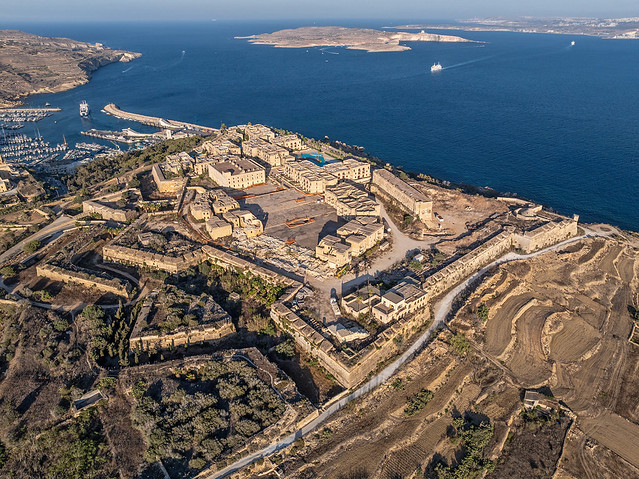
The barracks lie within Fort Chambray, located on a strategic bluff, giving it a commanding elevated position overlooking the harbour of Mġarr and Il-Fliegu t’Għawdex – the strait separating Gozo from Malta. Malta’s pivotal position at the heart of the Mediterranean means it has been coveted as a unique must-have prize by almost every force on every side seeking strategic trading or military advantage. Its history is a chronicle of overlayering of assault and rebuff, of a legacy of cultural imprints, of which the British presence is the most evident and indelible.
Fortresses are intended to repel danger from without, yet the ‘siege’ of the 18th century Chambray is commercial and the ‘assault’ on the 19th century barracks, existential. A succession of decisions over recent years has resulted in proposals to demolish the barracks to make way for ‘luxury’ development; reconstructing a vestige of it – a token partial shell – in another location is offered as an avatar of consolation. The barracks are tainted as ‘inconvenient heritage’, blocking lucrative new real estate and its views.
Din l-Art Ħelwa is no stranger to a challenge and demonstrates by example that heritage works, and continues to generate a return on societal investment. It doesn’t lack expertise or gumption, but the barracks, physically, historically and symbolically, have European DNA, which elevates this to a level of entreaty far beyond Gozo’s cliffs.
In May 2026, Din l-Art Ħelwa appealed and lost a challenge to halt demolition. This was the siren call to Europa Nostra, through the 7 Most Endangered Programme, to bring a mission visit before bulldozers sealed their fate. The barracks had been selected as one of the seven sites of most European significance facing the most significant danger. Too often, the 7 Most Endangered face a now-or-never moment of reckoning. It was time for the barracks.
Shortly afterwards, also in May 2026, Graham Bell, Board Member of Europa Nostra, and Chris Hurst, retired agent of the European Investment Bank, expert volunteers of the 7 Most Endangered Programme, held a series of meetings with those who could change the course of destiny for the barracks. They were accompanied by the representatives of Din l-Art Ħelwa who have assembled a formidable evidence base of the barracks’ extraordinary history and its eminent suitability for reuse: Architect Patrick Calleja, Executive President, Anthony Guillaumier, Secretary General, and Council Member Daniel Cilia, Gozitan/Għawdxi, celebrated photographer and assiduous researcher.
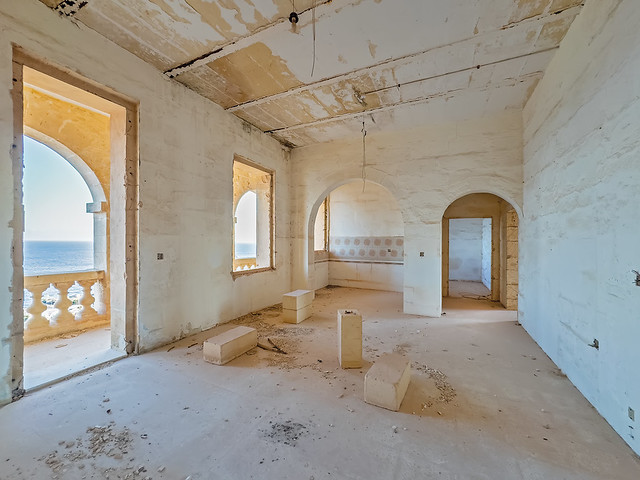
The barracks are disused, but their structural integrity is not in question, nor the premise for their demise. As a building designed for married officer quarters that subsequently provided welfare as a world war hospital and peacetime respite as specialised civilian healthcare, its configuration lends itself to reuse with limited need for adaptation or compromise of character and historic fabric. The location within the fort also affords appropriate setting and amenity for a building with presence and integrity. The mission considered these factors and was convinced that the universal principles inherent in a heritage impact assessment or conservation management plan would demonstrate that retention and sympathetic reuse would be an appropriate and realistic solution in accordance with international best practice.

Meeting at the Planning Authority with CEO Johann Buttigieg and Silvio Farrugia. Credit: Europa Nostra
Therefore, the mission enquiry focussed on the statutory and procedural history that led to the current commercial ownership and intent. Meetings were held with: Ivan Falzon, CEO of the Gozo Regional Development Authority; Johann Buttigieg, Executive Chairperson Planning Authority and Silvio Farrugia, Director Development Management Directorate; Mario Borg, Permanent Secretary for the Ministry of Gozo & Planning; Kurt Farrugia, Superintendent of Cultural Heritage; Andre Pizzuto, President of the Chamber of Architects of Malta, together with Andrea Bianco, Chairperson of the Policy Committee on Heritage of the Chamber of Architects, and Fabio Scicluna, Policy Officer of the Chamber of Architects. A round table review of the meetings, issues and scenarios was held with Reuben Grima, Associate Professor of Conservation and Built Heritage, University of Malta, Luke Said, Research Support Officer, University of Malta, and member of a number of Gozitan NGOs, and Godfrey Vella, Engineer, NGO member of Din l-Art Ħelwa, Għawdex.

Meeting with Mario Borg, Permanent Secretary for the Ministry of Gozo & Planning. Credit: Europa Nostra
Requests for meetings with the owner/developer and their architect received no response.
Sensitivity, and recognition of alleged deficiencies in government due process for more than 15 years, during which the site was transferred as a concession to private interests, were an undercurrent across all meetings, whether openly acknowledged or unspoken. Government financial and material interest in the site, in addition to the statutory planning roles, complicates objectivity and therefore the ability of civil servants to speak freely; one meeting in particular could be summarised in two words: ‘no comment’.
Meeting the European Commission representation to Malta was not possible.
The mission’s emerging synopsis is of a site whose recent history is of a succession of decisions or indecision that has not yielded the promised commercial success or public benefit; this is the consensus, but, given the complicated circumstances, not everyone can say so. Similarly, as the government’s earlier adopted development plan included retention and reuse of the barracks, there are reasonable grounds for believing the concession could be challenged, at least for the phase of development of the fort that includes the barracks, to revert back to the intended objective of public benefit.
The favourable condition and configuration of the barracks are compelling grounds for a deliverable alternative to the current misconceived plan, which is weak in respect of compliance with national government public interest, and fundamentally flawed in terms of compliance with international best practice for heritage assets. The barracks are a conspicuous anomaly in not being scheduled; that should immediately be rectified for consistency in government accountability. Scheduling would be a gamechanger, the precursor to correcting due process and a precedent for introducing best practice.