

Wildfire smoke pollution has surged across the US in recent years, with winds transporting harmful particles invisible to the naked eye hundreds or even thousands of miles from their source. The smoke has stalled air quality gains in many states and is estimated to have contributed to tens of thousands of deaths.
Research on the future of wildfire smoke in New England is scant. But looking at the US as a whole, researchers found that per-person annual exposure to wildfire smoke was four times higher on average between 2020 and 2024 than during the years prior from 2006 onward.
New England’s haze this week came largely from Canada, where roughly 850 fires are tearing through forests, including more than 100 in Ontario. Smoke from northern Minnesota, where nearly 20 wildfires have scorched tens of thousands of acres, has also contributed.
An enormous heat dome sitting over the upper Midwest created a clockwise rotation of the air, scooping up some of that smoke from Canada and Minnesota and carrying it eastward. Air quality in the Greater Boston area plummeted, reaching levels considered unhealthy for sensitive populations on Wednesday.
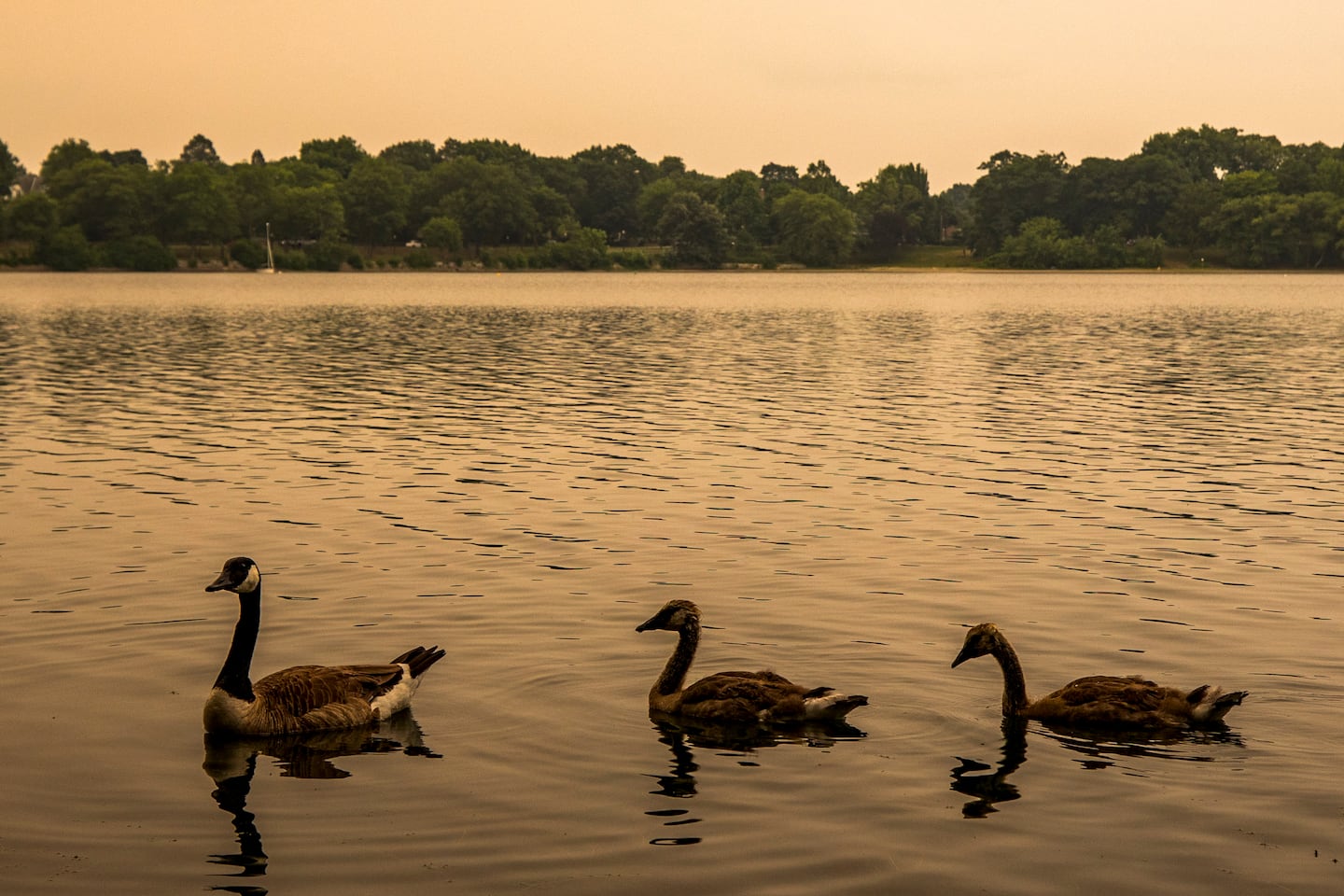 Geese at Jamaica Pond in Jamaica Plain.Christian Kantosky for The Boston Globe
Smoky days are not a new phenomenon in New England. In 1950, a heavy pall of smoke from Canadian forest fires almost blacked out the sun. Further back in 1881, immense quantities of smoke believed to have originated from Canada caused a historic “Yellow Day,” terrifying Bostonians who feared a popular prophecy that the world would end that year was coming true.
Nonetheless, scientists said the succession of orange days in recent years is noteworthy. Westervelt said the number of major smoke events appears to be on the rise in Boston and other cities along the northeastern coast.
In Boston, there are records of a handful of smoky days in the late 90s and early 2000s, he said. But now, he said, “this has become almost an annual issue.”
In 2023, a particularly bad year for New England smoke, Canada suffered its most destructive wildfire season on record. The blazes torched an area of land more than five times the size of Massachusetts.
Loretta Mickley, who co-leads the Atmospheric Chemistry Modeling Group at Harvard University, said that a few decades ago, people would look forward to cold fronts from Canada that would break up the smog in the northeast. The wildfires have reversed that paradigm.
“Instead of getting clean, cool air, we’re getting smoke from Canada,” she said.
Shel Winkley, a meteorologist at Climate Central, said that when the fires in Ontario broke out, temperatures across parts of the province were around 100 degrees Fahrenheit — about 25 to 30 degrees above average for this time of year.
 Cyclists pause on the Toronto Islands as forest fires in Northern Ontario cause poor air quality over Toronto.COLE BURSTON/AFP via Getty Images
“It would be almost impossible to get this hot in Ontario at this time of year if it wasn’t for climate change,” he said, citing a tool from his organization that calculates how climate change has altered the frequency of daily temperatures.
As wildfires become more prevalent across Canada, Winkley said, so too will the potential for this wildfire smoke to drift into the United States.
Some scientists, however, caution that the incidence of smoky days is hard to predict. Robert Field, an associate research scientist at Columbia University who has studied Canadian wildfire smoke, said it is too soon to quantify any trends in New England; because these smoky periods are short-lived and episodic, he said, they are still rare, making it difficult to draw conclusions. He added that modeling the relationship between the warming climate and smoky conditions on the ground is not straightforward.
“There’s a lot that happens between the flammability, the realized fire activity, smoke production, and where that smoke gets transported,” he said.
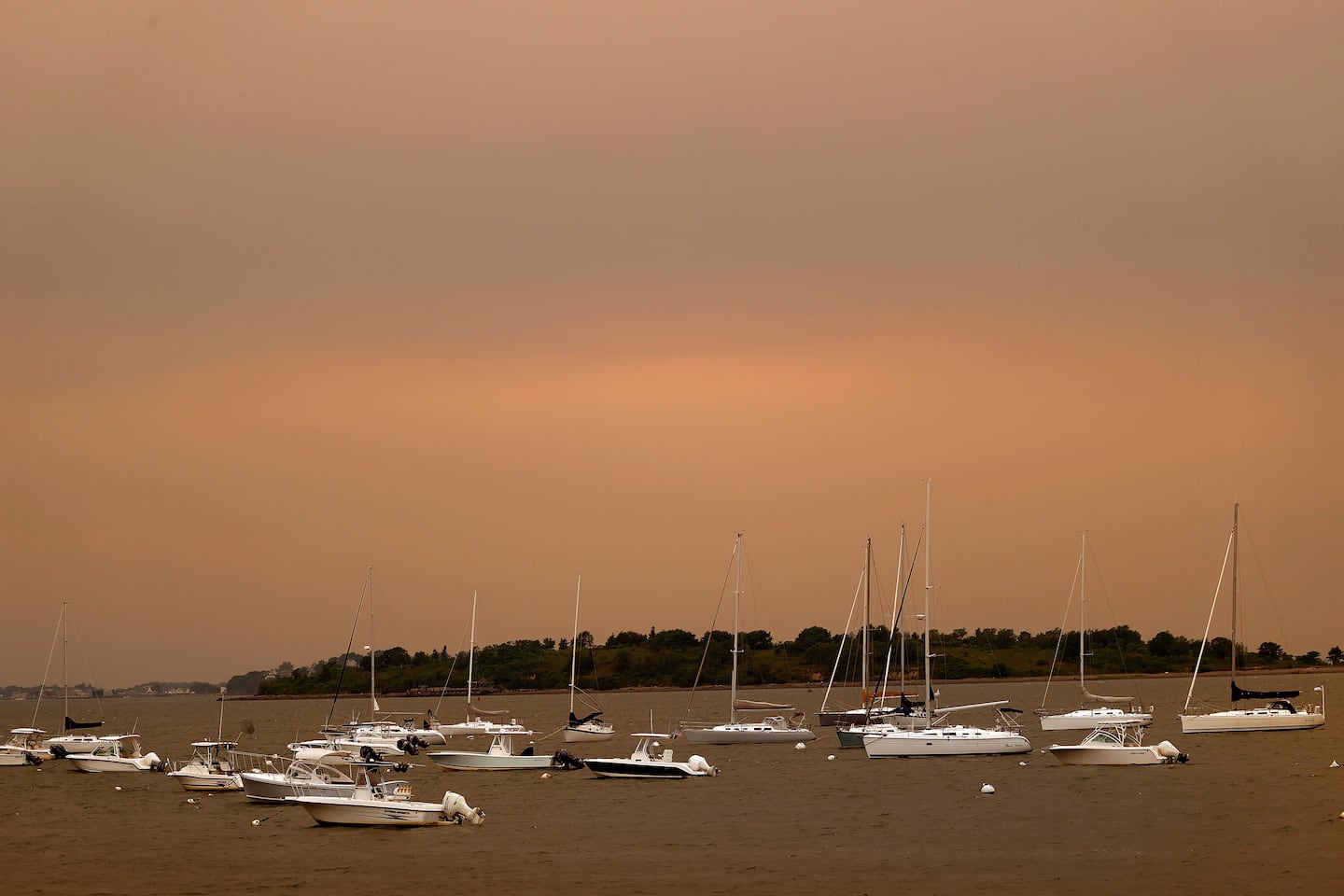 Hazy, smokey at dusk in Hingham from the Canadian fires on July 15.David L. Ryan/Globe Staff
More research has been done on the impacts of wildfire smoke. A Stanford University study found that the smoke has contributed to the stagnation of air quality improvements in Maine, Connecticut, and Rhode Island — and reversed the trend in a handful of states. Another study, led by a researcher at Oregon State University, concluded that smoke contributed to more than 160,000 deaths across the US between 2006 and 2020.
The smoke is dangerous because it contains a toxic mix of pollutants, including tiny airborne particles that are roughly 30 times thinner than a human hair. These particles, known as PM2.5, can become embedded deep in the lungs and cross into the bloodstream. Exposure has been linked to asthma, heart and lung issues, and premature death.
The particles can be hard to detect: “Generally, this level of fine particulate matter tends to be more invisible,” said Francesca Dominici, the director of the Harvard Data Science Initiative, who has studied air pollution. “You’re not smelling it.”
She said a day of breathing in the PM2.5 pollution seen in Boston on Wednesday morning can be compared, roughly speaking, with smoking one to two cigarettes. Although wildfire smoke and cigarette smoke aren’t chemically identical, she said, even short exposure to either can have health implications.
Forecasters expect that the smoke will finally dissipate by mid-Friday morning. But the reprieve may not last. It’s difficult to predict wildfire smoke more than a day in advance, but depending on the fires and atmospheric conditions, it’s possible that the plumes could return next week.
Ken Mahan and Jeremiah Manion of the Globe staff contributed to this report.
 Early morning haze is reflected on Dorchester Bay as an egret stalks the shore in Boston.Craig F. Walker/Globe Staff
Kate Selig can be reached at kate.selig@globe.com. Follow her on X @kate_selig.