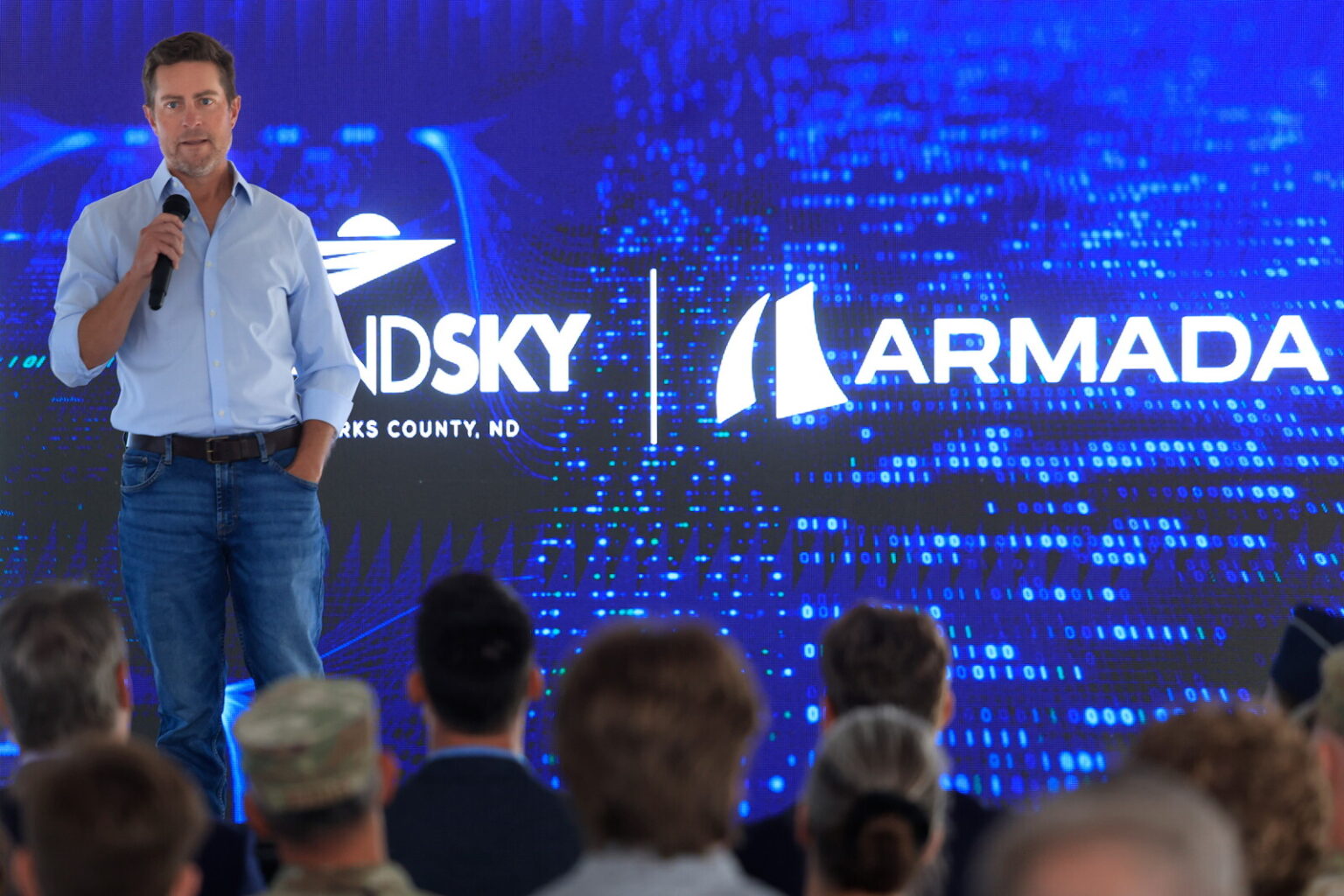
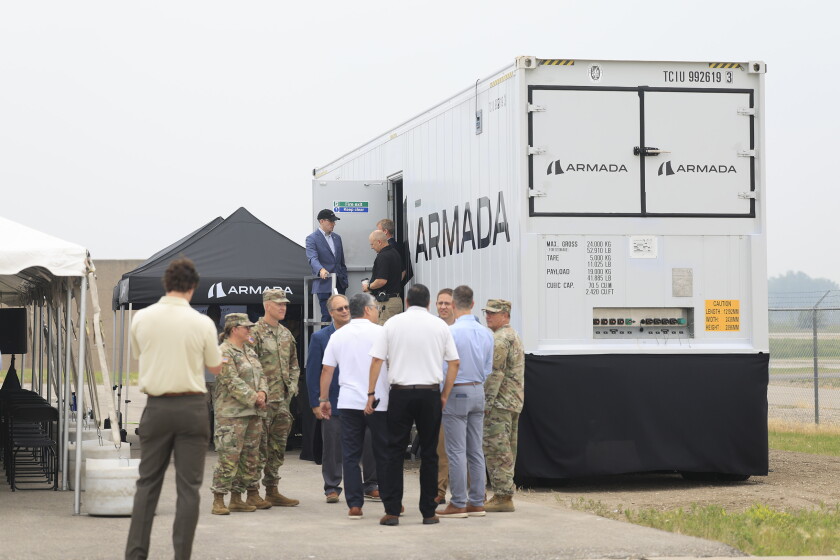
EMERADO — Artificial intelligence company Armada showcased its new transportable data center during an event on Friday at Grand Sky.
Named Triton, the 40-foot-long data center is compact enough to be pulled by a semi truck. Armada touts it as being functional anywhere on the planet — from the desert climate of Saudi Arabia to the minus 50 degree temperatures of interior Alaska.
“This just becomes one more tool to attract, not just another Northrop Grumman or General Atomics, but another inventor — another college student,” said U.S. Sen. Kevin Cramer, R-North Dakota, in his remarks at the event.
Triton’s unveiling comes two days after
North Dakota’s AI and Data Center Committee met
for the first time to discuss the strain the technologies have on energy use. Data centers accounted for about 4-5% of energy use in 2024, but is expected to increase to 9-17% by 2030. Rep. Mike Nathe, R-Bismarck, said at the meeting that the state simply won’t be able to keep up.
“We want to encourage the use and testing of this unit by all of the tenants here in both Grand Forks and at Grand Sky,” Armada Chief Operating Officer Jon Runyan said. “Whether you’re the Air Force, the National Guard, General Atomics, the University, Northrop — we encourage you to come.”
Triton will be used to collect and process data used in the aviation park’s unmanned aircraft system missions. Runyan said his company is allowing Grand Sky to have the data center free of charge for a year.
Additionally, Armada is partnering with the federal government on President Donald Trump’s planned Golden Dome missile defense system — a project praised by Cramer, who had pushed to make North Dakota a major part in its operation.
Earlier this year, Cramer supported a Senate appropriations package that includes a $5 million investment at Cavalier Space Force Station’s Perimeter Acquisition Radar Attack Characterization System, which tracks objects in orbit and is expected to be a key part of the Golden Dome project.
“The Golden Dome is the integration of new and existing capabilities with the focus of creating a dome that protects us from incoming missiles, aircraft, drones or, you know, robots,” Cramer said. “When you’re talking about integration, you’re talking about the ability — not just to collect data — but to move data quickly.”
How powerful each Triton is depends on the processing power of the computers housed inside, said Tori McCaffrey, senior project manager. Customers source GPU and CPUs themselves or from suppliers through Armada.
McCaffrey described Triton as being energy “agnostic,” meaning it can run on power produced from a variety of sources, renewable or not.
“We’re able to take advantage of stranded energy sources,” she said. “For example, we’re deploying these on an oil rig in the North Sea. In that case, you probably need a generator because there’s not another option around.”
McCaffrey added that Armada’s data centers differ from the traditional brick and mortar centers in that they take up less space, use less power and don’t use water for cooling. However, the sound emitted from the data centers is still notable.
Eric Hylden / Grand Forks Herald
Eric Hylden / Grand Forks Herald