
What’s the news?
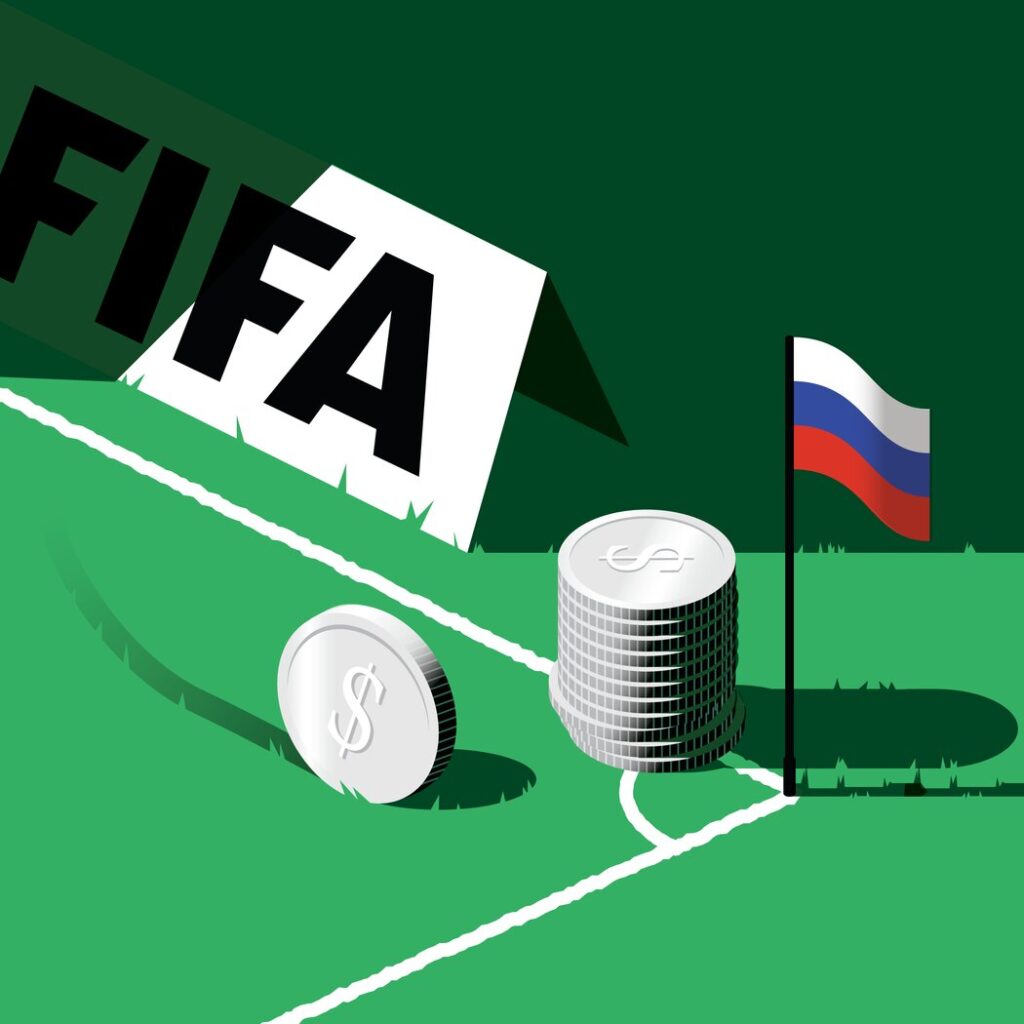
- FIFA shared the proceeds from the World Cup in Qatar with Russian clubs whose owners or principal sponsors are subject to sanctions imposed by the United States or the European Union, Follow the Money found.
- This year, following the World Cup in the United States, FIFA has even more money set aside for clubs that released players to their national teams. Russian football clubs are set to benefit from this too.
Why does it matter?
- These payments contravene international sanctions imposed following Russia’s invasion of Ukraine, and could lead to criminal prosecution.
How was it investigated?
- Follow the Money examined FIFA reports to check which Russian clubs had received World Cup payments, and found that all but one of these clubs were linked to sanctioned entities. We also spoke to legal experts to understand the risks FIFA was taking with these continued payouts.
Read more
Fold in
When FIFA President Gianni Infantino welcomed football executives from around the globe to the Qatar World Cup in 2022, he boasted that payouts to national associations had increased eight-fold under his leadership.
“Every association around the world 1784348115 receives at least $2 million every year as a minimum,” he said.
On top of this sum comes the Club Benefits Programme, through which associations receive money to distribute to clubs that release players to national teams during the World Cup. For the 2022 tournament, this fund totalled $209 million.
At the time, those applauding executives presumably did not realise that FIFA would land itself in legal hot water with this lavish spending programme – nor that the international football federation would be compounding the mistake in 2026. For the World Cup in the US, Canada and Mexico, the total pot for the Club Benefits Programme stands at $355 million.
The millions handed out by the FIFA president are distributed across the globe. This includes Russian clubs whose owner or principal sponsor is subject to sanctions imposed by the United States or the European Union, according to research by Follow the Money.
Our journalism is only possible thanks to the trust of our paying members. Not a member yet? Sign up now
That could prove costly for football’s governing body.
FIFA falls under US sanctions legislation, not just because the 2026 World Cup is being jointly held in the US but also because of sponsorship deals with companies such as Visa and Coca-Cola, and because of its offices in Miami and Trump Tower in New York.
FIFA is headquartered in Zurich, Switzerland, and must therefore also comply with Swiss laws and regulations, which follow the European Union’s sanctions regime.
Sanctioned gas and oil companies
Through its Club Benefits Programme, FIFA paid $1.2 million to six Russian clubs following the World Cup in Qatar, according to an official report from July 2023.
Zenit St Petersburg, for example, received nearly $500,000. The club is owned by Gazprombank, which is in turn owned by the oil and gas company Gazprom, an entity sanctioned by the United States.
Other clubs that received funds include Dynamo Moscow ($361,364), CSKA Moscow ($159,693), Rubin Kazan ($91,253) and Lokomotiv Moscow ($80,303).
All of these clubs are linked to international sanctions through an owner or principal sponsor. As far as is known, this does not apply to FK Krasnodar, which received $60,227.
Payments such as these were channelled through the national football associations to all 440 clubs that released players to take part in the tournament in Qatar. In May 2023, the associations received written instructions to transfer the funds: “These sums are due to the clubs.”
A similar scenario is set to unfold following the 2026 World Cup.

Spartak Moscow, among others, can now expect to receive funds. The club released midfielder Théo Bongonda to the Democratic Republic of the Congo national team, which reached the first knockout round after a memorable victory over Uzbekistan.
Spartak is owned by Lukoil, Russia’s largest oil company. In October 2025, US President Donald Trump imposed fresh sanctions on Lukoil.
Risk of infection
By making these payments to Russian clubs, FIFA is entering legally risky territory.
The same applies to the fixed annual contribution it pays to all football associations. Intended to support national teams and the development of the game, this funding also goes to the Russian Football Union.
The Russian association receives around $2 million each year, even though its president, Alexander Dyukov – who is also the chief executive of Gazprom – was personally sanctioned by the United States in January 2025.
In any event, FIFA cannot hide behind the argument that the Russian football clubs themselves are not directly subject to sanctions.
“Violating sanctions is a form of international organised crime and can be punished with a prison sentence”
The Netherlands-based lawyer Heleen Over de Linden, who works on cases related to Russia sanctions, said that “absolutely nothing” is permitted once a club owner or major sponsor is subject to sanctions. Funds simply cannot be allocated “if this directly or indirectly benefits a sanctioned person or entity”.
Over de Linden compared it to dealing with a person who is suffering from a highly infectious disease: “Anything you do with them, directly or indirectly, makes you infected too.”
To illustrate the point, she referred to a ruling by the Court of Justice of the European Union, which held that shareholders of a subsidiary are also covered by sanctions imposed on the parent company.
According to her, exceptions are only possible if FIFA has obtained an exemption from the Swiss and US authorities allowing payments to Russia. As far as is known, no such exemption has been granted.
‘International organised crime’
The Court of Arbitration for Sport (CAS), the highest tribunal in international sport, did rule on the issue in 2025. The case concerned a transfer fee that West Ham United refused to pay to CSKA Moscow because the club’s owner was subject to sanctions. CAS upheld West Ham’s position.
FIFA took a different approach, as a 2025 investigation by Follow the Money revealed. “The existence of sanctions has no effect on the existence and expiry date of a debt,” the international football association ruled in cases involving payment problems to Russia.
Clubs in arrears are ordered to settle their debts within 45 days. If they fail to do so, they face a transfer ban covering three transfer windows.
According to Markus Mohler, a Swiss criminal law expert, this is “not a standalone breach of the sanctions provisions” by clubs but “a breach imposed” by FIFA. Mohler described this as “coercion” and said it constitutes a criminal offence under the Swiss Criminal Code.
Coercion was also an issue in West Ham United’s dispute with CSKA Moscow. Over de Linden said it became clear at the time that FIFA was siding with the Russian club.
In 2023, CSKA proposed a series of arrangements designed to circumvent the sanctions.
The club suggested, for example, private payments via an investment firm in Hong Kong, payments via the Russian Premier League into an account at Raiffeisenbank in Moscow, or offsetting the debt against money owed by CSKA to SC Heerenveen.
FIFA held West Ham responsible for refusing to agree to these “proactive” solutions proposed by CSKA. The Court of Arbitration for Sport later ruled, however, that those payment methods – without the approval of the relevant authorities – amounted to “an undue attempt to circumvent the applicable sanction regimes”.
Responding to Follow the Money’s findings, the Swiss sanctions authority SECO said that “in principle, it is prohibited to make funds and economic resources available to sanctioned entities”. SECO declined to comment on individual cases, but said it “systematically follows up on indications of alleged sanctions violations and consistently prosecutes such violations”.
The US sanctions authority did not respond to a request to comment, while the FBI declined to comment on the findings.
FIFA did not respond to questions from Follow the Money. Nor did the Russian Football Union or any of the clubs mentioned.
Over de Linden believes FIFA is behaving as though it is above the law.
“Violating sanctions is a form of international organised crime and can be punished with a prison sentence of up to six years,” she said.