
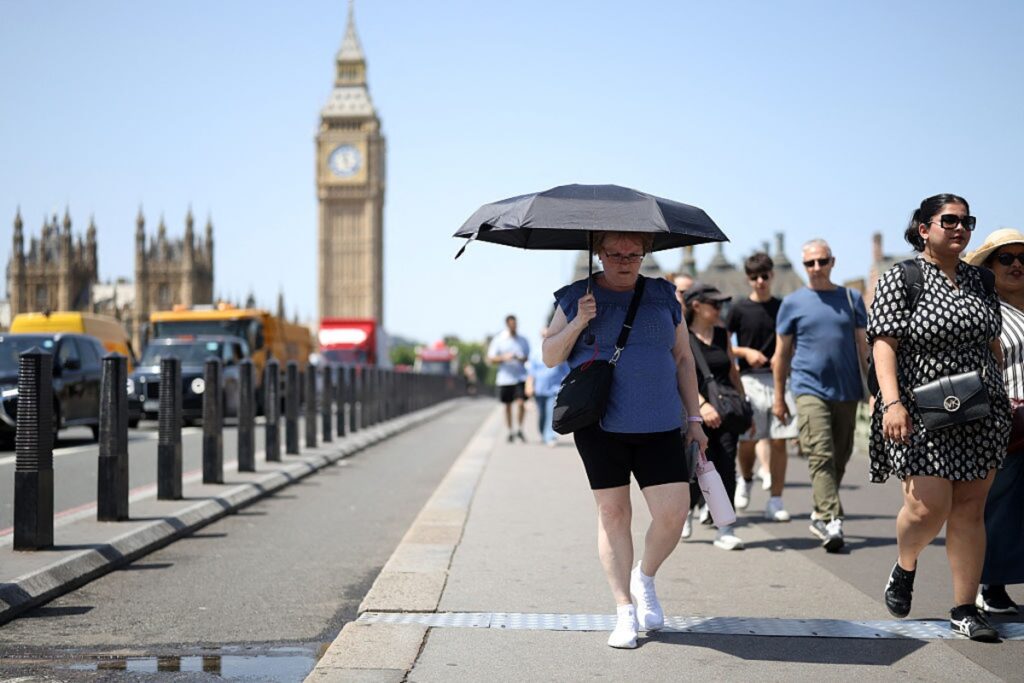
The Met Office confirmed at 11:00 BST on Saturday that Britain’s third heatwave of 2026 had ended for most of the country, as cooler Atlantic air displaced the blocking high-pressure system that had gripped the British Isles since early July. The relief arrives at the close of what is already the most extraordinary meteorological summer in modern UK history.
Before the third heatwave is even counted in the mortality ledger, an estimated 2,700 people are thought to have died from heat-related causes during May and June’s record-breaking spells — and roughly 1,140 of those deaths, or 42%, would not have occurred in a world without human-induced climate change. That finding, from a peer-reviewed rapid attribution study jointly conducted by researchers at the London School of Hygiene & Tropical Medicine (LSHTM), Imperial College London, and the Met Office itself, transforms what began as a season of temperature records into something more consequential: a direct, peer-reviewed count of lives taken by warming weather.
Third Heatwave Began July 4 — and Peaked Above 35°C
The third heatwave was formally declared on 4 July when parts of southeast England met the Met Office’s official threshold: at least three consecutive days above the county-specific benchmark, which ranges from 25°C in Scotland and parts of Wales to 28°C in the southeast. When Deputy Chief Forecaster Steven Keates announced the start of the spell on 6 July, he placed it in context: the third heatwave in the same calendar year — an unusual sequence even for a Britain already accustomed to warming summers.
The peak arrived on Thursday 10 July and the days immediately surrounding it, when temperatures widely exceeded 30°C across England and Wales. The highest readings reached 35°C or above, with some locations in southern England coming close to 36°C the following day. The third heatwave never matched the June event’s raw extremity — it was, as Keates had forecast, less record-breaking than its predecessor — but two weeks above threshold in late July, stacked on top of what May and June had already done, cemented the summer’s place in the record books.
Why 2026 Has Already Rewritten UK Climate History
By 10 July, the 2026 season had secured a statistical first that no previous UK summer had achieved: temperatures of 35°C or higher had been recorded in May, June, and July of the same year. Met Office Science Manager Dr Amy Doherty stated the full measure of what that meant: a record eight days with temperatures exceeding 34°C in a single calendar year, surpassing the previous benchmark shared by 1976 and 2020.
By 15 July, 2026 had already logged more days above 30°C than the entire 1976 summer — which for decades had served as British shorthand for an extreme heatwave season.
The May heatwave, which ran from late in that month, broke the UK’s all-time record for May when 34.8°C was registered at Kew Gardens in London on 25 May, and broke it again when 35.1°C was recorded in the same location the following day. The previous May record had stood since 1922.
June was more severe. A punishing spell during the last week of the month sent temperatures provisionally above 37°C in East Anglia on 26 June, shattering the UK’s previous June record — a benchmark from 1976 that had survived for half a century — by more than 2°C. Over 150 weather stations set their own highest-ever June maximum temperature record, and a similar number broke their June overnight minimum records, including stations with more than a century of data. The UK and Wales also logged a new overnight temperature record: 23.5°C at Cardiff Bute Park on 25 June, surpassing the previous high by 3.5°C.
Climate Science Has Put a Number on the Deaths
The most important finding of this summer is not the temperature records — it is what happened to the people who lived through them.
An estimated 550 people are thought to have died from heat-related causes during the May heatwave, and around 2,200 during the June heatwave, in England and Wales alone. These are modeled estimates, not confirmed official mortality counts: they are based on historical mortality records and established peer-reviewed methods. But they come from the same institutions — the Met Office, LSHTM, and Imperial College London — that the UK government relies on for public health guidance, and they were published five days ago.
Of the total estimated 2,700 deaths, approximately 42% — roughly 1,140 people — are attributable to the additional heat that human-induced climate change added to this summer. The study found that climate change has added between 3°C and 4°C to maximum temperatures across England and Wales compared to what the same weather patterns would have produced without greenhouse gas emissions. That is not a projected future risk. That is the documented condition of the UK climate today.
Dr Clair Barnes, Research Associate in Extreme Weather and Climate Change at Imperial College London, described what the numbers mean in practice: “We now live in a country with dangerously hot summers. To protect people during future extremes, we must urgently adapt to the reality of the climate we now have, and double down on global efforts to reach net zero emissions to stop this from getting worse.”
Dr Mark McCarthy, Manager of Climate Attribution at the Met Office, noted that the May and June events had broken records “that had stood from May 1944 and June 1976 respectively. For the time of year these events were extreme, even in our warmer climate.”
The regional distribution of deaths adds a further finding. While southern England recorded the highest temperatures, the Midlands reported a death rate per million that was comparable — suggesting that populations less frequently exposed to extreme heat are disproportionately vulnerable when temperatures do spike, regardless of peak values.
How Attribution Science Connects Weather to Deaths
The question “how do scientists know climate change caused those deaths?” is one readers are right to ask, and the methodology behind the answer is specific.
Extreme event attribution is a branch of climate science that emerged from a landmark 2004 analysis of the deadly 2003 European heatwave. Scientists compare two model scenarios: the world as it actually is, with approximately 1.4°C of warming above pre-industrial levels, and a counterfactual world in which human-caused greenhouse gas emissions never altered the climate. By running large ensembles of climate model simulations under both conditions, researchers can estimate how much more likely or more intense a specific weather event becomes under real-world warming.
For this summer’s June heatwave, the World Weather Attribution network — the international scientific consortium founded in 2014 and co-led by Prof. Friederike Otto of Imperial College London — found that the temperatures seen across Western Europe would have been “virtually impossible” in the climate of 1976, just 50 years ago. A similar event in the 1976 climate would have been around 3.5°C cooler; such events are now tens to hundreds of times more likely than they were in 2003.
The atmospheric mechanism behind the July spell follows a familiar pattern. A blocking high-pressure system stalls over the British Isles, preventing the normal west-to-east movement of Atlantic weather systems. Air descends under the high-pressure cap, suppressing cloud formation and convection. The result is an extended period of clear skies and rising surface temperatures. What changes under climate change is not the weather pattern itself — blocking highs occurred in 1976 too — but what that pattern now delivers: the same southerly airflow now produces temperatures measurably higher than historical data would predict, because the baseline has shifted.
How Does Climate Change Affect UK Heatwaves?
The direct mechanism operates on two levels. First, human-caused warming raises the average temperature of all air masses, including those that circulate into the UK from the south during blocking patterns. Second, a warmer atmosphere holds more moisture, intensifying the humidity of the night air — a factor that can be as dangerous as peak daytime temperatures, because high overnight humidity prevents the body from cooling during sleep. June 2026 demonstrated this: dew points approached 22°C, a level at which evaporative cooling through sweat becomes severely impaired even at temperatures below 2022’s absolute maximum of 40.3°C.
What Comes Next: August Is Still Peak Heatwave Season
Saturday’s end to the third heatwave does not end the season. The Met Office’s Saturday morning update describes a transition to warm but less extreme conditions: after several nights when temperatures struggled to fall below 20°C, overnight values will return to the low and mid-teens for most areas, bringing significantly more comfortable sleeping conditions.
Southern areas are likely to remain relatively warm and dry into next week, with the Azores High expected to sit close to southern Britain and low-pressure systems continuing to track across Scotland and the northwest. That pattern — warm and settled in the south, wetter in the north — has been a recurring feature of the 2026 summer.
The broader outlook, however, is not reassuring. The second half of the UK summer — August in particular — is historically the period when blocking high-pressure systems are most likely to recur. Meteorologists note that further hot episodes through August would be entirely typical. The death toll from the July heatwave has not yet been estimated.
Should You Still Be Worried About the Summer?
For most people, Saturday marks real relief. Temperatures are returning to seasonal norms, and the health alerts that had blanketed much of England are easing. The immediate risk to health has passed — for now.
But the context of this relief matters. Britain has now, in a single summer, confirmed a mortality toll from heat that approaches or exceeds the total heat mortality recorded across all of 2022 — and August has not happened yet. The UK’s residential housing stock was not built for sustained periods above 30°C; the vast majority of homes have no air conditioning. The adaptation gap is structural, not temporary.
The summer of 2026 has demonstrated, in measurable terms, what a warmer baseline climate costs the UK in lives. The record temperatures this summer produced are not anomalies waiting to be averaged away. They are the new upper range of what the existing blocking-high weather pattern now delivers — and that upper range will keep rising until net-zero emissions are reached globally.
Frequently Asked QuestionsIs the UK heatwave over?
As of Saturday, 18 July 2026, the Met Office confirmed that the third heatwave of the year had ended for most of the UK. Cooler Atlantic air pushed south and eastward through Saturday morning, displacing the blocking high-pressure system that had dominated since early July. Temperatures are expected to return to seasonal norms over the weekend, with the south remaining relatively warm and dry while the north and northwest see more cloud and rain.
How many people died in the 2026 UK heatwaves?
An estimated 2,700 people are thought to have died from heat-related causes in England and Wales during the first two heatwaves — the May event (approximately 550 deaths) and the June event (approximately 2,200 deaths). These are modeled estimates based on historical mortality records and established scientific methods, published on 13 July 2026 by researchers at LSHTM, Imperial College London, and the Met Office. Deaths from the July heatwave have not yet been estimated. The July death toll, when assessed, will likely bring the 2026 total above the full-season figures for 2022.
What made the June 2026 heatwave so deadly, and is it really climate change?
The June heatwave combined peak temperatures in excess of 37°C in East Anglia — a new UK June record — with unusually high humidity. Dew points approached 22°C, severely impairing the body’s ability to cool through sweat, making the physiological toll greater than raw temperature figures suggest. The World Weather Attribution network found these temperatures would have been “virtually impossible” in the climate of 1976; a comparable event 50 years ago would have been approximately 3.5°C cooler. A joint study by LSHTM, Imperial College, and the Met Office estimated that climate change was responsible for 42% of the heat-related deaths — roughly 1,140 of the 2,700 estimated fatalities.
What can people in the UK do to protect themselves in future heatwaves?
For immediate protection during a heatwave: stay hydrated, avoid direct sun between 11am and 3pm, keep living spaces cool by opening windows at night and closing curtains during the day, check on elderly or vulnerable neighbors, and watch UKHSA heat-health alerts. For the structural risk: the research team has emphasized that adaptation of UK homes, workplaces, and infrastructure to extreme heat must accelerate — particularly retrofitting ventilation and cooling into older housing stock. No cooling technology can substitute for the systemic reduction in greenhouse gas emissions that would slow the pace at which future heatwaves intensify.