
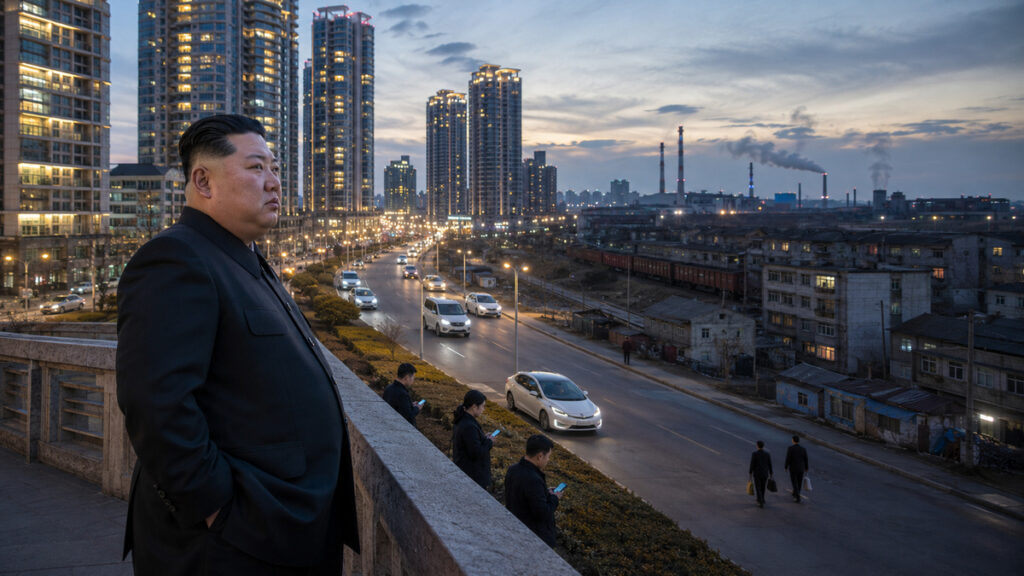
North Korean economy records highest growth in eight years, as military cooperation, foreign trade, and digital revenues strengthen Kim Jong-un’s regime
The North Korean economy grew by 3.7% in 2024, according to estimates released by the Bank of Korea.
This was the largest advance recorded in eight years. However, about 11 million North Koreans still suffer from malnutrition, according to the United Nations.
Under Kim Jong-un’s leadership, the country expanded its cooperation with Russia, maintained trade with China, and strengthened its nuclear program.
Additionally, the regime increased control over informal markets and found new ways to circumvent the effects of international sanctions.
North Korean economy shows signs of recovery
For decades, North Korea faced economic stagnation, international isolation, food shortages, and the abandonment of public services.
Subsequently, the COVID-19 pandemic worsened this situation in 2020. During that period, border closures further reduced commercial activities.
Amid the difficulties, Kim Jong-un appeared on television and apologized to the population. The leader acknowledged that his efforts had not eliminated national problems.
However, in March 2026, Kim adopted a different tone during a session of the Supreme People’s Assembly.
On that occasion, the leader declared that the country had undergone a “miraculous transformation”. Furthermore, he stated that North Korea would not be vulnerable.
Russian support strengthens state-controlled industries
Since February 2022, the Russian invasion of Ukraine has brought Kim Jong-un closer to Vladimir Putin’s government.
In this context, North Korean factories resumed the production of ammunition and weapons destined for Russia. Consequently, industrial sectors returned to operate with greater intensity.
 Kim Jong-un accompanies a military inspection in front of a mobile launcher, while cooperation with Russia stimulates strategic North Korean sectors.
According to Western intelligence reports, approximately 15,000 North Koreans were sent to fight or work alongside the Russians.
In June 2024, Russia and North Korea signed a Comprehensive Strategic Partnership, including a mutual defense clause.
Cooperation with Moscow boosted sectors such as mining, chemical industry, machinery manufacturing, and heavy industry.
China remains essential for the North Korean economy
Although Russia has increased its importance, China remains fundamental to the functioning of the North Korean economy.
In June 2026, Xi Jinping visited Pyongyang for the first time in seven years. During the meeting, the governments advocated for greater economic cooperation.
Previously, in 2017, Beijing had supported international sanctions against the North Korean nuclear program.
Subsequently, however, the Chinese position began to change after the failure of the meeting between Kim Jong-un and Donald Trump, held in 2019.
 Kim Jong-un and Donald Trump during a diplomatic meeting; the failure of subsequent negotiations contributed to changes in the Chinese position on sanctions.
In this scenario, Xi avoided publicly advocating for the denuclearization of the Korean Peninsula. Additionally, he promised to elevate the bilateral relationship to another level.
The economic future of North Korea still largely depends on the trade relations maintained with China.
Growth still does not reach the entire population
Currently, the most visible signs of recovery remain concentrated in Pyongyang, where streets have gained lighting and elevators are functioning again.
Additionally, visitors reported a greater circulation of cell phones, electric cars, and delivery and transportation apps.
In parallel, the government completed the Wonsan Kalma tourist complex and announced the 20×10 program, aimed at building factories outside the capital.
However, Chainalysis estimated that North Korean hackers stole more than $2 billion in crypto assets during 2025.
Despite these revenues, experts warn that growth depends on military demand and has not yet significantly improved the lives of ordinary citizens.
Therefore, the recovery has strengthened the regime and some productive sectors. However, inequality, malnutrition, and economic fragility remain present in the country.
In your opinion, will North Korea’s economic recovery reach the population or remain concentrated in Pyongyang and the regime’s elite?