

The remains of a Roman military camp dating to the reign of Emperor Marcus Aurelius have been uncovered near the town of Šurany in southwestern Slovakia. Archaeologists believe the site dates to the Marcomannic Wars, a series of conflicts fought between the Roman Empire and Germanic tribes from CE 166 to 180.
 Credit: MH Invest
The camp was found during one of the largest archaeological excavations ever carried out in Slovakia. Researchers from the Institute of Archaeology of the Slovak Academy of Sciences have examined more than 150 hectares inside the future Šurany Industrial Park, with work still underway on nearby land.
Covering about 7.4 hectares, the temporary marching camp is the first Roman military camp identified in the Nitra region. The find fills an important gap in the history of Roman military activity north of the Danube, where written and archaeological evidence has remained limited.
Unlike the standard rectangular layout seen at many Roman camps, the Šurany site has an unusual shape. Even so, archaeologists identified the defensive features expected at a Roman military camp, including ditches, ramparts, five entrance gates, and a clavicula, a curved entrance designed to slow attackers. This marks the first time a clavicula gate has been found in Slovakia.
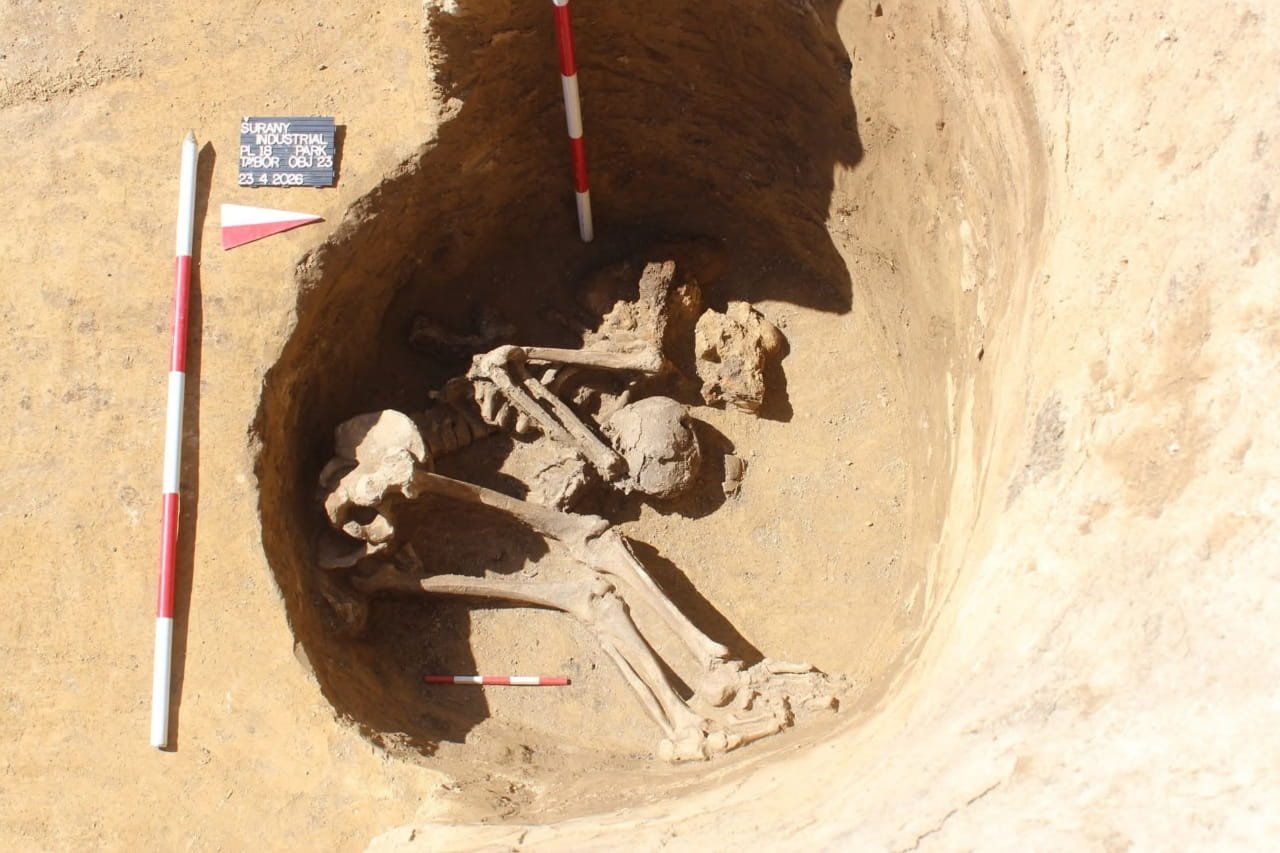
The excavation also produced a large number of human remains. Complete skeletons and isolated bones were recovered from defensive ditches, storage pits, wells, and shallow graves. Early evidence points to many of the dead being Roman soldiers.
Military equipment found with the remains includes spearheads, arrowheads, fragments of helmets, pieces of segmented and scale armor, legionary brooches, coins, and iron hobnails from Roman military sandals known as caligae. Researchers also recovered everyday items such as an axe, a cutting tool, and a gaming die.
Many questions still surround the site. Researchers hope laboratory studies will reveal who the dead were, how they died, and why many bodies ended up in pits or wells instead of formal graves. They also want to learn whether disease played a role and why valuable military equipment remained where the soldiers fell instead of being removed after the fighting.
The scale of the excavation gave researchers a rare chance to investigate almost the entire military camp. Large Roman camps are often only partly excavated because modern buildings, roads, or separate land ownership limit access. At Šurany, archaeologists have been able to document the camp in far greater detail than is usually possible.
Many of the finds are now being conserved in specialized laboratories. Some artifacts have already been X-rayed while still inside blocks of soil, allowing researchers to examine fragile objects before removing them. The preserved remains of Roman footwear have proven especially valuable, even allowing experts to estimate the shoe sizes of individual soldiers.
The project will continue for years as specialists from several countries study the material. Radiocarbon dating is taking place in Poland, while researchers in Austria, Germany, the Czech Republic, South Africa, and other countries will carry out genetic, isotope, and soil analyses.
The Roman camp is only one part of a much larger archaeological landscape. Excavations have also uncovered a large Bronze Age settlement, an early medieval village dating to the seventh and eighth centuries, an Avar cemetery, and another burial ground used from the Bronze Age through the Celtic period, the Early Middle Ages, and into the 10th century. Together, these finds provide a record of more than 3,000 years of human activity in the Nitra region.
More information: MH Invest