

Despite decades of dire scientific warnings to curb global warming gases, we are now facing apocalyptic meteorological changes threatening life on Earth. The proof is all around us. A “meteorological Armageddon” was a hypothetical 2050 scenario popularized by a mock TV forecast. It was chillingly exceeded during record-smashing global warming including blistering heat waves in late June and July. The sudden acceleration of hot planetary climate is driving increasing deaths and disasters in excess of traditional, cautious modeling.
Early in my 57-year environmental advocacy career, I learned the critical importance of establishing credibility with sound science, not resorting to hyperbole and misguided “the sky is falling” tactics. It was essential that science guide my activism.
In the case of global warming, it is hard to overstate the urgency. In a 2022 U.N. report, reviewed and agreed upon by 195 countries, more than 200 scientists demanded immediate action or the Earth would become uninhabitable. They predicted low-lying cities would be permanently flooded, and “unprecedented heat waves, terrifying storms, widespread water shortages and the extinction of a million species of plants and animals.” They warned that record-high harmful carbon emissions put the world on a fast track to disaster.
The 2015 Paris Climate Agreement set two primary goals to prevent disasters: (1) the world’s nations must strive to limit increases in global temperatures to 1.5 degrees Celsius above pre‑industrial levels, an ambitious target that would significantly reduce risks; and (2) keep increases well below 2 C, which was considered the maximum increase to avoid the most severe climate impacts.
To keep temperatures below 1.5 C, global greenhouse gas (GHG) emissions must peak before 2025 and decline by 43% by 2030 relative to 2019 levels. To permanently achieve this, global GHG emissions must reach net-zero around 2050, requiring deep, rapid cuts with nations developing policies to achieve these goals.
Unfortunately, global temperatures exceeded 1.5 C several times over the last 5 years. This did not violate the Paris Agreement’s goal, which was for a 20- to 30-year span. Current emission trajectories suggest a breach may occur in February 2029. Worse, many studies predict reaching the 2 C increase by 2037 if emissions remain close to current levels.
In 2025, global temperature averaged 1.47 C above pre-industrial levels, continuing an extraordinary streak of the last 11 years becoming the 11 warmest on record, and ocean heating continued unabated.
The alarming effects of global warming are upon us, as documented by the Lancet medical journal’s 2025 report, Countdown on Health and Climate Change. Produced in collaboration with the World Health Organization, the report documents more than a million lives lost annually from global warming. Extreme heat was the major cause, with infants and older adults facing 20 heat wave days per year — a nearly fourfold increase since 2001, with 84% of heat wave days attributed to global warming.
The rate of heat-related deaths surged 23% to 546,000 a year. Biological aging research indicates that repeated exposure to heat waves can accelerate cellular aging and impact chronic health conditions. Other species are also threatened.
Droughts and heat waves pushed an additional 124 million people into moderate to severe food insecurity, leading to many more deaths. Wildfires, fueled by warming weather and drought, are increasing and growing in size. A record-high 154,000 estimated deaths occurred from wildfire smoke-derived small particulate matter air pollution.
Global warming is a major factor in increasing transmission of vector-borne diseases, including from mosquitoes and ticks. Rising temperatures directly accelerate their life cycles, increase biting rates and shorten incubation periods of viruses within them. The Lancet report found that potential global dengue transmission rose by up to 49% since the 1950s. A record 12,000 dengue-related deaths were reported in 2024.
 An aedes mosquito, primary carrier of dengue, Zika, chikungunya, and yellow fever. Rising temperatures are expanding their population and geographic range in the U.S. as well as their diseases. (CDC)
Warmer temperatures have led to increasing transmissions of Lyme disease, malaria, Zika virus and West Nile virus. Water-borne diseases are increasing from higher water temperatures and increased flooding, spiking increases in cholera, gastroenteritis, typhoid and cryptosporidiosis, as well as flesh-eating diseases in the Chesapeake Bay and elsewhere.
Extreme heat, prolonged pollen seasons and smoke from climate-fueled wildfires worsen asthma and COPD. The Lancet report found that air pollution from the burning of fossil fuels was attributable to 2.5 million deaths globally each year.
The prestigious Lancet used 128 experts from 71 collaborating institutions in over 50 countries to produce its report. It found that excessive heat exposure cost $640 billion in lost labor hours, equivalent to $1.09 trillion in productivity. Older adults’ heat-related deaths cost $261 billion. The report concluded that failure to curb GHG emissions is increasing human deaths and affecting livelihoods
Western European countries reported more than 10,000 excess deaths during the record-breaking heat wave that engulfed the continent in late June. The vast majority — more than 9,000 — were aged 65 and above. Extreme heat can kill by causing heat stroke or aggravating cardiovascular and respiratory diseases. Scientists concluded that the late-June heat wave would have been “virtually impossible” without human-caused climate change, which is making heat waves more frequent and intense.
In the U.S., exposure to climate-driven heat is extensive. Nearly two-thirds of Americans live in counties experiencing a dramatic rise in extreme heat days compared with historical baselines. In 2024, the average person was exposed to 16 days of dangerous heat that would not have occurred without climate change, with infants and older adults facing over 20 heat wave days per person — a fourfold increase over 20 years.
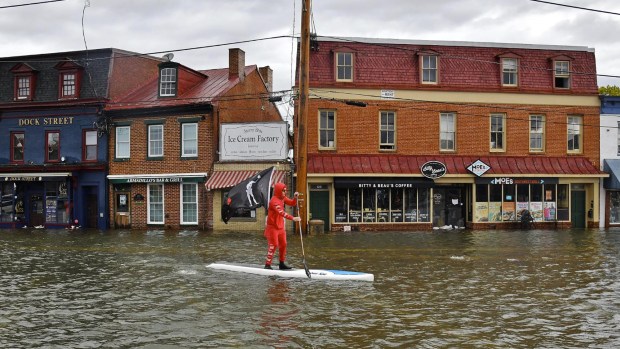 A paddle on a flooded downtown Annapolis. The City is spending $87 million on the City Dock Resiliency Project, the largest infrastructure project in the city’s history, to combat flooding which has greatly increased in frequency and depth from sea level rise linked to global warming. (The Capital/File)
At least 44 deaths occurred as a result of the July 1 to July 4 heat wave, but it will be weeks or months before all deaths are known. Just last Friday, a record heat wave enveloped us, with forest fire smoke triggering a Code Purple, the most dangerous air quality alert, sending people to the emergency room and raising the risk for 100 million people. Even an MLB game in Cleveland was postponed. The death toll is still being tallied from record temperatures exceeding 100.
As this tragedy unfolds, President Donald Trump went before the U.N. calling global warming a “con job” and urged more fossil fuel burning. He insanely pushed for more coal burning and forced aging, inefficient, older coal-burning plants to stay open with $800 million in subsidies. He blocked clean wind energy.
U.S. greenhouse gas emissions rose in 2025 by 2.4%, reversing two years of declines and reaching record levels. This deadly increase was driven by a 13% surge in coal-fired power generation. The Lancet report noted that there were an estimated 160,000 premature deaths avoided every year globally between 2010 and 2022 from reduced coal-derived outdoor air pollution alone.
Global GHG emissions also rose by 1.1% and set a record. The U.S. accounted for 36% of that increase. U.S. per capita GHG emissions in 2025 were more than 15 tons, placing it among the highest per-person emitters in the world at roughly three times the global average and significantly higher than most other major economies. Putting this consumption succinctly, we are energy hogs.
Besides greenhouse gases, sulfur dioxide spiked by 18% from power plants and nitrogen oxide by 7%. Coal-burning mercury emissions also increased. The latter two pollutants present serious problems for Chesapeake Bay.
Unless we come to our senses, worsening catastrophic global warming-driven meteorological events are in our future.
Gerald Winegrad represented the greater Annapolis area as a Democrat in the Maryland House of Delegates and Senate for 16 years. Contact him at gwwabc@comcast.net.