
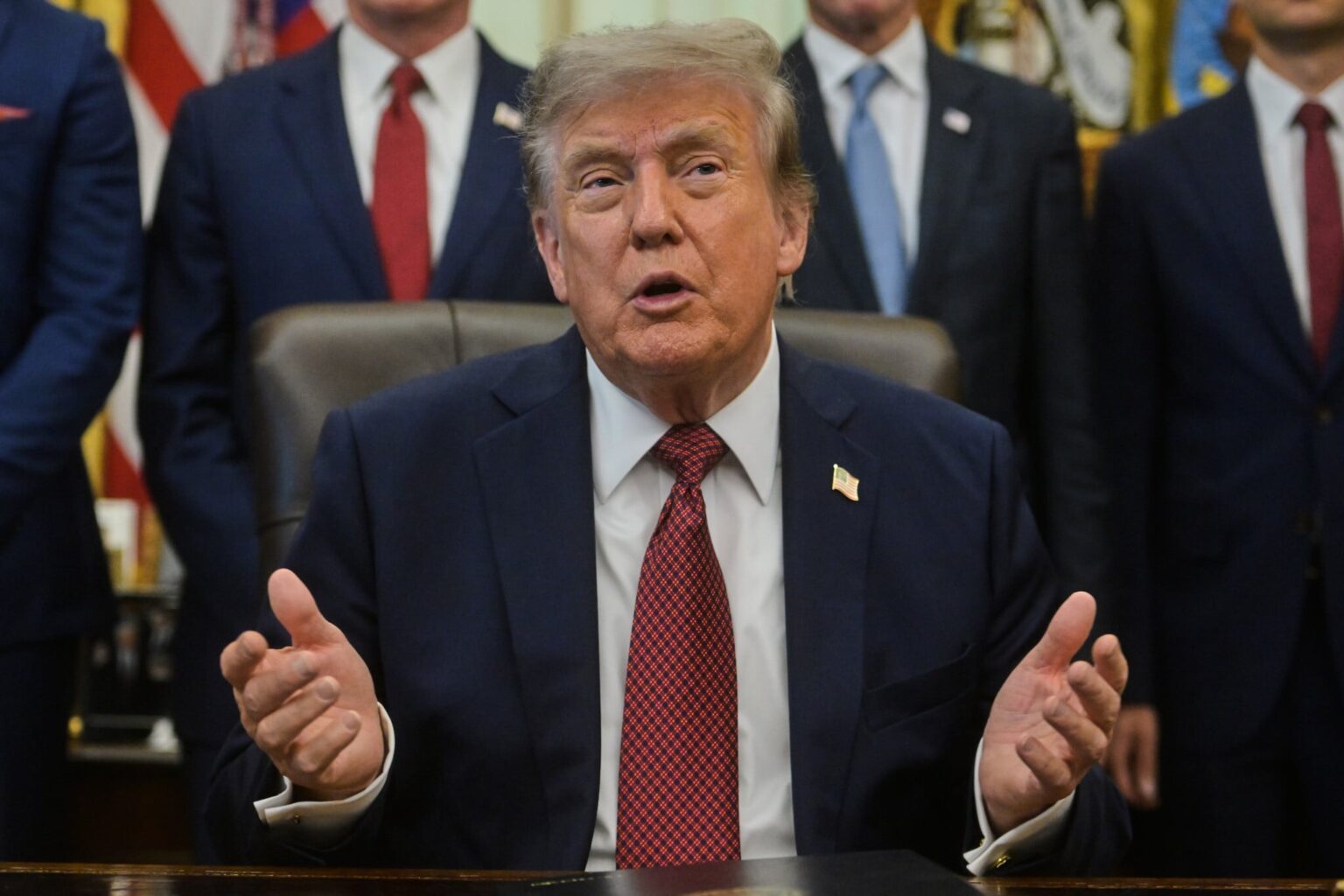
US President Donald Trump said Friday that he had not decided on whether to launch major strikes on Iran yet, as Tehran was now getting “serious” in talks with Washington.
His comments came after reports that an increasingly frustrated Trump was meeting senior advisors to discuss launching a large-scale military operation against Iran.
“No I haven’t,” Trump told journalists in the Oval Office when asked if he had made a decision. “Look, we’re talking to them right now. I think they’re getting more and more serious as the days go by, for maybe the obvious reason.”
Trump said Iran had a choice between making a deal or facing a “much higher level” of strikes, after nearly two weeks of US attacks and Iranian strikes across the region that have left a ceasefire in tatters.
The United States says it is carrying out the strikes to stop Iran closing the crucial Strait of Hormuz. Iran has carried out attacks on US bases that have killed four service members.
“We’re locked and loaded and ready to go. But we’re talking to them, so I think while we’re talking, we’ll see what comes of it. I believe… they’re very serious. They should be,” Trump said.
The war that Trump once predicted would last four or five weeks is now nearing its fifth month, and is weighing on the Republican’s approval ratings ahead of crucial midterm elections in November.

This screen grab made on July 24, 2026, from handout footage released by the US Central Command on July 23, 2026, shows what it says is a precision strike by US forces against Iranian military capabilities. (CENTCOM/AFP)
‘Massive attack’
The New York Times reported earlier that Trump had met advisors on Friday to discuss whether to escalate the conflict, while the Axios news outlet quoted the US leader as saying on Thursday that he was considering a “massive attack” on Iran.
Two Iranian officials cited by The New York Times Thursday warned that the next stage of the escalation in fighting between Washington and Tehran would include Iran striking Tel Aviv.
Trump separately doubled down on comments in an earlier social media post in which he said he believed that Russia and China were not arming Iran, despite reports that both countries were giving Tehran intelligence to target US forces.
“I mean, I will tell you that President Xi said he will not partake, and President Putin said the same thing. I think you know I trust them,” Trump told reporters. “I don’t think they’d want to have me disappointed.”
Earlier in a post on his Truth Social platform, Trump had warned Moscow and Beijing not to sell weapons to Iran.
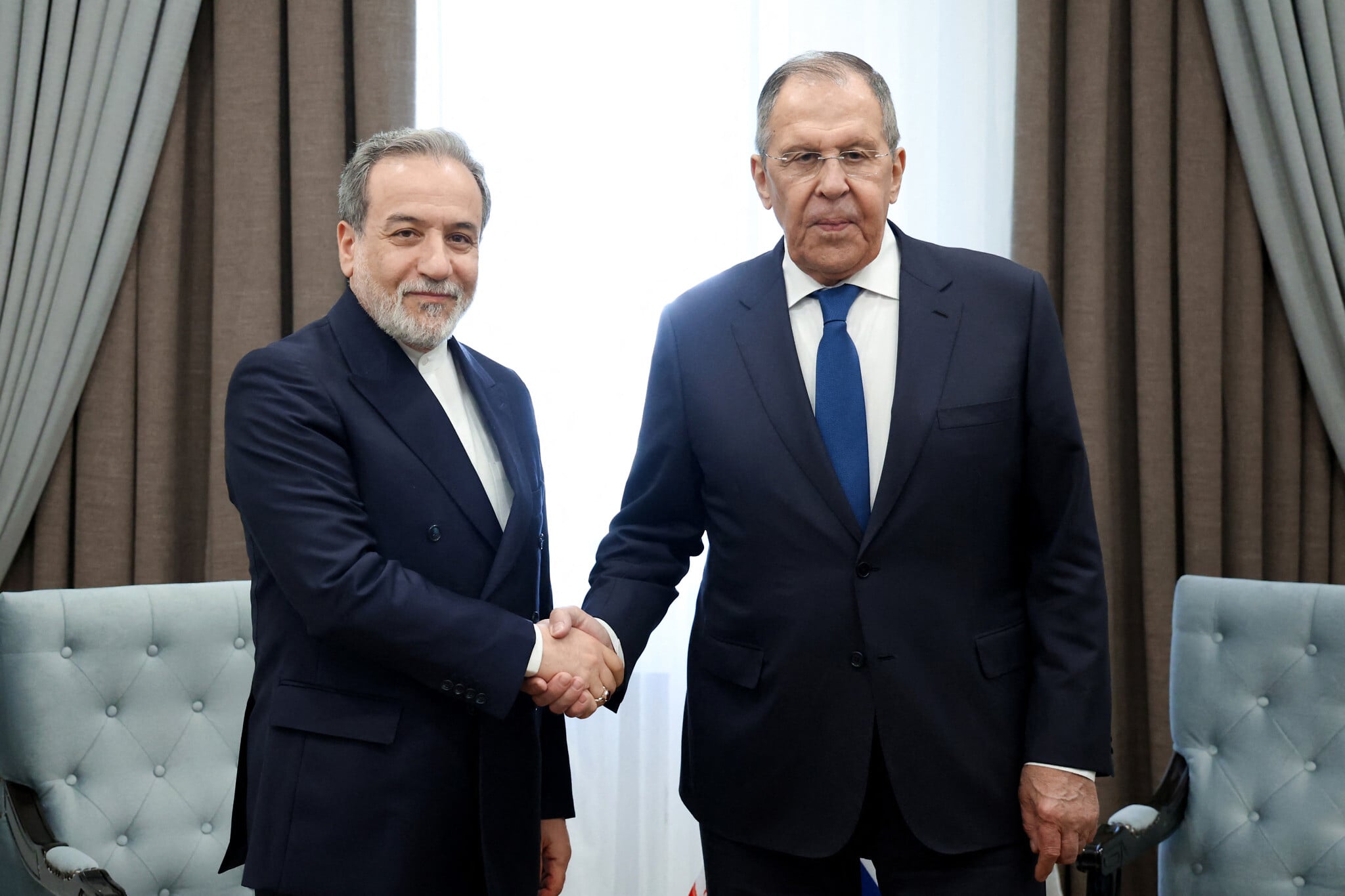
In this handout photograph taken and released by the Russian Foreign Ministry on July 24, 2026, Russia’s Foreign Minister Sergei Lavrov (R) shakes hands with Iran’s Foreign Minister Abbas Araghchi prior to their talks on the sidelines of the Meeting of the Council of Ministers of Foreign Affairs of the SCO Member States in Cholpon-Ata, northeastern Kyrgyzstan. (Handout/RUSSIAN FOREIGN MINISTRY/AFP)
“If they did, it would be very bad for them — certainly not in their best interests,” he wrote.
US missiles struck targets across Iran on Friday, and Iranian armed forces responded by firing at US bases in neighboring Arab countries and warning people there that they could strike non-military buildings used by US personnel.
Saudi-led coalition hits Houthis
The entrance to the Persian Gulf has so far been the focus of a war that has killed thousands in almost five months, stoked global inflation and fanned fears of an economic downturn.
The Houthis, who control northern and western Yemen, have announced a naval blockade on Saudi Arabia, which has diverted millions of barrels of oil each day by pipeline to the Red Sea to skirt Iran’s near-total blockade of the Strait of Hormuz.
After the Houthis said they had struck two Saudi tankers on Thursday, Trump said he would hold Iran accountable for any further attacks by the fighters.
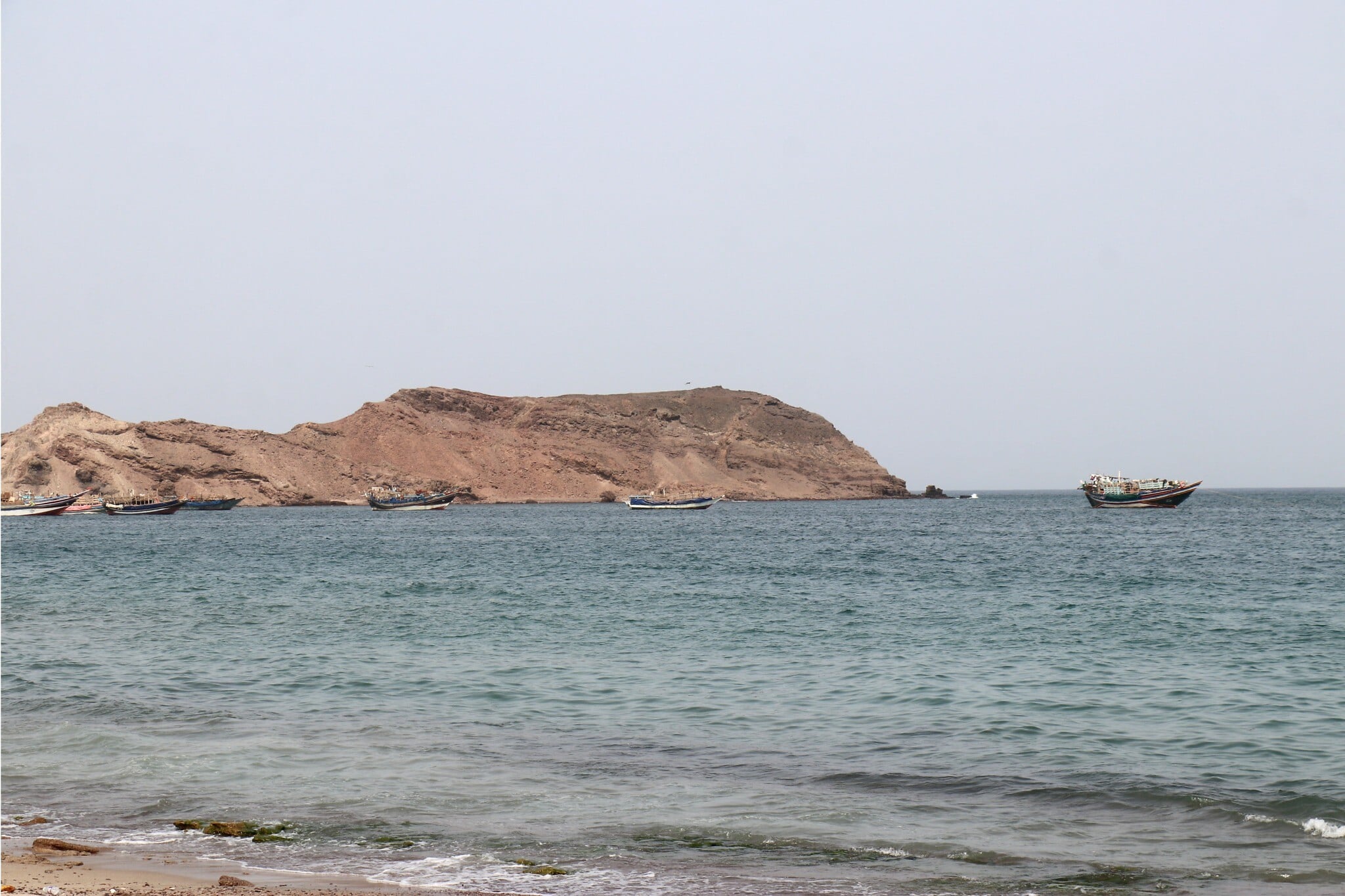
A photo taken from the Yemeni coast southwest of the city of Taiz, shows boats floating at Bab al-Mandab Strait, in the Red Sea, on July 24, 2026. (Khaled ZIAD/AFP)
On Friday, several strikes hit Yemen’s Hodeidah port, eyewitnesses said. The Saudi-led coalition in Yemen said it carried out a “proportionate military response operation” that targeted Houthi military sites in Hodeidah governorate.
Iran threatens US forces
The US military launched air strikes on Iran late on Thursday and early on Friday, for a 13th consecutive night of attacks, prompting Iran to fire at neighboring Arab countries that host US bases.
US missiles struck a Revolutionary Guards Navy headquarters in the Ziba Kenar area of the Caspian Sea province of Gilan, according to a security official in Gilan quoted by Iranian media. Provincial authorities said US projectiles had also struck the port city of Bandar Anzali, according to the ILNA news agency.
Four people were killed and five injured in a US attack on the Iranian city of Ahvaz, the state broadcaster IRIB said.
In a statement carried by Iran’s Fars news agency, the Revolutionary Guards warned the populations of Gulf countries of potential strikes against US military personnel who may be using “buildings in cities as locations to direct their crimes.”
In a statement on X, the Iranian health ministry said 59 people had been killed and 666 wounded since the resumption of clashes with US forces in late June. It does not differentiate between military personnel and civilians.
Iranian media cited the head of Iran’s top joint military command as saying Iran would kill a member of the US forces for every Iranian killed.
The war has killed 18 US service members. The Pentagon said on Monday that 100 service members had been injured since July 7 and 96% have returned to duty. Officials have told Reuters that more than 500 US troops have been injured so far.
Pakistan seeks renewed talks
The attack on the Saudi tankers on Thursday in the Red Sea’s Bab el-Mandeb Strait boosted oil prices 7% to top $100 per barrel for the first time since May.
However, by around 1600 GMT on Friday, Brent futures were down more than $4 to a little over $96.

Traders work on the floor of the New York Stock Exchange (NYSE) on July 23, 2026 in New York City. (Spencer Platt/Getty Images/AFP)
Sources said Pakistan was exploring a path towards a resumption of stalled talks between the US and Iran over ending the war, following a push initiated by China.
Exploratory discussions took place during a visit by Iran’s Interior Minister Eskandar Momeni to Islamabad this week — his second within the last 10 days, three Pakistani sources said.
Tankers rerouting, shipping insurance rises
The Houthi attacks forced several other tankers to turn around and head north through the Suez Canal, potentially using a much longer route to reach Asia by sailing around Africa.
Shipping insurance costs through the southern Red Sea doubled for some companies on Thursday, sources said.
Still, half of the 18 ships exiting Bab el-Mandeb on Thursday were carrying crude oil, including two Chinese supertankers. The number of tankers crossing through the Strait of Hormuz fell to just one on Thursday, the lowest since May 7.
A Houthi spokesman said Friday that the Iran-backed terror group was not blocking traffic through the Bab al-Mandeb Strait into the Red Sea, adding that the group’s position was “limited to a maritime blockade that only affects the Saudi side.”
The US and UK were planning a high-level conference that will bring together European and Middle Eastern senior officials to discuss protecting shipping in the Strait of Hormuz, according to Axios.
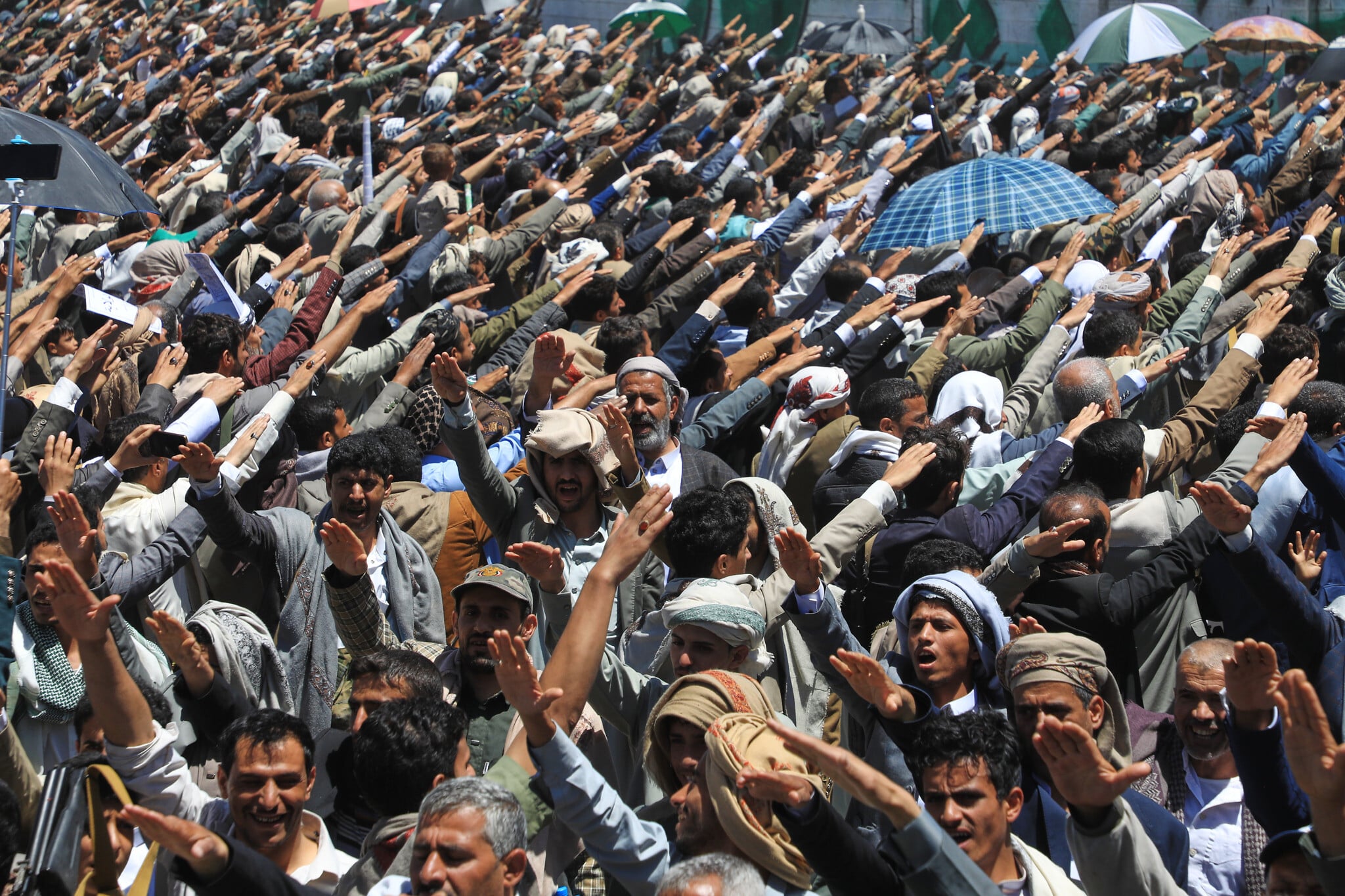
Houthis chant religious slogans as they celebrate Eid al-Ghadir, the day on which they believe Islam was completed as a religion by the appointment of Ali as Prophet Muhammad’s successor, in Sanaa, Yemen, June 4, 2026. (AP/Osamah Abdulrahman)
The conference, to take place next week, has not been scheduled. But it is meant to include defense ministers and military chiefs from participating countries.
US Defense Secretary Pete Hegseth and military chief Dan Caine are slated to attend, according to the report.
US warns citizens in Mideast
The Iranian army said it had attacked US military equipment depots at Al-Adiri, officially named Camp Buehring, in northern Kuwait, and the positions of US troops at Camp Arifjan and at Camp Doha, near Kuwait City.
In the early evening, Kuwait said its air defenses were intercepting “hostile” targets launched from Iran.
Iran’s Revolutionary Guards said they had significantly damaged a surveillance tower used by the US Fifth Fleet in Bahrain.
They also said they had attacked a US barracks and fighter jets in Jordan, and a US barracks and spy balloon as well as Patriot air defenses in Erbil in Iraq’s Kurdish region, according to the semi-official Tasnim news agency.
Jordan’s army said it had downed seven Iranian missiles and six drones, state TV reported, and that the attack had caused no material damage or casualties.
Several blasts sounded near Erbil airport, which hosts US-led coalition troops, an AFP journalist said. Explosions were heard after air defenses were activated, according to the journalist, who also saw drones hovering over the city and smoke rising in the airport area.
The US embassy in Baghdad said US citizens in the Middle East should exercise caution and remain on heightened alert.