
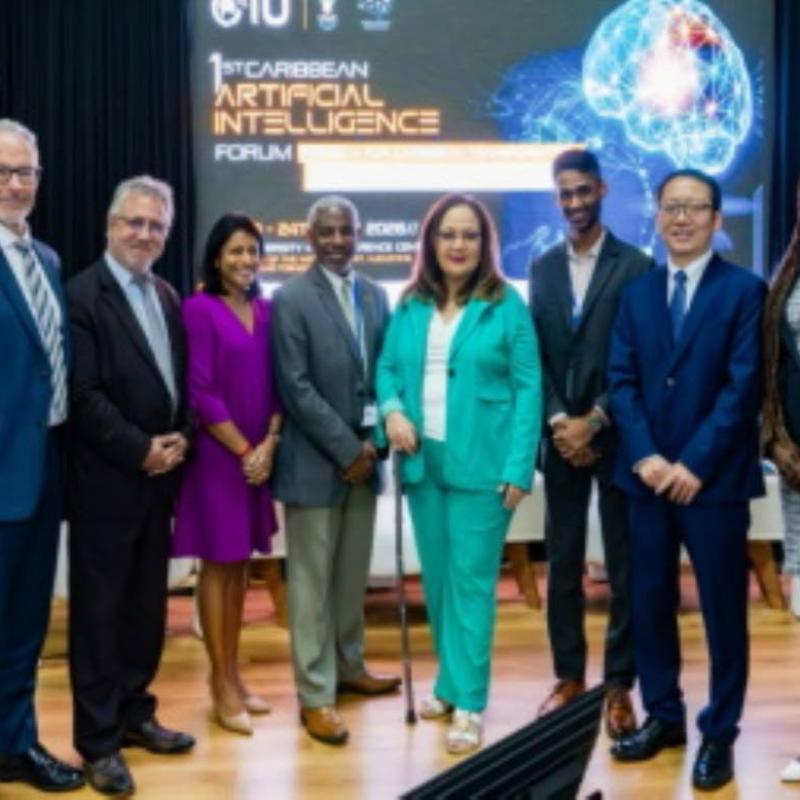
PORT OF SPAIN, Trinidad, CMC – The Trinidad-based Caribbean Telecommunications Union (CTU) is underscoring the need for a structured regional framework to guide the responsible development and implementation of artificial intelligence (AI).
“AI must be harnessed to reduce our vulnerabilities and amplify our strengths. That requires a forum that sets the pace and the structure for action: standards that fit our scale, governance that protects our citizens, capacity development pathways that keep talent in the region, and financing models that help make pilot projects sustainable and scalable,” Nigel Cassimire, the CTU’s Deputy Secretary-General, told the two-day first Caribbean Artificial Intelligence Forum (CAIF) 2026.
He told the forum, being held under the theme ‘AI for Caribbean Transformation: Governance, Innovation and Resilience for a Shared Digital Future’ in Trinidad and Tobago, that there is a need for a structured regional framework to guide the responsible development and implementation of AI.
The founding member of World Digital Governance (WDG), Graeme Thomson, called for bold regional cooperation to strengthen digital transformation, build shared capabilities and amplify the Caribbean’s voice in global digital governance.
“The future belongs to those who think boldly and organise intelligently and together. Sovereignty and cooperation are not opposites. The coming of artificial intelligence and digital transformation are challenges too big for us to tackle alone,” Thomson said.
“Only together can we educate a regional workforce, can we build interoperable digital services and the infrastructure underpinning them. And only together can we shape international conversations to our interests. This is not surrendering sovereignty. It is exercising sovereignty intelligently.”
The forum, which ends on Friday, has been organised by the CTU in partnership with The University of the West Indies (UWI) St Augustine Campus and the Artificial Intelligence Innovation Centre (AIIC).
The organisers said it is expected to generate actionable recommendations to support policy harmonisation, foster innovation, strengthen regional capacity and position the Caribbean as a leader in the responsible and inclusive development of artificial intelligence.
The forum has brought together regional and international leaders, policymakers, academics, innovators, development agencies, youth representatives and private-sector stakeholders to advance the responsible development and adoption of artificial intelligence across the Caribbean.
A key feature of the forum has been the launch of the Caribbean AI Task Force Report (CAITF), which outlines recommendations to guide regional AI policy and implementation.
Principal of the UWI St Augustine Campus, Professor Rose-Marie Belle Antoine, reaffirmed the tertiary institution’s commitment to advancing innovation and scholarship in support of the region’s digital future.
“As a regional university, we have always been committed to advancing knowledge in service of society. Indeed, some of you may not be aware, but our campus has a proud and longstanding history of leadership in AI that stretches back decades,” she said.
“Long before the global surge in interest in AI, the Faculty of Engineering hosted the Caribbean’s first AI conference in 1989, establishing a foundation for innovation and scholarship that continues to this day. A couple of years ago, I found out this well-kept secret… the tremendous AI expertise and creativity housed right here and I vowed to support its development.”
Chair of the Caribbean AI Task Force, Dr Craig Ramlal, said regional cooperation is essential to building a competitive and resilient Caribbean AI ecosystem.
“The Caribbean cannot afford to remain on the sidelines of the AI revolution. Our markets may be small individually, but together we have the scale to develop harmonised AI policies, strengthen regional innovation, protect our data sovereignty and build an AI ecosystem that reflects Caribbean priorities,” said Ramlal, who is also the executive director of the Artificial Intelligence Innovation Centre.
“The work of the Caribbean AI Task Force demonstrates that regional cooperation is not simply desirable – it is essential if the Caribbean is to compete and thrive in the global digital economy,” he added.
Follow The Gleaner on X, formerly Twitter, and Instagram @JamaicaGleaner and on Facebook @GleanerJamaica. Send us a message on WhatsApp at 1-876-499-0169 or email us at onlinefeedback@gleanerjm.com or editors@gleanerjm.com.