On July 13, more than 200 leading economists and AI researchers, including 16 Nobel laureates, signed an
open letter organised by the Stanford Digital Economy Lab. Its warning was stark: artificial intelligence may drive an economic transformation “larger than the Industrial Revolution” compressed into a fraction of the time, and that we “must act now” to build the institutions to steer it.
We agree with every word. Then we scanned the signatory list. Four in five signatories come from the United States and Canada, and the rest almost entirely from Europe. Not one name comes from China.
The letter writes about a global economic transformation, but its signatory list suggests half the AI world does not exist. China is home to roughly half of all frontier model development and has arguably the world’s fastest AI adoption. Trying to understand this transformation while excluding China is like studying the Industrial Revolution while ignoring the country with the most factories.
No one intended the omission. It reflects a two-level information gap that runs deeper than most Western observers realise.
The first level is of the AI models themselves. Western businesses are already ahead of Western discourse here. DoorDash, Siemens and Airbnb have adopted Chinese models from DeepSeek, Z.ai (Zhipu AI) and Moonshot AI alongside, and sometimes
instead of, their American counterparts.
For cost-conscious companies and governments, the sensible choice is often an open-weight model that runs cheaply on local hardware. Today, that choice is a Chinese model. With the recent release of Moonshot AI’s
Kimi K3, which matches leading US models on many benchmarks, that trend will only accelerate. Investors grasped this immediately: US chip stocks fell on the news.
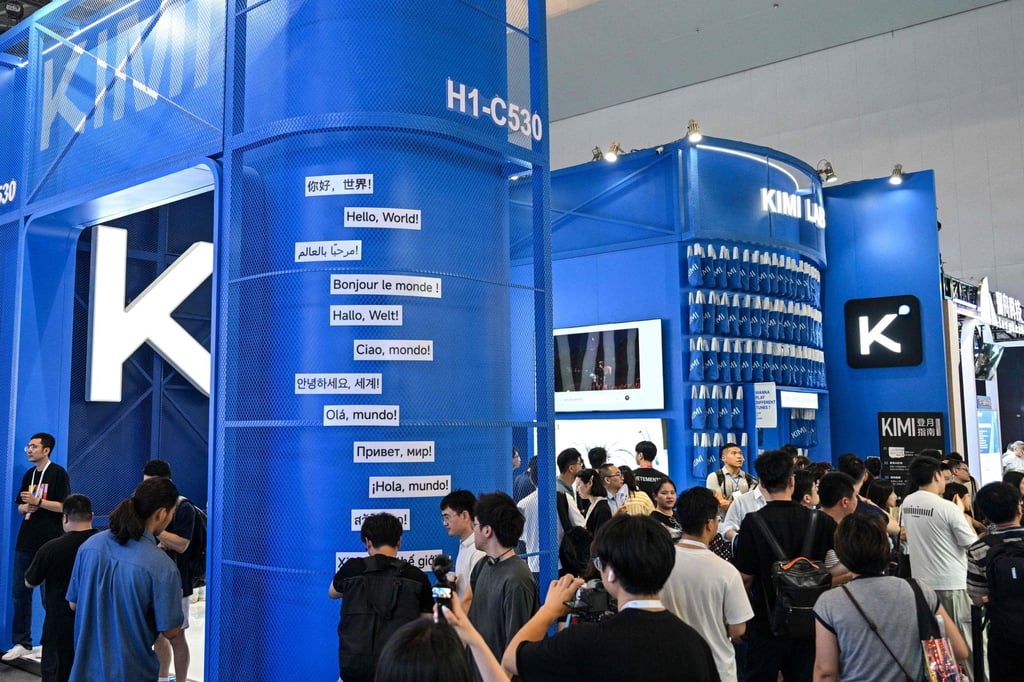
People visit the Moonshot AI stand, featuring the Kimi K3 model, a 2.8 trillion-parameter large language model that is the world’s biggest open-source AI model so far, at the World Artificial Intelligence Conference in Shanghai on July 18. Photo: AFP