US President Donald Trump’s administration has maintained that Turkey does not currently meet the criteria necessary for purchasing F-35 fighter jets from the United States.
The US State Department made the revelation in a letter it sent to Republican Rep. Wesley Bell during the past week. Bell had reached out to the White House inquiring about the matter after Trump indicated during a meeting with Turkish President Recep Tayyip Erdogan that he was inclined to back the long-stalled F-35 sale.
Turkey joined a multinational program to purchase F-35 fighter jets from the United States, but was removed from it in 2020 over its purchase of Russian S-400 air defense systems.
The S-400 purchase initiated US sanctions of Turkey under the Countering America’s Adversaries Through Sanctions Act (CAATSA). While Trump announced in his July 7 meeting with Erdogan that he would be lifting those sanctions, the State Department letter indicated that this has yet to happen.
“Our policy regarding Turkey’s purchase of F-35s remains unchanged and fully consistent with Section 231 of the CAATSA and section 1245 of the Fiscal Year 2020 National Defense Authorization Act (FY 2020 NDAA),” read the letter to Bell.
“This includes resolving the S-400 issue by Turkey no longer possessing the system or associated equipment, providing assurances against its future acquisition, and meeting the other statutory certification requirements,” the letter continued.
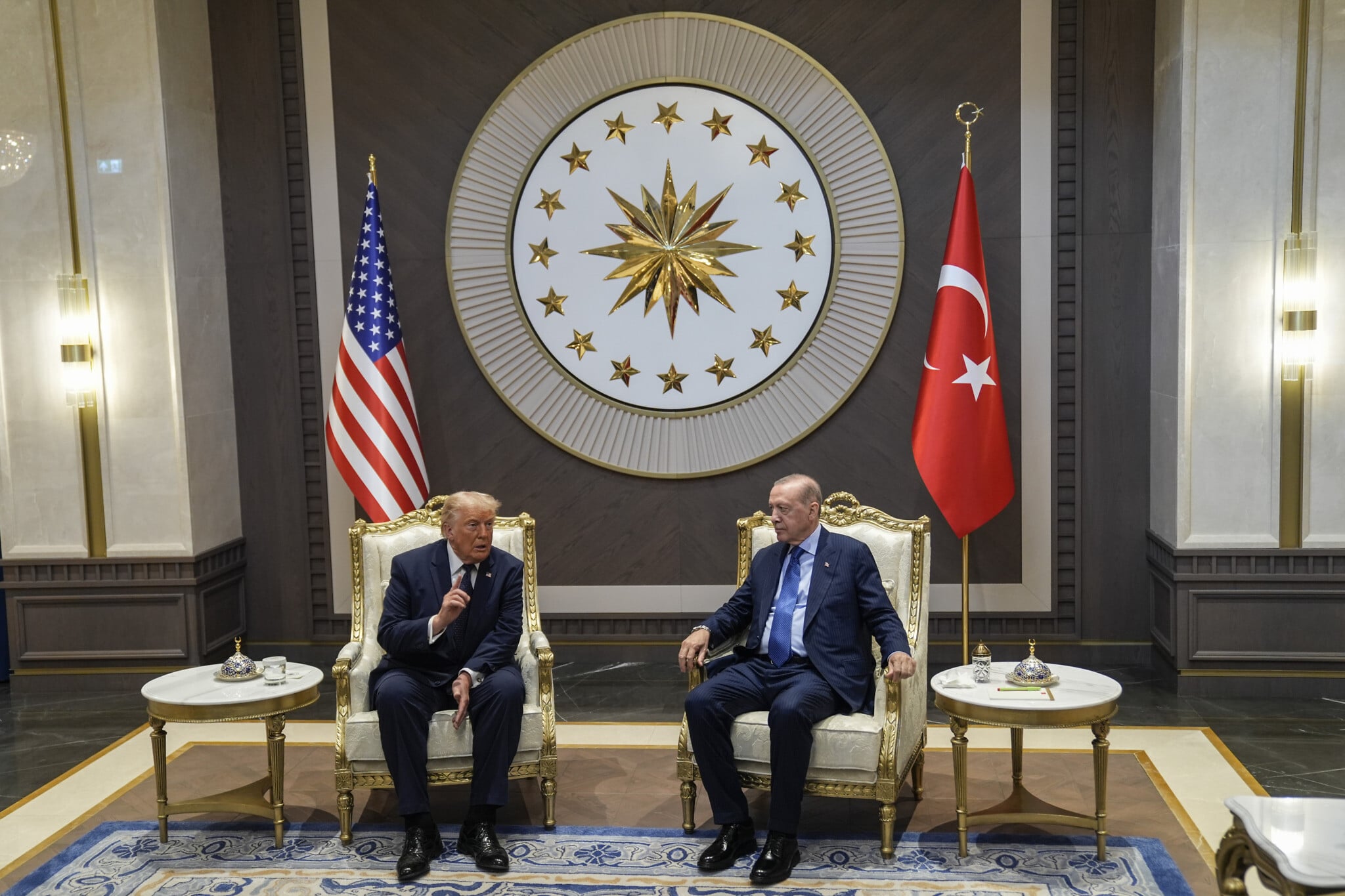
US President Donald Trump, left, meets with Turkish President Recep Tayyip Erdogan as he arrives for the NATO summit in Ankara, Turkey, July 7, 2026. (Osmancan Gürdoğan, Pool Photo via AP)
“Turkey has not yet met these conditions,” it added, while not ruling out the possibility that Ankara could later meet them.
To address US concerns, Turkey has been in talks with Washington about offloading the S-400 system.
However, the letter indicated that such a transfer has not yet taken place.
The letter appeared to be another example of Trump’s public comments not lining up with the policies being advanced by agencies within his own government.
Over the past week, US Energy Secretary Chris Wright signed a deal to establish a civil nuclear program with Saudi Arabia only for Trump to declare the next day that the already-inked agreement was actually conditioned on Riyadh joining the Abraham Accords and normalizing ties with Israel.
In its letter to Bell, the State Department went on to express concern over Turkey’s relationship with Hamas, while acknowledging that those ties had proved critical in coaxing the Palestinian terror group to accept the Gaza ceasefire deal brokered by the Trump administration last year.
The State Department also praised Turkey for becoming a founding member of Trump’s Board of Peace, which is responsible for overseeing the postwar management of Gaza.
Prime Minister Benjamin Netanyahu has said that Israel is opposed to the F-35 sale, and has said he urged Trump against the move. Turkey’s leaders have likened Israel’s conduct in Gaza to that of the Nazis during the Holocaust, and Jerusalem has also warned that selling the stealth jets to Ankara would undermine Israel’s qualitative military edge in the region, which US law commits to maintaining.
The F-35, built with stealth technology that allows it to evade enemy detection, is considered the world’s most advanced fighter jet.
Israel has operated the aircraft for over a decade, building multiple squadrons, and remains the only Middle Eastern country to possess it.
The Israel Air Force currently operates 48 of the aircraft with another 52 units on order.
Israel is anxious to preserve its qualitative military edge in the region by having the most advanced aircraft, and has previously worked to prevent the sale of the F-35 to other nearby countries, including Turkey, Saudi Arabia and the United Arab Emirates.