
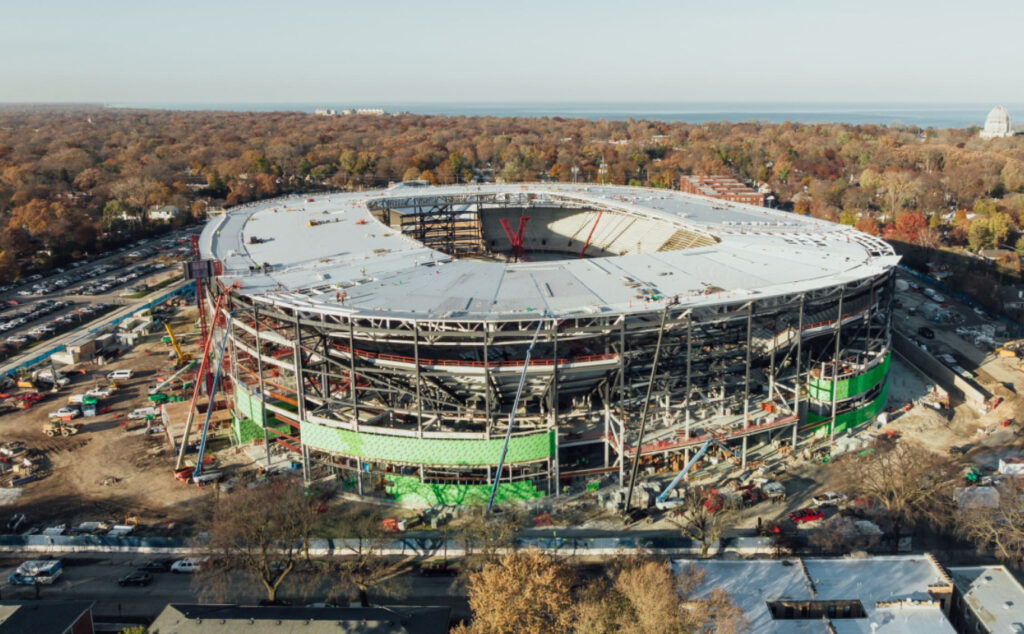
Evanston’s Environment Board, City Manager Luke Stowe and Deputy City Manager Carina Sánchez all agreed at the board’s Thursday night meeting that Northwestern University’s proposed Ryan Field sustainability plan will need some changes before going to City Council for final approval.
The plan, which Northwestern is required to submit as part of the agreement authorizing construction of the new Ryan Field, is supposed to lay out what the university is doing to make the project environmentally sustainable both during construction and when the stadium is up and running.
Board member Rachel Fleishman, who’s been acting as one of the board’s liaisons to the Ryan Field Community Advisory Council, presented a list of follow-up questions for the university at Thursday’s meeting. She said she felt that several aspects of the plan require further elaboration, and that the plan doesn’t sufficiently justify why certain sustainability measures can’t be implemented. The rest of the board generally agreed with that assessment, with members also arguing that the plan’s transportation section is under-developed. Members also wanted to see how the Ryan Field plan aligns with Northwestern’s larger sustainability plans for all university operations.
The board agreed to have Fleishman bring their questions to the advisory council, which is scheduled to meet in early August.
Sustainability during construction
Sports and live entertainment consulting firm Oak View Group is developing the sustainability plan on behalf of Northwestern and the Ryan Field Foundation.
Before Thursday’s meeting shifted to a discussion on the plan, Stowe, who was present to speak on a different matter, made it clear that the city will seek changes.
“I think there is more work they need to be doing,” he said. “I think this is just going to [take] a certain effort from us to lobby them to do more, or do better.”
Sánchez agreed.
“It’s a good thing it’s a draft concept, because there’s a lot of work that needs to be done,” she said. “[We are] pushing them to do better.”
There are also many aspects of the proposal the board did not comment on. All stadium lights will be LED, including new parking lot lights. Parking lots will have 26 electric vehicle chargers that will “support charging for 52 designated EV spaces” immediately, with the infrastructure in place to add 206 spaces further down the line. Stadium kitchens will be fully electric, as well.
One of the Environment Board’s major recurring concerns, however, was that the plan isn’t specific enough. The plan mentions that “equipment and limited materials from the previous stadium were recovered for reuse by Northwestern” without giving any additional details. It also indicates that around half of all trees and plants on the property will be either native or nativar (a cultivated native plant), and it outlines the types of trees/plants being used, but it groups native and nativar plants together.
Fleishman said she’d like to see a detailed breakdown of the two.
Another issue she raised was the report rejecting several sustainability elements without elaborating on why. The plan says on-site solar panels are not feasible, for example.
“The implementation of a 100% electric stadium was investigated by the project team and was determined not to be feasible,” the plan states, leading Fleishman to wonder how that’s possible, given that the university is building a new stadium from scratch. Additionally, the plan’s commentary that “electric hand dryers were analyzed and determined not feasible for the project to implement at this time” raised a few eyebrows.
The plan does explain why developers decided not to use greywater digester systems, which collect and treat water from washing machines, bathroom sinks, showers, and kitchens for reuse. The system uses 3,500 gallons of water a day, and the bacteria that cleans up the water needs to be regularly fed.
“The bacteria that produce the enzymes used for the digesting process will die after 10 to 14 days if they are not given food to digest,” the plan says. “The system will need to be recommissioned if the building is dark (i.e. no event days) longer than 10 to 14 days. There will likely be periods between events which will extend past the 14 day limitation.”
Operations
Once the stadium is complete, the plan promises to “implement a waste collection system that supports landfill, recycling, and composting,” but composting will only be available in the back of the house during the first year of operations, and will be “rolled out front of house” starting next year. Recycling will be available universally from the start, with signs clearly telling customers what can and can’t be recycled.
When it comes to plates, cups, utensils and other service-wear, the university promises to implement reusable items “where collection, washing, storage, labor, food
safety, and event operations make it practical,” but the plan doesn’t explicitly rule out single-use plastics.
Levy, the stadium’s food and beverage provider, has a goal to reduce food waste by 50% by 2030, and the plan indicates that Levy will look for opportunities to donate unused food to local nonprofits.
As for transportation, the university researched the possibility of using electric shuttle buses, reaching out to 24 Chicago area and national operators, and found that “while there is growing interest in electric fleets, current vehicle pricing, charging infrastructure requirements, and operational limitations have made widespread adoption financially impractical for their businesses.”
Ryan Field is served by CTA bus route 201 Central/Ridge, which currently doesn’t operate on Sundays and major holidays. The agency is looking to make its bus fleet all-electric on by 2040. The stadium is located between the Central Street Metra and L stations.
The plan also mentions that “Ryan Field will be operating a bike valet service to encourage bike use for attending events.”
Board member Olin Wilson-Thomas wondered why the plan doesn’t consider installing a Divvy station, especially since the bike-sharing service is installing new stations across Evanston this summer.
Jim Cahan, the board’s other liaison to the stadium advisory council, agreed that the transportation section of the plan is lacking.
“Frankly, what is the point of a stadium if you don’t have people coming to it?” he said.
Fleishman added that she believes the issues she and other board members brought up can be addressed.
“These are open questions,” she said, “but I think they have solutions.”
Related Stories