


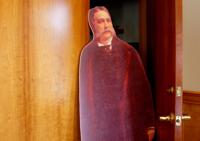
The Fairfield Town Hall has a small exhibit on Chester A. Arthur, and they keep a cardboard cutout of the former president in the closet.
VERMONT — While the United States celebrates its 250th year as a nation, Vermont technically has one more year to wait.
On a stormy night in 1777, Vermont’s founding fathers adopted their own constitution to separate themselves from the pack and protect their own.
It just goes to show — throughout the last 250 years — Vermont politics have always been a bit contrarian. From the state’s founding to the most recent presidential election, Vermont has found a political niche among its larger state brethren as a fierce proponent of rural life and small-scale control.
In this latest part of our “250 years of home” series, the Messenger examines the last 250 years through the lens of politics, by focusing on a few of the places where some of the biggest decisions affecting the state’s trajectories were made. And to show how Vermonters always tend to do things just a little bit differently.
Old Constitution House/Windsor
What do you do when you buy land from one state, just to be taxed by another moving in? For the Allen brothers, they go to war.
Much has been written about Vermont’s founding fathers, but their influence on the state’s beginning and its early nationhood is undeniable.
It all happened on a stormy night in 1777, when 72 delegates — rallied together due to widespread efforts of a one-eyed Connecticut lawyer named Thomas Chittenden — spent a few days down at Elijah West’s tavern down in Windsor.
“The delegates had been debating for days when terrifying news arrived — the British army had advanced, and the Battle of Hubbardton had just been fought,” Laura Trieschmann, the Old Constitution House’s executive director, described by email. “Panicked and eager to return home to defend their families, the delegates were on the verge of abandoning the convention without a finished document. Just as they were about to scatter, a massive, severe thunderstorm rolled into Windsor, trapping everyone inside the tavern.”
The resulting weather gave them enough time to finish the document and establish themselves as the new “Republic of Vermont,” which lasted until 1791 when Vermont finally joined the newly-created United States as its 14th member.
In many ways though, the early story of Vermont was about a group of people protecting their own.
In the years prior to the adoption of the Vermont Constitution, New York officials had been setting up a court in Westminster to act as the seat of a new county. Residents from out west, known as Yorkers, also started finding their way into southern Vermont, converging around Bennington.
The problem was many people who already lived there had secured their land grants from the New Hampshire governor. Gary Aichele lays out how the period played out in his work “Making the Vermont Constitution: 1777-1824” published by the Vermont Historical Society in 1988.
To resolve the land disputes, New York was willing to play ball with those early settlers, and there’s no doubt some farmers were willing to take the state’s deal, offering to pay taxes to keep their properties if New York could actually protect them.
Larger landowners like the Allens, however, saw the newly-imposed property taxes, known as quitrents, as likely to bankrupt them.
After years of legal battles over the issue, the first major standoff broke out in 1771 when Albany sheriff Henry Ten Eyck and the city’s mayor, Abraham Cuyler, marched 200 militia men over the Walloomsac River to push out Bennington property owners unwilling to pay the New York tax. There, they found Ethan Allen and his own local militia, the Green Mountain Boys, waiting for them. The Yorkers were soon routed.
In subsequent years, Allen turned up the pressure, leading the Green Mountain Boys to harass New York officials and create problems for the Yorker settlers, sometimes burning their properties and whipping any surveyors out of the area. One Yorker supporter, Dr. Samuel Adams, was even strapped to a chair and hoisted onto a signpole outside Stephen Fay’s Tavern in Bennington, where he sat for hours.
By 1775, New York state’s governor was trying to get the leaders tried and arrested for the chaos they caused.
The stand-off between the homegrown militia and the State of New York, however, didn’t last too long, as there were bigger problems coming home to roost. The rest of the 13 colonies — or at least a new generation of leaders concerned about British overreach — had declared themselves a new nation by 1776, thereby sparking a war with England.
It was also the same year Ethan Allen and the Green Mountain Boys eventually got their breaks with the Americans by taking Fort Ticonderoga and securing Lake Champlain to help cut off any British military aid coming out of Quebec.
Additional troops were also sent up to Montreal, which had been taken by England a decade earlier, although the American military expedition ultimately failed to gain a stronger foothold in Quebec to bring it into the fold. Simply put, the French Catholics in the northern region weren’t interested in the American ideals of revolt.
By 1777, however, the Allens and their supporters were ready to carve out their own niche. Despite having Vermont colonialists fighting on their behalf, the Americans continued to support New York’s territorial expansion.
In response, the early Vermonters decided to set up a new system of governance involving a unicameral legislature and 12-person governors council to lead the first iteration of Vermont, as a Republic. Thomas Chittenden was chosen as the nation’s first president, while Ethan Allen remained a major player in early politics.
“There is an original something in him that commands admiration,” George Washington wrote in reference to Ethan. “And his long captivity and sufferings have only served to increase, if possible, his enthusiastic zeal. He appears very desirous of rendering his services to the States, and of being employed.”
The old tavern where Vermont’s founding document was signed still stands in Windsor. These days, it’s been moved from its original location, and restoration efforts have brought the building closer to its look in 1777 after it had been heavily altered. Treishchmann said the site is currently closed, however, while it undergoes an update of its exhibits.
19th century changes
The 1800s in the United States focused largely around extraction industries while urban actors extended railroad lines to new markets, taking advantage of new industrial technologies, new financial tools and the abundance offered by the great landscapes of the western United States.
Vermont, too, continued to evolve. By the 1830s, Vermont eventually made reforms to its first Constitution to break the “Allen/Chittenden junto” which had taken root in the post-colonial age, and the state underwent a massive clearcutting to be turned into a major agricultural hub of New England. At this time, the Whigs dominated Vermont politics for roughly 20 years.

The Chester A. Arthur Historic site features a reconstruction of his boyhood home located roughly six miles from Fairfield’s town hall.
Josh Ellerbrock
The railroad industry also steadily made its inroads, eventually establishing connections between the state’s closest urban centers of New York, Boston and Montreal. As a direct result, immigrants from French Canada — including some of Irish descent — also started to move into the area in higher numbers, tempted by high-paying skilled jobs offered by major industries, like St. Albans Central Valley Railroad.
One of those immigrants, consequently, was Chester A. Arthur’s father. William Arthur emigrated to Quebec and taught school near the border before he ended up getting married to a Vermont girl, Malvina Stone.
When Chester was born in 1829, they were living in Fairfield as his father worked as a Baptist minister. The family didn’t stay long in Vermont, however, and they were living in New York by the time “Chet” had started school.
Few suspected Arthur would make it to the presidency though. And in some ways, it was a fluke of the day’s politics.
“(Arthur) was a product of the patronage system,” Joe Luneau, Saint Albans Museum president and the city’s state representative, said. “And he was the guy who signed the Pendleton Act.”
After completing his education to become a lawyer, Arthur’s political career began in New York City, where he started working closely with Roscoe Conkling, New York’s Senator and a Republican Stalwart who eventually got him a job as a tax collector with the New York City Customs House.
By 1881, the political machine which ran New York City was recommending Arthur to function as a vice president in order to represent the Stalwart faction of the Republican party in D.C, and they paired him with presidential candidate James Garfield, who eventually won the ticket and the White House.
Arthur became president not long after due to a political assassination. Just three months into Garfield’s first term, he was shot in the hip by a disgruntled man, Charles Guiteau, who had been looking for a political job. Garfield died months later.
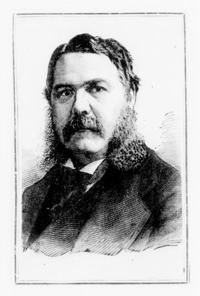
A headshot of Chester A. Arthur included with his correspondence, as catalogued by the Library of Congress.
Courtesy Library of Congress
It was during this time, however, that minds also began to change in Washington about the government’s approach to civil service. For most of the country’s first hundred years, political jobs ended up going to the victors, no matter their expertise.
Politicians from both political parties had been trying to change the practice for decades, but Garfield’s subsequent death — caused by one man who wanted such a job — and the results of the 1882 election were enough to push legislators to pass the Pendleton Act, which mandated federal jobs be awarded on the basis of merit. By the time Arthur put the new rules into effect, roughly 12% of all federal positions qualified.
Arthur ended up dying just a few years later. He declined to run for a second term, and by Nov. 18, 1886, he died due to kidney disease.
Looking back at Arthur’s political legacy, the Pendleton Act remains the most consequential aspect of his presidency, despite Arthur’s road to the White House as a “spoilsman.”
Those interested in learning more about Arthur can also check out Chester A. Arthur’s historic site in Fairfield. The building — a reconstruction of Arthur’s boyhood home — is open on weekends,
Bernie and the modern era
While Arthur climbed the ranks to the presidency, Vermont’s politics remained solidly Republican. From 1855 to 1963, Vermont voters maintained their preference for a Republican governor up until the election of Democratic governor, Phil Hoff.
The state’s politicians also stuck to the “mountain rule” up until the 1930s. If a governor candidate is from the west side of Vermont’s mountain range, then politicians were careful to nominate one from the east side in subsequent elections.
The Republican Party’s dominance, however, started to fade in the mid-20th century as more people began to take notice of Vermont.
After WWII, the national economy had largely moved past its worst extraction practices, and Vermont began to retool itself and its self-image, emboldened by movies like “White Christmas,” which featured the idyllic fictional town of Pine Tree, Vermont.
Automobiles were also changing how people came to Vermont. As cars came to prominence, the state began to see more traffic from people interested in its recreational assets, which catalyzed the growth of the modern tourism industry. On the shores of Lake Champlain, for example, camp houses began showing up en masse, and the state’s sizable ski industry began to stake out some of its most popular attractions.
By 1921, Stowe held its first winter carnival celebrating winter sports, and the Stowe Mountain Resort opened by 1937. The Boston Globe that year labeled the experience as “the best skiing in the east.”
Just a few decades later by the ‘70s, Vermont was well on its way toward being a Democratic epicenter, further spurred by the “Back-to-the-land” hippie movement.
“We found here when I moved to Montgomery that it had been abandoned in a lot of ways,” researcher Joe Sherman said. As a former reporter, Sherman covered 50 years of Franklin County politics in his book “Dirt Lane on a Fast Road.” He’s also one of the people who moved back to the state in the ‘70s.
He described the decade as a time when a lot of smart creative young people were trying to build the state up, doing things like building more playgrounds and hosting more music events. Many of those people then ran for office, or found their ways on local boards, Sherman said.
Bernie Sanders was one of them. In the ‘70s, Sanders ran for state office a few times before he tried his hand at becoming Burlington’s mayor, eventually winning the seat in 1981 in a surprise victory against a veteran politician, George Paquette.
Luneau said the election was an important one, as Franklin County voters and residents began to turn on the Democratic brand. In decades past, voters didn’t mind casting their ballots for someone like George Aiken — a blue-dog Democrat who served as Vermont’s senator for three decades. But the Democratic socialism of Sanders scared people.
“I think everyone’s scared right now,” Mark Kaplan, the Democratic state committee chair said in the days following Sanders’ win in 1981.

A file photo taken from the Messenger archives. The original print depicts Bernie Sanders at a political event in 1976.
From the Archives
Now, Sanders is Vermont’s senior senator, having taken his Burlington gig to larger political heights, even running for president in 2016.
To explain Sanders’ success, Sherman said it’s likely due to his consistency and realness. Many who’ve known him over the years say he hasn’t changed much from his early days.
“He wasn’t acting like a wealthy person,” Sherman said. “He was a Jewish guy from New York, and he stayed like that in a lot of ways. He’s not performing some kind of concept of politics. He was just who he was.”
Over time, voters across Vermont also began filling the statehouse with Democrats, erasing the former supermajorities Republicans could command prior to the ‘70s. In addition, Luneau said, Vermont changed how representation worked in 1966. Prior to a state law change, every town sent one representative to Montpelier. Now, House members are apportioned by population, which helped alter the statehouse makeup.
Today’s issues
In 2026, it’s hard to imagine what Vermont politics might look like in a decade or two, although due to changes in national politics and technology, many are expecting some major shifts in the political status quo, especially as the state moves through its demographic challenges.
Whether the shift will be large enough to re-establish Republican majorities, or change state leadership, largely depends on individual political beliefs.
Either way, Vermont will likely be there for the ride. Throughout much of its history, Vermont residents have been careful to maintain the state’s identity as outside forces have continued to change and evolve.
The next iteration is anybody’s guess.
“My concern is it’s actually going to be difficult to live here,” Sherman said, referencing the state’s affordability issues and environmental challenges. “Maybe (Franklin County) will stay like it is for a while. A lot of the farms are huge, but they’ve managed to keep them rolling.”