
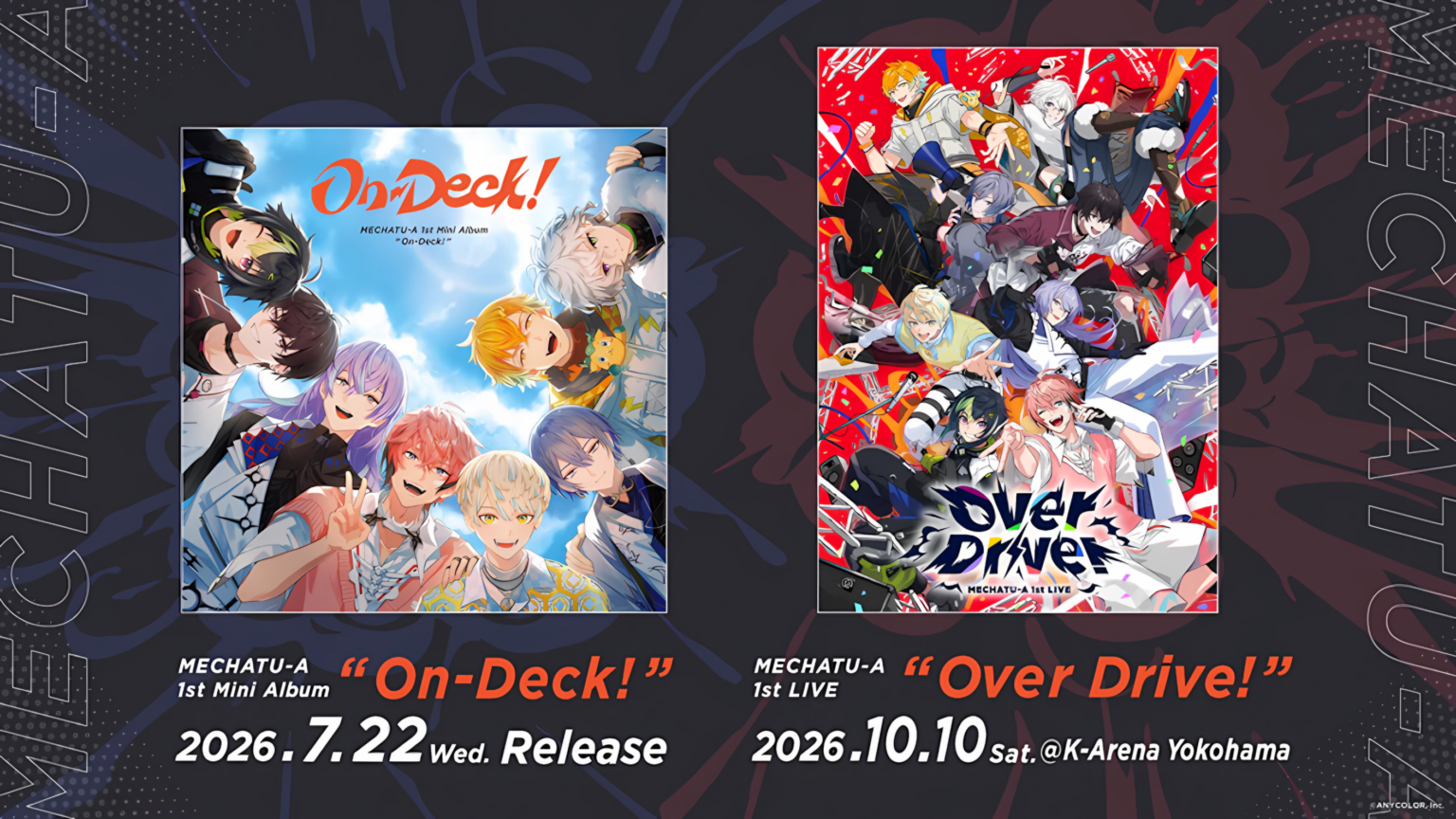
NIJISANJI’s eight-member debut unit MECHATU-A sold 326,207 copies of its first mini album On-Deck! during the July 20–26, 2026 tracking period — accumulating the entire figure across fewer than six days of availability after the album reached shelves on July 22, according to Billboard Japan’s chart data. Billboard Japan released the final count Monday, and the data will be officially published on July 29 as part of the standard weekly chart cycle. (Exchange rate as of July 27, 2026; all yen conversions are approximate.)
K-pop group aespa and Japanese act Ryugūjō finished second and third on the Billboard Japan Top Albums Sales chart for the week, at a significant distance from MECHATU-A’s opening figure.
The scale of the opening is hard to read accurately without understanding how Japan’s idol music economy operates — and why the number is both genuinely impressive and partly a product of a purchasing mechanism that has no real equivalent in the US market.
Japan’s Ticket Lottery Drives the First-Week Figure
Every edition of On-Deck! includes a serial code that enters the buyer into a lottery for priority access to tickets for MECHATU-A’s first live concert, “MECHATU-A 1st LIVE ‘Over Drive!’,” scheduled for October 10, 2026, at K-Arena Yokohama, one of the world’s largest dedicated music arenas at approximately 20,000 capacity. Purchasing multiple editions — and three distinct editions were available at launch — means purchasing multiple lottery entries, improving the buyer’s odds of securing a seat.
This is not incidental packaging. It is the same concert ticket lottery serial code model that has produced outsized opening-week sales figures for J-idol acts for more than a decade: Snow Man’s 2025 best-of compilation debuted at over 1.4 million copies in week one using the identical mechanism. The mechanism converts what would otherwise be a music purchase into a probabilistic transaction for scarce concert access, concentrating purchasing behavior into the smallest possible window around release.
A fan noted on social media within 48 hours of the release, when the mid-week tally was already at 302,951 copies: “Two days, 300,000 copies — but K-Arena’s capacity is about 20,000. This is very troubling.” The comment captures the structural tension built into the model: a fanbase large enough to generate a quarter-million purchases in a tracking window but competing for a venue that seats a fraction of that number.
Mid-week pre-release data published by Billboard Japan on July 23 showed 302,951 copies sold during just the July 20–22 portion of the tracking period — before the counting closed.
MECHATU-A and the Unit Behind the Debut
MECHATU-A is an eight-member unit operating under the NIJISANJI banner, the flagship VTuber group run by ANYCOLOR Inc., a publicly listed entertainment company on the Tokyo Stock Exchange Prime Market. The members are Ittetsu Saiki, Wen Akagi, Rito Usami, Mana Hibachi, Sho Hoshirube, Kagetsu Murakumo, Rou Koyanagi, and Rai Inami. Each operates within a fictional hero-themed character setting — archetypes running from ninja and swordsman to mechanic — and the unit divides into two internal sub-units: Oriens (Saiki, Akagi, Usami, Hibachi) and Dytica (Hoshirube, Murakumo, Koyanagi, Inami), as NIJISANJI announced in April.
On-Deck! contains seven original tracks. The lead single, “The Hearties,” was released as a digital advance track on May 1 alongside a music video, giving the unit a pre-established streaming footprint before the physical package arrived.
Three physical editions were available at retail: a First Press Limited Edition priced at ¥8,470 (approximately $52 USD), a “MECHADE-K” LP-format edition at ¥4,400 (approximately $27 USD), and a standard edition at ¥2,860 (approximately $17 USD), according to the official announcement. The First Press Limited Edition includes a bonus disc featuring solo self-cover recordings of “The Hearties” by all eight members, as well as the ticket lottery code. All editions carried lottery entry codes.
What ANYCOLOR’s Business Model Has to Do With It
The album-plus-live-event pairing is not an accident — it is ANYCOLOR’s documented strategy for monetizing new group-level IP. The company’s most recent full fiscal year (ending April 2026) generated ¥55.681 billion (approximately $340 million USD) in net sales, up 29.9% year over year, with operating profit of ¥20.172 billion (approximately $123 million USD). The company describes its revenue model as a four-track approach: live streaming, commerce (merchandise and music), events (live concerts), and promotions (brand partnerships).
Launching a new unit with a simultaneous album release and arena-level live concert booking activates at least three of those four tracks at once. The lottery-code mechanism connects the music commerce track directly to the event track, creating purchasing pressure in the earliest possible window after release.
The company stated 2.03 million registered ANYCOLOR IDs — accounts required to purchase from the official NIJISANJI store and fan club and to enter ticket lotteries — as of the end of FY2026, up 20.6% year over year.
Japan’s Physical Market Makes the Number Possible
A first-week figure of 326,207 copies for a seven-track debut mini album by an act with no prior solo album release would be essentially impossible in the US market, where physical sales represent a small fraction of music revenue and the lottery-code purchasing model does not exist. In Japan, it is structurally achievable.
Japan is the world’s second-largest recorded music market, according to the IFPI Global Music Report 2026, growing 8.9% in 2025 after a flat 2024. Physical formats — CDs and vinyl — accounted for approximately 60% of Japan’s total music revenues in 2025, making Japan the largest single contributor to global physical music sales and the market most hospitable to the kind of opening-week concentration the lottery-code model produces.
The Billboard Japan Top Albums Sales chart, which MECHATU-A topped, is a pure-transaction chart: it counts physical retail purchases and digital download purchases, compiled by Hanshin Contents Link Corporation using SoundScan Japan data, under a license from Billboard Media, LLC, a subsidiary of Penske Media Corporation. Streaming plays do not count toward this chart, meaning the 326,207 figure represents actual financial transactions, not passive listens — and that it is particularly susceptible to the lottery-code concentration effect.
K-Arena Yokohama and the Live Debut
The unit’s first concert, “MECHATU-A 1st LIVE ‘Over Drive!’,” is scheduled for October 10, 2026, at K-Arena Yokohama, which holds approximately 20,000 seated concertgoers. K-Arena Yokohama, which opened in September 2023, ranked first globally in Pollstar’s 2025 top arena tickets chart. Booking an arena at that scale for a first standalone live event represents a significant commitment — most major J-idol acts build to K-Arena-tier venues over multiple touring cycles.
Whether MECHATU-A sells out the 20,000-seat venue will be a more direct signal of audience conversion than the album sales figure, since ticket demand reflects an intent to attend a physical event rather than a lottery calculation.
Frequently Asked QuestionsWhat is MECHATU-A and why did their album sell so many copies so fast?
MECHATU-A is an eight-member VTuber unit under NIJISANJI, the virtual talent agency operated by ANYCOLOR Inc. Their debut mini album On-Deck! sold 326,207 copies during the July 20–26, 2026 tracking period — with the majority accumulated in fewer than six days of availability after its July 22 release. The sales figure reflects Japan’s unique concert ticket lottery model: every edition of the album included a serial code entering the buyer into a lottery for priority access to concert tickets, incentivizing rapid multi-copy purchases concentrated around the release date.
How does the Billboard Japan Top Albums Sales chart work, and is 326,000 copies in a week unusual?
The Billboard Japan Top Albums Sales chart counts physical retail purchases and digital download transactions, compiled by Hanshin Contents Link Corporation from SoundScan Japan data. It does not include streaming plays. Opening figures of 300,000+ copies in a single week are uncommon but not unprecedented in Japan’s idol music market — Snow Man debuted their 2025 best-of album at over 1.4 million copies using the same ticket lottery mechanism. For a VTuber unit’s debut mini album, 326,000 copies in under a week is a commercially significant result within that market structure.
What is the concert ticket lottery, and how does it explain the album sales?
Japanese idol acts routinely bundle concert ticket lottery entry codes with physical album editions. Buying more copies means more lottery entries and a higher statistical chance of securing a seat to the live event. MECHATU-A’s three editions all included these codes, and the unit’s first concert — scheduled for October 10, 2026, at K-Arena Yokohama — has a capacity of approximately 20,000 seats. With hundreds of thousands of copies sold, the vast majority of buyers who purchased for the lottery will not receive tickets. This mechanism drives concentrated early purchasing but means the album sales figure should not be read as equivalent to a traditional measure of music demand.
What is VTuber music and how has it scaled commercially in Japan?
VTubers are online performers who use animated virtual avatars — typically powered by real-time motion capture — in place of direct camera appearances. Major agencies like NIJISANJI and its competitor Hololive (operated by COVER Corp.) have extended their operations into music releases, live concerts, and merchandise over the past several years. ANYCOLOR, NIJISANJI’s parent company, reported ¥55.681 billion (approximately $340 million USD) in full fiscal year 2026 revenues, with events and commerce — including album sales and live concerts — among its primary revenue streams. MECHATU-A’s chart debut reflects that expansion reaching mainstream commercial chart scale within Japan’s physical music market.