
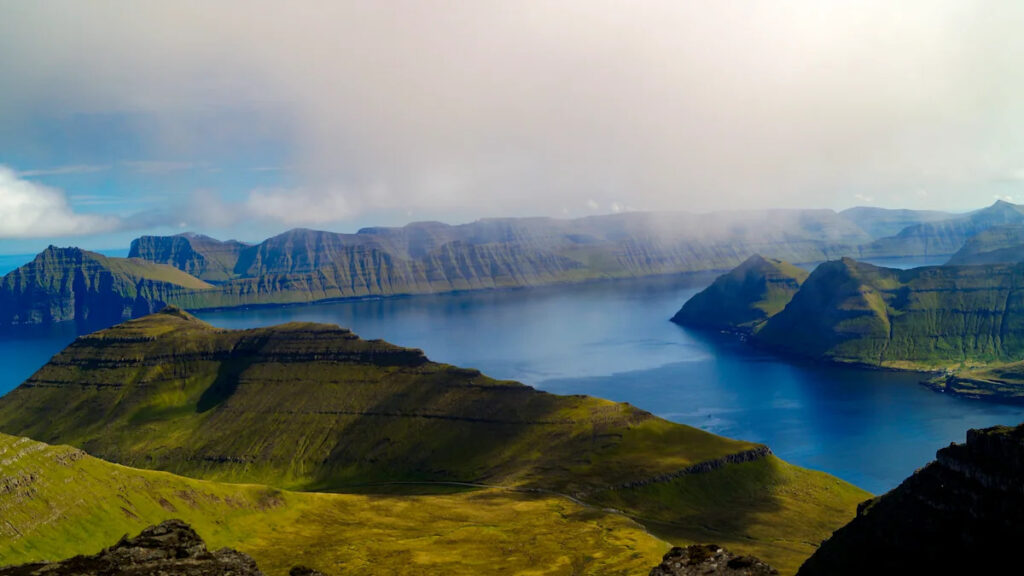
The road looked like it was heading right into the ocean, with dark mountains on either side, waterfalls spilling from cliffs, and clouds so low over the green peaks they seemed almost touchable. Just as I wondered where it would lead, a small village appeared beneath the mountains. The dark wooden houses had thick grass roofs, and the harbor blended so well with the landscape that it felt like it had always been there.
I was in the Faroe Islands, a group of 18 islands in the North Atlantic between Iceland, Norway, and Scotland. I found the dramatic scenery, unpredictable weather, and plenty of sheep right away. But soon, those things stopped feeling like the main reason to visit.
Having visited over 115 countries, it’s rare for a place to truly surprise me, but the Faroe Islands did, time after time. It wasn’t about seeing famous spots from social media. Instead, the islands kept revealing new layers I never expected from photos of waterfalls and cliffs.
Beyond the scenery, I found ambitious restaurants, contemporary art, independent fashion, local beer, a lively music scene, and hotels that made the changing weather part of the experience. Tórshavn, one of the world’s smallest capitals, felt more modern, social, and confident than I expected. The quieter islands introduced me to crafts, traditions, and ways of life still deeply connected to the land.
What struck me most was not just the beauty of the Faroes, but how complete they felt as a destination. Nature, food, architecture, design, history, and daily life all seemed connected, each helping to explain the others. Almost everything started with the same mix of ocean, weather, and isolation.
The scenery was only the beginning

A guided coastal hike with Guide to Faroe reveals the dramatic beauty of the Faroe Islands, where mist, sea cliffs, and ever-changing weather create unforgettable scenery. Even on a foggy day, the islands’ rugged landscapes offer a breathtaking experience that showcases why unpredictable weather is part of the destination’s charm.
(Olivia Liveng)
Getting around the Faroe Islands was much easier than I expected. Roads, ferries, bridges, and tunnels—even ones that go under the sea or through mountains—connect most of the islands. You can stay in Tórshavn and explore places that look and feel completely different each day, even though they’re not far apart.
One moment I could be driving beside a busy harbor, and the next the road would disappear into an undersea tunnel before emerging into a wide valley framed by waterfalls and steep green slopes. A drive of less than an hour might cross several islands, pass beneath the Atlantic, and end in a nearly silent village where houses clustered beneath a mountain and sheep wandered freely beside the road.
The system made the islands remarkably accessible, but I quickly realized that ease of transportation did not eliminate the value of local knowledge. Weather could alter a hiking plan within minutes, some trails crossed privately managed land, and the most interesting stories behind a village, a building, or a traditional food were easy to miss when driving through alone.
I booked two experiences through Guide to Faroe Islands, and they became two of the most valuable parts of my trip because they revealed opposite sides of the destination. One introduced me to the islands through one of their most famous natural landscapes, while the other helped me understand Tórshavn through its food, architecture and how Faroese traditions continue to evolve.
A guide showed me what photographs leave out

My first Guide to Faroe Islands excursion took me toward Sørvágsvatn, also known as Leitisvatn, the lake that appears from one particular viewpoint to float improbably above the Atlantic Ocean.
I had seen the famous photograph countless times before arriving, and like most visitors, I already knew that the effect was an optical illusion created by perspective rather than a lake actually suspended high above the water. Even so, understanding the illusion did nothing to lessen the impact of seeing the landscape in person, particularly as mist moved across the hills and the cliffs appeared and disappeared with every shift in the weather.
Our guide read the conditions in a way I could not, which mattered in a place where a patch of gray sky might mean that a view would open in 10 minutes or that visibility was about to disappear entirely. The trail crossed exposed ground, and the weather seemed to move across it almost as quickly as we did.
Without someone explaining the terrain and weather, I might have walked to the viewpoint, taken the photograph I had already seen online, and moved on. Instead, the hike became less about reproducing an image and more about understanding why the landscape felt so powerful, especially when the clouds briefly lifted and revealed the lake, cliffs, and enormous stretch of Atlantic below.
The lake looked almost exactly as it does in photographs, but no image could convey how exposed the cliffs felt, how vast the ocean appeared, or how quickly the entire scene could vanish again. The experience taught me one of the most important lessons of traveling in the Faroes: the islands do not necessarily reveal themselves according to a visitor’s schedule, and patience is often more useful than a perfectly timed itinerary.
Tórshavn felt far more modern than I expected

The historic Skansin Fortress overlooks the harbor in Tórshavn, Faroe Islands. Originally built in 1580 to protect the capital from pirate attacks, the stone fort is one of the Faroe Islands’ most significant historic landmarks, offering sweeping views of the North Atlantic and the city’s waterfront.
(Olivia Liveng)
The second Guide to Faroe Islands experience, A Taste of Tórshavn, introduced me to a completely different side of the country and ultimately changed the way I understood its capital.
Coverage of the Faroe Islands often becomes an endless parade of waterfalls, turf roofs, sheep, and coastal cliffs. Those images are accurate but do little to explain how people have built lives in this environment or how the Faroese have developed such a confident contemporary culture in a place shaped by a short growing season, limited farmland, geographic isolation, and severe weather. Food begins to answer that question because Faroese cooking developed around the sea and the need to preserve what was available. Fish, shellfish, lamb, and fermented foods were not originally part of a fashionable culinary philosophy; they were practical responses to climate and geography, and the tour connected those historical necessities to what chefs, producers, and restaurateurs in Tórshavn are doing today.
As we walked, the city itself became part of the explanation. Tinganes, the historic government district beside the harbor, is made up of red wooden buildings with turf roofs, narrow lanes, and uneven stones. It looks almost too picturesque to remain functional, yet Faroese government offices still operate there, and people continue to work inside the same buildings that visitors stop to photograph.
The nearby neighborhood of Reyn felt more like a preserved village than part of a national capital, with black-tarred wooden houses, white-framed windows and grass roofs clustered along narrow paths. Yet the presence of laundry, front doors and the ordinary signs of family life prevented it from feeling frozen or staged.
That mixture of preservation and practicality became one of the qualities I liked most about Tórshavn. The city did not divide its history from its present, and the oldest parts of town were not isolated from contemporary life as attractions solely for visitors. A turf-roofed house might sit near a minimalist café, while a centuries-old lane could lead toward a modern restaurant, independent fashion store, or working office.
Walking through Tórshavn felt less like moving between a designated old town and a newer downtown than seeing several periods of the city share the same streets. The newer architecture also felt rooted in its surroundings, using glass, stone, wood, and dark tones that echoed the landscape without attempting to imitate the historic buildings.

A serving of Ræst kjøt, the Faroe Islands’ iconic fermented lamb, during a traditional food tour. Aged using centuries-old preservation methods before being cooked or boiled, this distinctive local delicacy is celebrated for its bold aroma, rich flavor, and deep connection to Faroese culinary heritage.
(Olivia Liveng)
The food tour gave those streets a deeper narrative, connecting ingredients to survival, trade, family traditions, and the gradual transformation of Faroese food from necessity into a source of culinary pride. Fermentation, drying, and preservation can sound intimidating when listed on a menu, but the techniques became far more understandable while standing beside the harbor with cold air coming off the water and mountains visible beyond the city.
These methods were not imported trends or culinary theatrics. They developed because people needed food to last through difficult conditions. Contemporary Faroese chefs have found ways to build upon that history without treating it as something untouchable.
Faroese dining experiences rival those of major cities

A creative seafood course at ROKS Restaurant in Tórshavn, Faroe Islands, where locally sourced seafood takes center stage in a modern Faroese dining experience. The inventive presentation balances contemporary technique with ingredients and flavors deeply connected to the islands’ culinary traditions.
(Olivia Liveng)
The relationship between landscape and food became especially clear at ROKS, where seafood formed the center of a modern Faroese dining experience that felt polished and inventive without becoming disconnected from its origins.
The meal demonstrated that Faroese chefs are not simply preserving traditional ingredients for historical interest. They are actively shaping what contemporary Faroese cuisine can become, using fish and shellfish from the surrounding waters while presenting them with a level of creativity I would expect in a much larger culinary capital.
The dishes did not feel interchangeable with those from another Nordic restaurant because the relationship with the sea was too present. Even when the preparation was contemporary, the meal remained grounded in fishing culture outside.
Áarstova offered a contrasting but equally important perspective. Located inside a historic wooden building in central Tórshavn, the restaurant is known for slow-cooked Faroese lamb, and the warmth of the room felt naturally connected to the food being served.
Sheep are so abundant across the islands that visitors quickly begin treating them as part of the scenery, but eating lamb at Áarstova made their broader significance impossible to overlook. Sheep have shaped Faroese food, farming, clothing and trade for generations, and the dish felt connected to that larger history rather than included as a local specialty.
The difference between ROKS and Áarstova showed what makes the city’s dining scene so interesting. One is modern and focused on seafood, while the other feels warm, historic, and centered on lamb. Neither seemed created just to impress tourists. Both are part of a food culture that respects tradition but keeps evolving.
Tórshavn’s creativity extended far beyond its restaurants

The same balance between continuity and reinvention appeared throughout the capital. At Steinprent, a working lithography studio and exhibition space near the harbor, old printing equipment and works in progress revealed a creative process that felt physical, deliberate and connected to traditional craftsmanship.
At Tutl, an independent record label and music store, shelves filled with Faroese folk, rock, electronic and experimental music demonstrated just how much cultural output has emerged from such a small population. Guðrun & Guðrun has transformed Faroese wool and hand-knitting into contemporary fashion with an international audience, while the National Gallery showed how generations of artists have interpreted the islands’ landscape without reducing it to a simple postcard.
Even OY Brewery contributed to my sense that Tórshavn was a modern and genuinely social capital. Its combination of locally brewed beer, food and music created a casual atmosphere that felt like part of everyday life rather than an experience constructed exclusively for visitors.
Tórshavn was definitely quieter than Copenhagen or New York, but it was not lifeless. Its energy felt more personal than missing. The city had enough restaurants, shops, art, and music to make evenings fun, but it was still small enough that the harbor, old town, and cultural spots were all close by.
Hotel Føroyar kept me connected to the landscape

The striking exterior of Hotel Føroyar in Tórshavn, where contemporary Nordic architecture blends seamlessly into the surrounding hillside. Designed to complement the Faroe Islands’ rugged landscape, the hotel offers one of the destination’s most scenic and peaceful stays.
(Olivia Liveng)
Hotel Føroyar did not feel like a neutral place to sleep between excursions, because its location and design made it another way of experiencing the islands.
Built into the hillside above Tórshavn, the hotel appeared to follow the shape of the land rather than compete with it. Its long, low profile and grass-covered roof nearly disappeared into the slope from certain angles, while large windows opened toward the capital, harbor and mountains.
From my room, I watched fog move across the hills, sunlight slide over the water and clouds reshape the same view several times within an hour. A mountain that had been fully visible at breakfast might disappear by the time I returned for a jacket, only to emerge again later in the afternoon.
I began looking forward to returning each day, not because I wanted to retreat from the destination, but because being at the hotel still felt like being immersed in it. Even while sitting indoors with wet shoes drying near the door, I remained connected to the weather and the landscape outside.
Inside, the hotel used stone, wood, dark colors, and big windows to create a strong sense of place without copying Faroese culture too literally. The rooms and shared spaces felt cozy enough to make a rainy afternoon enjoyable, and the views kept the hotel from ever feeling closed in.
Faroese artwork throughout the hotel also connected it to the creative culture I had seen elsewhere in Tórshavn. Rather than feeling like decorative images added to remind guests of their location, the art seemed integrated into the property’s identity.
Breakfast became part of the experience for the same reason, since I could sit with coffee while looking across the fjord and watching the capital below. The hillside location also created a useful balance, offering a sense of peace and separation while remaining close enough to central Tórshavn for dinners, museums and walks.
For travelers seeking a familiar international brand or hoping to use loyalty points, the Hilton Garden Inn Faroe Islands offers another option near the capital. Hotel Føroyar, however, was the property that defined my stay because it made the landscape part of every hour, including those when I was not actively exploring it.
Ress Spa and Saunadypp offered two versions of Faroese wellness
Ress Spa made Hotel Føroyar even more central to my experience of the islands. Before arriving, I had not associated the Faroes with polished wellness, because I imagined spending most of the trip in hiking boots and waterproof trousers, bracing against weather that could change without warning.
After several days of wind, rain and uneven trails, however, moving between warm water, sauna heat, steam and cold elements felt less like an unrelated luxury and more like a continuation of the environment outside.
Large windows and natural materials kept the fjord, hills and changing light present, which prevented the spa from feeling like a sealed world disconnected from the destination. Sitting in warm water while looking toward the same mountains I had spent the day exploring changed the way I thought about travel in the Faroes.
The islands are often advertised mainly for adventure, with lots of focus on hiking, boat trips, and dramatic views. But Ress showed that you do not have to treat the Faroe Islands as a test of endurance. You can enjoy art, long meals, architecture, and quiet afternoons to recover, all without losing the special feeling of the place. It offered a more rustic and elemental version of the same relationship between heat, cold water, and landscape. Where Ress felt polished and restorative, Saunadypp brought me directly to the edge of the North Atlantic, where the pleasure depended on working up enough courage to leave the sauna and enter the water.

Saunadypp in Glyvrar offers the Faroe Islands’ first floating sauna, combining Nordic wellness traditions with spectacular coastal scenery. Guests can warm up in the wood-fired sauna before taking an invigorating cold plunge in the calm waters of the surrounding fjord.
(Olivia Liveng)
There was nothing graceful about my own entry, which involved hesitation, complaining, and finally lowering myself into water cold enough to erase every other thought. The shock was intense but brief, and once I returned to the sauna, warmth gradually came back into my hands and feet as I looked toward the water through the window.
Saunadypp was not an escape from the Faroese weather. Instead, it made me take part in it more directly. Together, Ress and Saunadypp showed two types of wellness that fit the islands perfectly. One was refined, and the other rustic, but both were shaped by the same cold water, mountains, and unpredictable sky.
Sandoy rewarded a slower pace

Although Tórshavn worked well as a base, leaving the capital was essential because the islands quickly began to feel distinct from one another.
Vágar is home to some of the best-known scenery, including Sørvágsvatn and the village of Gásadalur, where Múlafossur waterfall drops dramatically toward the sea. Eysturoy contains mountain villages such as Gjógv, which is built around a natural gorge, while Sandoy felt quieter and less defined by any single famous attraction.
I went there with my guide, Ditte Joensen, and the fact that our day was not focused on one famous viewpoint made it even more memorable. Sandoy felt open and relaxed, with small villages between stretches of farmland and daily life going on without much concern for visitors.
Ditte supplied the context I would have missed alone, connecting places to Faroese history, pointing out subtle features in the landscape and explaining how the island’s culture had been shaped by weather, isolation and community.
While we were talking about the Faroese singer-songwriter Teitur, she offered one of the most useful ways of understanding not only Faroese music but the destination itself.
“For many of the things in the Faroes, you need patience,” she told me, explaining that some of Teitur’s slower songs require a listener to sit down, pay attention and allow the music to unfold rather than treating it as background noise.
She then compared the experience to waiting for the landscape to emerge from the weather.
“When there’s fog during the summer, you have to have some patience to wait for when it clears up,” she said.
By then, I realized she was talking about more than just music or fog. The islands often asked for the same kind of patience. A mountain might stay hidden until the clouds moved, a village might seem quiet until you started a conversation, and a road that looked like it led nowhere could end at a harbor or church with a story I would never have found alone.
Kyrra Micro-Spinnery transformed the way I saw Faroese wool

A team member at Kyrra Micro-Spinnery on Sandoy, Faroe Islands, where locally sourced Faroese sheep’s wool is carefully transformed into high-quality yarn. The small-scale workshop preserves traditional craftsmanship while showcasing the Faroe Islands’ long-standing connection to wool production and sustainable textiles.
(Olivia Liveng)
One of our stops on Sandoy was Kyrra Micro-Spinnery, a small operation that transforms Faroese wool into yarn.
Until that visit, the sheep had mainly registered as movement within the scenery: white dots scattered across dark hills, animals wandering beside roads and occasionally staring into the car as though I were the inconvenience.
At Kyrra, they became part of a much larger story about survival, labor and cultural continuity. Wool provided essential warmth in a place where warmth was never optional, but it also carried economic value and generations of knowledge involving sorting, washing, spinning and knitting.
Seeing the process on a small scale made that history tangible. The fibers, equipment, and finished yarn revealed how much work sits between a sheep standing on a hillside and a sweater hanging in a shop, while the operation’s intimate scale allowed me to understand the process in a way that would have been impossible in a large industrial facility. Kyrra was not keeping wool as a museum piece or treating tradition as something stuck in the past. Instead, it showed how an old material can stay important when people value the quality of the wool, the skills behind making it, and the time it takes to turn it into something new.
After the visit, Faroese knitwear looked different to me. It remained beautiful, but it no longer felt like a souvenir detached from its origin, because I could see the weather, sheep, labor, and inherited knowledge represented within it.
The experience also made the contemporary work of Faroese designers feel more significant. Modern knitwear was not replacing tradition but extending it, which reflected the same balance I had seen throughout the islands: old houses still used as offices, traditional ingredients appearing in modern restaurants, and historic materials being adapted for present-day life.
Even seeing puffins required patience

Ditte’s observation about patience returned to me when I went looking for puffins, whose bright beaks and almost comically solemn expressions have made them one of the most recognizable symbols of the North Atlantic.
Before seeing them in the wild, I had imagined them primarily through close-up photographs, but what struck me in person was how small they appeared against the cliffs and sea. Their size emphasized the scale of the environment around them and made every sighting feel fleeting.
Wildlife does not follow an itinerary, and puffin sightings depend on the season, weather, waves, distance and luck. Fog can obscure a cliff, the birds may remain offshore, and even an experienced guide can only take visitors to the places where they are likely to appear, rather than guaranteeing an encounter.
The search became part of the experience as I studied sections of cliff that initially appeared empty, waiting for a small shape to move against the gray rock. When the puffins finally appeared, their compact bodies moved quickly above the dark water, and their bright beaks remained visible only briefly before they disappeared toward the sea or settled near their burrows.
Seeing the puffins felt more special because it was not guaranteed. The birds did not seem like an attraction set up for visitors, but part of a much bigger world of seabirds, cliffs, wind, and ocean that kept going whether or not anyone was there with a camera.
Keeping a respectful distance is essential, especially during nesting season, because the ground surrounding the burrows can be fragile and approaching too closely risks disturbing the birds. The goal should not be to get as near as possible for a photograph, but to appreciate the privilege of seeing the puffins in an environment that still belongs to them.
The Faroe Islands still feel like somewhere people live
Calling the Faroe Islands undiscovered would be inaccurate, because their waterfalls, turf roofs, puffins and dramatic viewpoints already circulate widely online, while their hotels, restaurants and tourism services are more developed than many visitors expect.
But the islands have not been overwhelmed like Iceland and other popular European nature spots. This means communities still feel whole, not shaped just for tourists, and quiet places really do feel peaceful.
That quality is worth protecting. The Faroese population is small, popular hikes may cross privately managed land, and rapidly changing weather can make even familiar terrain dangerous, so using local guides, respecting access rules, and spending money with Faroese hotels, restaurants, makers, and other businesses helps tourism benefit the communities receiving visitors.
Travelers should also accept that the weather will almost certainly rearrange part of their plans. Fog may hide a viewpoint, wind may make a hike unwise, and rain may arrive even when the morning began with clear skies.
Waterproof clothing and sturdy shoes are essential even in summer, but flexibility is ultimately more valuable than any piece of outdoor gear. A rental car offers the greatest freedom, particularly when plans need to shift around the weather, while travelers who feel uncomTórshavnable with narrow roads, dark tunnels, or rapidly changing conditions can stay in Tórshavn and use guided day trips instead.
The Faroe Islands are not cheap, do not promise sunshine, and are not built for resort-style nightlife, but these limits are closely tied to what makes them unique.
I came for the scenery but left thinking about everything around it

I arrived expecting the scenery to be the entire story, but I left thinking about everything the Faroese had built around it, including restaurants that transformed necessity into modern cuisine, a hotel that made fog part of its design, wellness experiences that turned cold water into pleasure, old houses still used for everyday life, wool still spun into something useful and guides who understood that patience was not an inconvenience but a way of seeing.
I thought about Tórshavn’s red government buildings, the grass moving on rooftops in the wind and the way contemporary architecture reflected the landscape without attempting to imitate it. I remembered the warmth of slow-cooked lamb, the refinement of modern seafood, the machinery at Kyrra transforming local wool into yarn and the puffins appearing briefly against enormous cliffs before disappearing again.
I have been to places with taller mountains, more predictable weather, and longer lists of famous sights, but very few have felt as complete as the Faroe Islands. They offer the dramatic views people look for in Iceland, the maritime feel of remote Scotland, and the design, food, and cultural confidence of Scandinavia, but the mix feels unique to the Faroes.
I went expecting to photograph the islands, but I left believing they are one of Europe’s most compelling destinations and one that Americans should experience before everyone else reaches the same conclusion.
Curious about more of my adventures in the Faroe Islands? Read about my time at one of the most unique music festivals in the world, G! Festival, here.