
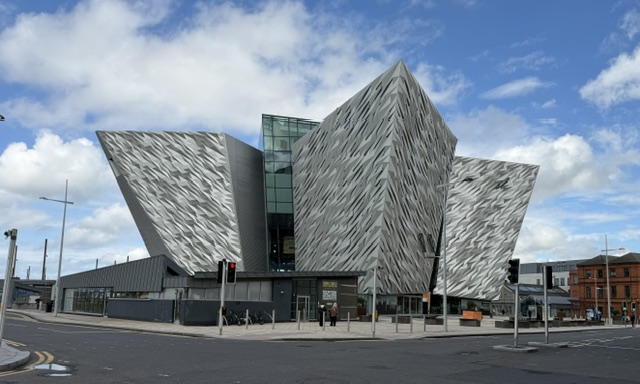
The Titanic Museum in Belfast, Northern Ireland, has the same size as the bow and hull of the massive ship and is covered with 3,000 shiny panels which reflect the sky and water. Tom and Ginny Lounsbury did a self-guided tour from the engine room all the way to the top and could get a sense of the horror and hopelessness of the passengers and crew after the Titanic struck an iceberg and sunk in 1912.
Ginny Lounsbury
On a pedestrian-only city street featuring shops of all kinds as well as pubs, this young musician is playing the Irish Uilleann Pipes (bag of the elbow) with the bellows strapped to the elbow for inflating. The sound is much softer than that made by Scottish bagpipes.
Tom Lounsbury/Hearst Michigan
A unique out-of-the-way stop was a “Circle of Life” created using large boulders and rocks which served as an ancient Celtic meeting place. Other ancient Celtic sites such as this were also checked out along the way, which were always made in a circle.
Tom Lounsbury/Hearst Michigan
Sue and Sunil Jayaratne of Kansas City complete a lengthy round-trip hike to see the unique geological rock formations at the “Giant’s Causeway” in Northern Ireland..
Tom Lounsbury/Hearst Michigan
The final waterfall of a river on its way to the nearby Atlantic Ocean. Waterfalls are a common sight to see in the lush countryside of the Emerald Isle.
Tom Lounsbury/Hearst Michigan
Provided by Tom Lounsbury
It had been raining all night and it was still drizzling when we loaded up into the unique “Driftwood” van in Dublin on our first morning and headed for Northern Ireland.

Our Irish “vagaguide,” Brian, right away had all of us get to know each other on our eight-person tour by making introductions and saying where we were from. There were sisters Bernilda and Sylvia from Puerta Rico, Andy and Karen from Sydney, Australia, Sunil and Sue (formerly of Sri Lanka) from Kansas City, and my wife Ginny and I from Michigan’s Thumb. Yep, folks, it was quite a mix of different parts of the world, which we all quickly came to appreciate.
Article continues below this ad
We travelled along a winding, wet road with the sea to our right and lush, green rolling countryside on our left and soon stopped to do a tour of Hillsborough Castle and Gardens, where the royal family stays whenever they are in Northern Ireland. Then, we were on to Belfast. This being Ireland, wet weather had abruptly changed to being bright and sunny when we arrived for a scheduled three-hour stop.
Our travelling companions opted for the “Black Cab Tour,” which delves into the deeply personalized Belfast history and its “troubles,” allowing folks to get a sense about hard feelings which still exist in a political atmosphere that has been ongoing since Scottish and English settlers arrived in the area during the 17th century. Today, Belfast’s population is 40% Catholic and 37% Protestant, although folks in Northern Ireland are entitled to both Ireland and United Kingdom citizenship.
Ginny and I opted for a self-guided tour of the Titanic Museum, which sits right on the same site where the enormous ship was built. The museum is constructed to match the size of the Titanic’s massive bow and hull and is covered with 3,000 individual silver-anodized aluminum sheets designed to reflect the surrounding water and sky to duplicate moving waves and ice crystals.
Yep, folks, it is quite a sight to behold, and Ginny and I would tour the museum’s inside from the engine room all the way up to the top, which offered a dramatic experience, especially when you fully sense the obvious horror and hopelessness of the passengers and crew after the ship hit an iceberg and began to sink.
Article continues below this ad
Then, our small tour group was back on the road, travelling along the spectacular Causeway Coastal Route to our first night’s stay at the Ballygally Castle Hotel. They offered plush rooms and fine food, not to mention the possibility of a ghostly encounter regarding a former resident from way back when, with a tour being offered in the “haunted” tower.
Ginny and I didn’t go on the tour, but I had my own unusual moment that night just as I was about to fall asleep in our room. Something went by our window right next to me which looked like a reflection of a man in formal attire.
I got up to see what he was up to, but there was nothing on the dark flat roof just below our window. Then, loud hammering on something metal began out of sight in the darkness and went off and on for a while. Sunil and Sue in the next room heard the hammering as well, and it was most likely a well-dressed castle employee fixing something. Nope, folks, I had no problem going to sleep, ghost or no ghost, because it had been a full and very exciting day.
Our first stop the following morning was to experience a hike to the Giant’s Causeway, a World Heritage Site, and view its spectacular 40,000 hexagonal basalt columns. Then it was off and heading south along the west coast to Derry/Londonderry, with multiple stops along the way to review notable sites, such as a historical museum which featured the Irish lifestyle from ancient to more recent times.
Article continues below this ad
I was amazed at what the Irish country folks could make out of straw, including chairs, heavy-duty rope and even a horse collar. There was also a display featuring a favorite and very rugged sport in Ireland called “hurling,” which is lacrosse on steroids.
At Derry/Londonderry, Ireland’s only walled city, we did an enlightening “city tour” along wet cobblestone streets during a heavy downpour where our raincoats paid dividends. and we learned a whole lot more about the conflicts and the hard feelings remaining in Northern Ireland.
Then, we were off and heading south along the “Wild Atlantic Way” and into the Irish Republic, which lacks a political atmosphere. I immediately fell in love with the western, coastal side, which features rugged, barren and tall mountains intermixed with deep valleys. Its spectacular terrain reminded me of the Torngat Mountains of Labrador and northeastern Quebec, where I have gone bowhunting for caribou.
While the eastern side of Ireland offers the most fertile ground, the western side does not. Our knowledgeable vagaguide, Brian, pointed out the noticeable patches of ground on the mountainsides called “lazy beds,” which were created by carrying up basketfuls of beach sand and mixing it with seaweed to create more fertile soil in which to grow potatoes.
Article continues below this ad
Brian also described Ireland’s Potato Famine (aka The Great Hunger), which peaked in 1847 and killed over a million people who were dependent on potatoes as a primary food source, with almost two million more leaving Ireland to settle in the United States, Canada and Australia. Many would die en route while being crammed into what became called “casket ships” due to disease and starvation, because they had to provide their own food on the voyage, with some not having enough.
Ireland is still recovering from such a dramatic population loss, which is why, during our travels, we met many people from all over the world who work in Ireland and keep things ticking today.
During our travels, we also learned about the distinct impact the Vikings had when they began raiding Ireland in the ninth century with a focus on churches and monasteries, where their primary goal was to capture people to sell in the lucrative slave market. The Vikings would also establish the country’s first port cities and play an important role in Ireland’s future architecture of castles and buildings, eventually integrating into Irish society.
Many of the roads we took to out-of-the-way places were quite narrow, and I was impressed with how polite and patient everyone was when meeting oncoming traffic and working things out safely. There were times Brian could thread the needle maneuvering our van, even on traffic-filled streets that were none too wide.
Article continues below this ad
We soon found ourselves in Connemara for a two-day stay at a fine hotel, which even offered laundry services while allowing us time to check out the local scenery and do some shopping. The pubs were great places to dine which often featured Irish music, and it was great staying in one place for a bit because day-to-day touring can tire you out.
However, we were all excited about what was yet to be discovered on our Ireland Odyssey tour.
Email Thumb-based freelance outdoors writer Tom Lounsbury at tlounsburyoutdoors@gmail.com
Article continues below this ad