
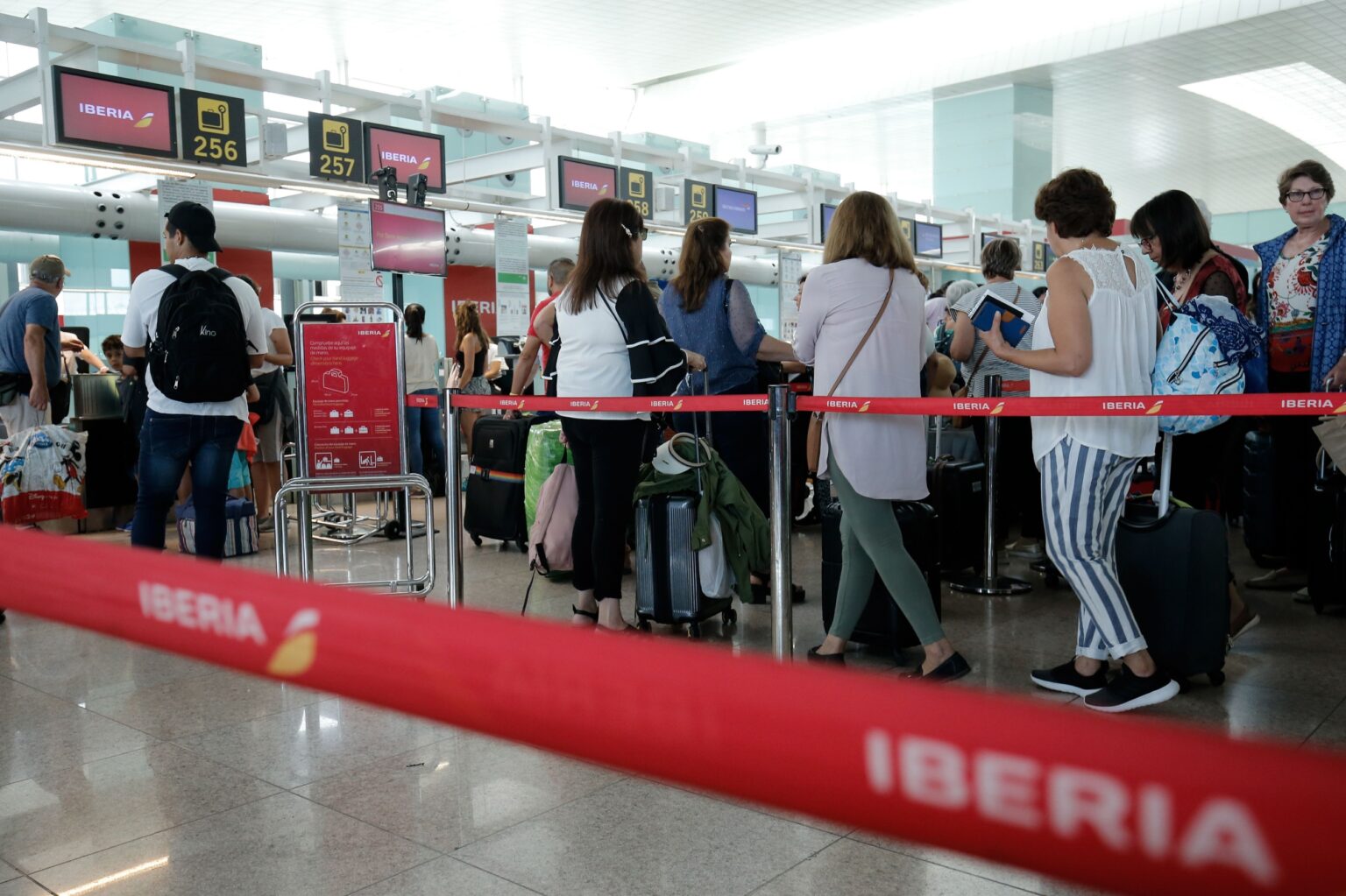
Workers handling baggage, check-in, and boarding at two of Spain’s biggest summer airports are set to walk out indefinitely next Tuesday — and the flights at risk include United, Lufthansa, Air France, and Air Canada routes that tens of thousands of American travelers have booked for August vacations, according to the combined report from Hosteltur.
Both strikes begin at midnight on August 4, making Tuesday the day travelers flying through Barcelona–El Prat or Palma de Mallorca need to know about before they reach the airport. Spain’s Ministry of Transport calculates that roughly 2 million passengers at Barcelona alone could be affected between now and the end of September, with approximately 11,600 flight movements and 2.4 million seats at stake. Palma’s passenger impact has not yet been separately quantified by the ministry.
This is the second time in 2026 that Groundforce — the Globalia subsidiary that handles check-in, baggage loading, boarding, and flight coordination for more than 20 airlines at Barcelona’s two terminals — has faced an indefinite walkout. A March 2026 strike involving workers across 12 Spanish airports was partially suspended after a last-minute agreement, but the union that called August’s action says the underlying problems were never resolved.
Workers at Breaking Point: What Drove Two Airports to Walk Out Simultaneously
The Barcelona strike has been called by CGT, the anarcho-syndicalist union that holds a majority on Groundforce’s works council. The union has convened all 1,179 employees who handle ground operations at El Prat — including check-in agents, ramp workers, baggage loaders, and passenger assistance staff — in what it describes as a last resort after months of ignored requests, as Forbes España reports.
CGT’s formal grievance list documents what the union characterizes as an operation run at skeleton staffing through peak season: unsustainable workloads on the ramp and in baggage halls, extreme physical fatigue, stress, risk of accidents, task accumulation, excessive overtime, insufficient rest between shifts, and inadequate training for newly hired staff brought in to cover attrition. Workers told the wire service EFE that the company “sees nothing but numbers” while employees “see nothing but illnesses” — a reference to the musculoskeletal injuries that handling workers report as the sector’s dominant occupational disease.
At Palma, some 600 workers employed by Swissport have been called out by UGT, the union that holds majority representation on Swissport’s works council. UGT’s demands at Palma are structurally similar, if differently specified: the union is calling for expanded contracted hours for part-time workers currently below 40 hours per week, negotiated rather than arbitrarily imposed irregular schedules, a reduction in compulsory overtime, a formal stress-and-overload allowance, two consecutive guaranteed rest days per week, and air conditioning in all operational vehicles — a demand that signals conditions on the apron in a Mallorcan August.
Though CGT in Barcelona and UGT in Palma are separate unions acting at separate companies, the convergence on August 4 reflects a shared structural diagnosis: Spain’s liberalized ground handling market, opened to competition by the EU’s 1996 Ground Handling Directive, has compressed margins so severely that labor costs have been squeezed at the same time that passenger volumes have surged. The result, workers say, is an understaffed sector running at maximum load exactly when its workload peaks.
Which Airlines Are Affected — and Which Airports
At Barcelona–El Prat, Groundforce is the primary handling contractor for Air Europa, Lufthansa, Air France, KLM, Qatar Airways, Turkish Airlines, United Airlines, Etihad Airways, SAS, ITA Airways, Finnair, El Al, LOT Polish Airlines, Air China, Saudia Airlines, Air Transat, and Luxair, among others. Check-in, baggage loading, boarding, and flight coordination for all of these carriers will be subject to minimum service requirements ranging from 35% to 80% of normal operations in August, depending on the route type and the availability of alternative transport connections.
At Palma de Mallorca, Swissport handles ground operations for Condor, Sunclass, the TUI Group, Air Canada, Etihad Airways, Alba Star, and TAP Air Portugal — operators whose schedules are concentrated on summer leisure travel to the Balearic Islands. Minimum service levels for the Palma Swissport action had not been published by the Ministry of Transport as of July 30.
Neither Groundforce nor Swissport issued statements in response to media requests for comment before publication.
Why the Same Company Has Struck Twice in Five Months
The March 2026 Groundforce walkout was triggered by a different set of unions — CCOO, UGT, and USO — over the company’s alleged failure to apply a Spanish Supreme Court ruling (Sentence 369/2025, April 2025) that required corrected salary tables and restoration of purchasing power lost across the 2022–2025 inflation period. That dispute, which produced baggage collapses at Madrid and delays of up to 50 minutes across multiple airports, was suspended after a partial agreement on April 28.
CGT’s August strike rests on a different but related grievance — occupational health and working conditions rather than salary tables — but its statement makes explicit that the company’s unresponsiveness to concerns raised throughout 2026 is what drove the August action. The union characterizes the August walkout as the inevitable consequence of management that has “failed to respond satisfactorily” to repeated requests.
The pattern has caught the attention of lawmakers. In July 2026, USO — Spain’s third-largest aviation union and a separate organization from both CGT and UGT — filed a petition with the European Parliament seeking regulatory recognition of ground handling as a hazardous occupation qualifying for early retirement provisions under Spain’s Real Decreto 402/2025. The petition before the European Parliament’s Petitions Committee noted that no comprehensive scientific study evaluating the cumulative effects of handling’s combined occupational hazards — physical loading, irregular hours, noise, vibration, weather exposure, time pressure — had ever been conducted. That regulatory gap is a significant reason these disputes keep returning: the occupational health problem is structurally unresolved, and no EU-level standard yet compels employers to address it as an integrated hazard.
What Passengers Can Actually Claim Under EU Rules
The key consumer fact for travelers on August flights is one many overlook: ground handling contractor strikes occupy a legally contested position under EU Regulation 261/2004. The European Court of Justice has distinguished between airline-internal strikes — where airlines remain liable for compensation of €250 (approximately $288 USD; exchange rate as of July 30, 2026; conversions are approximate) to €600 (approximately $690 USD) — and third-party strikes, such as those by independent handling contractors, which may be classified as “extraordinary circumstances” outside the airline’s control.
If a carrier successfully argues that the Groundforce or Swissport walkout constitutes an extraordinary circumstance, it is not required to pay cash compensation for delays of three or more hours or cancellations. However, the airline is still required — under all circumstances — to provide care: meals, accommodation if an overnight stay is required, transport between accommodation and the airport, and rebooking to the final destination at the earliest opportunity, or a full refund.
Package holiday travelers have additional protections under the EU Package Travel Directive, which treats tour operators as the primary responsible party for the contracted journey.
Practically, passengers with flights through El Prat or Palma from August 4 should take several steps now:
- Check in online as early as possible. Ground-crew disruptions affect check-in counters and bag drop; online check-in without checked luggage eliminates exposure to those operations.
- Contact the airline directly before arriving at the airport if flights appear to be affected; airlines may rebook proactively.
- Document everything: keep receipts for meals and accommodation purchased due to delays, as these are reimbursable under the “right to care” regardless of the extraordinary-circumstances ruling.
- Review your travel insurance policy for strike-specific coverage terms; some policies have specific exclusions or notification requirements.
- Check for updates from AENA and your airline in the days leading up to August 4, as both Groundforce and Swissport management may yet reach last-minute agreements with their respective unions to suspend the action.
Is There Any Chance the Strikes Are Called Off?
As of July 30, no emergency mediation has been publicly announced by the Spanish Ministry of Transport or AENA. The precedent from March 2026 is that a last-minute agreement is possible — that dispute was suspended after talks resumed just hours before minimum service levels were due to expire — but CGT’s statement in the August case is notably harder in tone, emphasizing that dialogue has already failed multiple times.
The timing works against a quick resolution. August 4 falls at the absolute peak of Spain’s summer travel season: El Prat handles more passengers in August than in any other month except Easter week, and the Balearics are at maximum tourism capacity. The leverage for workers is real; so is the economic pressure on both companies to reach a settlement before disruption compounds.
Travelers should assume the strikes will proceed and plan accordingly.
Frequently Asked QuestionsWill my flight to Barcelona or Palma be canceled because of the strike?
Not necessarily canceled, but potentially delayed or disrupted. Spain’s minimum service law requires Groundforce to maintain between 35% and 80% of normal operations at Barcelona in August, depending on the route type. This means some flights will operate normally, others will face delays, and a smaller number may be canceled — particularly at the margins of the schedule. The practical result is likely to be slower check-in, baggage handling backlogs, and extended processing times even for flights that depart. Travel with hand luggage only if your schedule permits, and check in online.
Do I get compensation if my flight is delayed or canceled because of a ground-handling strike?
Possibly, but less automatically than many travelers assume. Under EU Regulation 261/2004, airlines must pay €250 (approximately $288 USD) to €600 (approximately $690 USD) in compensation for cancellations and delays of three or more hours — but only if the disruption is within the airline’s control. Strikes by independent ground handling contractors like Groundforce and Swissport occupy a legally contested zone: the European Court of Justice has allowed airlines to argue these constitute “extraordinary circumstances” exempting them from cash compensation. Even if cash compensation does not apply, airlines are still legally required to provide care — meals, hotel accommodation, and rebooking — regardless of the cause. Contact your airline directly rather than waiting at the airport.
Why has the same handling company struck twice in 2026?
Groundforce — owned by Spanish tourism group Globalia — faced an industry-wide indefinite strike in March 2026 called by three unions (CCOO, UGT, and USO) over the company’s alleged failure to implement a Spanish Supreme Court ruling requiring corrected salary tables. That dispute was suspended in late April after a partial agreement, but underlying occupational health concerns were not resolved. The August strike by CGT focuses specifically on working conditions — unsustainable workloads, insufficient rest, physical overloading, and high staff turnover — that CGT says have gone unaddressed despite repeated requests. Separately, a petition filed with the European Parliament in July 2026 by union USO revealed that no comprehensive scientific study of the cumulative health hazards of ground handling work has ever been conducted — a regulatory gap that experts and unions say explains why these disputes keep recurring.
What extra protections do I have if I booked a package holiday?
Package travelers have additional rights under the EU Package Travel Directive, separate from EU261. If your flight is canceled or significantly delayed and the package organizer cannot provide an alternative of equivalent value, you are entitled to a full refund of the package price. You may also be entitled to compensation from the tour organizer for any failure in the contracted services. Contact the company that sold you the holiday — not just the airline — if your trip is disrupted, since the tour operator may have pre-arranged alternatives or supplementary compensation obligations.