
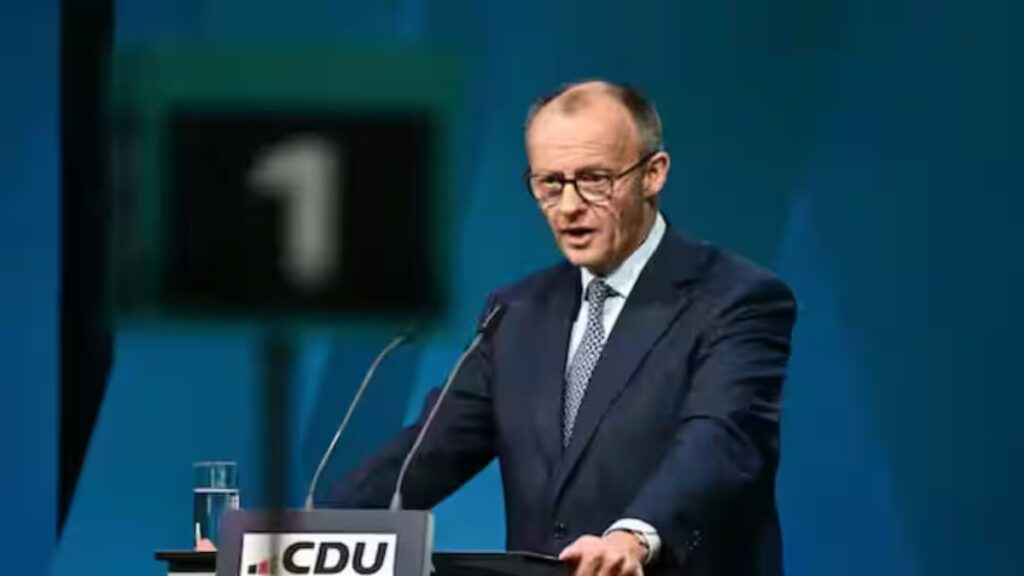
Amid the escalating tensions in Europe, German Chancellor Friedrich Merz is reportedly drawing secret plans to prevent “pro-Kremlin traitor states” from obstructing Nato’s plan to defend itself against Russian aggression. According to a report by The Telegraph, German officials are afraid that the Alternative for Germany (AfD) party could frustrate the movement of allied forces through two eastern states, where it is expected to win in the September elections.
If the far-right party manage to win an absolute majority in Saxony‑Anhalt or Mecklenburg‑Vorpommern, it would be able to form a state government, giving it control over internal security, policing and other powers. However, this could slow the
movement of troops and equipment in the region through bureaucratic obstructionism over permits and permissions.
Those in power in the region could also end up obstructing the deployment of state-level police resources and refuse to give the military priority on local roads. According to The Telegraph, these concerns are coming at a time when Nato officials have intelligence suggesting that
Russian President Vladimir Putin is preparing to use political allies within Europe to hinder the response to Moscow’s attack on the continent’s eastern flank.
In a bid to avoid this from happening, Merz’s government is preparing mechanisms to override state governments’ decision-making powers in the event of a crisis, as well as protect key officials and infrastructure in neighbouring states, The Telegraph reported. It is pertinent to note that Germany is divided into 16 federal states with powerful regional administrations and is nicknamed “Nato’s roundabout”.
Using ‘Russia-friendly’ politicians to delay Nato response
Several crucial logistical routes pass through the country towards the border with Russia. Using Kremlin-friendly politicians to delay
Nato’s efforts to deploy troops swiftly could be “very effective”, a Western defence source told The Telegraph in a joint investigation with Die Welt.
“For Putin, it’s perhaps not even an objective to defeat Nato militarily, because that’s a challenge. But if he can find the cracks inside the alliance on a political level and exacerbate those, then that’s the shortcut to breaking the alliance,” the source said. Meanwhile, Roderich Kiesewetter, an MP for Mr Merz’s Christian Democrats (CDU), agreed.
He insisted that the Kremlin’s strategy was to exploit divides in attitudes towards Russia in Germany, and make it “as unreliable a logistics hub as possible”. He said that counter-measures against rebel state governments were being drawn up by interior ministry officials, but they were complicated by constitutional laws governing state independence.
“There are plans under development on how to protect the secret services and how neighbour states can take over and safeguard key infrastructure and also key personnel,” he added. “The key question is how to circumvent a state not adhering to the federal idea without violating the constitution.”
The German politician maintained that the country’s response to a Russian military threat could not depend on a single state, so it was necessary to “create mechanisms that would make it possible to overrule individual states or to take the necessary measures”. Amid the reports,
Boris Pistorius, the German defence minister, has warned that AfD state governments could be excluded from some intelligence briefings because of the party’s close links to the Kremlin. Overall, the Merz administration is planning to remain prepared for Russian aggression.