

In recent years, Azerbaijan’s relations with the countries of Central Asia have developed rapidly and now serve as a model of successful interregional integration. Ethnic kinship and cultural ties have gradually evolved into a strategic alliance based on shared political and economic interests.
On 31 July, the Interstate Council of Azerbaijan and Kyrgyzstan held its third meeting in the city of Cholpon-Ata, attended by Azerbaijani President Ilham Aliyev and Kyrgyz President Sadyr Japarov.
Cholpon-Ata is also hosting the informal summit of the heads of state of Central Asia and Azerbaijan — the “Group of Six” — established during the seventh Consultative Meeting of the Leaders of the Central Asian States in Tashkent in November 2025. The previous “5+1” format no longer reflected the interests of the participating countries, and Azerbaijan became a full participant in the Consultative Meetings. This was a logical and natural outcome of the broader transformations taking place across Eurasia.

Credit: AZERTAC
Baku’s initiatives have provided the Central Asian states with a new and more reliable gateway to Europe and the broader West. The region, which only a few years ago was regarded as a “closed club”, has emerged from the isolation created by its dependence on Russia. New transport routes and opportunities have fundamentally changed the regional landscape, enabling the Central Asian countries to become more independent and increasingly influential actors.
The Central Asia–Azerbaijan Summit reflects a long-term trend: Central Asia is no longer a peripheral region in world politics but is becoming an independent centre of Eurasian geoeconomics and transport logistics. Against the backdrop of the crisis of the previous model of globalisation, sanctions-driven geopolitical tensions, conflicts in the Middle East and the restructuring of global transport corridors, this format is acquiring particular strategic significance.
This development is particularly significant for Kyrgyzstan. For many years, the country remained on the periphery of the region, largely excluded from major projects and economic opportunities. As the regional landscape has evolved, however, Bishkek’s role has begun to change.
On 31 July, a ceremony for the exchange of bilateral documents took place in Cholpon-Ata in the presence of Presidents Aliyev and Japarov. The most significant of these was the Treaty on Allied Relations. Allied relations represent the highest level of interstate cooperation, demonstrating that bilateral ties have reached a qualitatively new and unprecedented stage. This was a goal that both Baku and Bishkek had long pursued and have now successfully achieved.
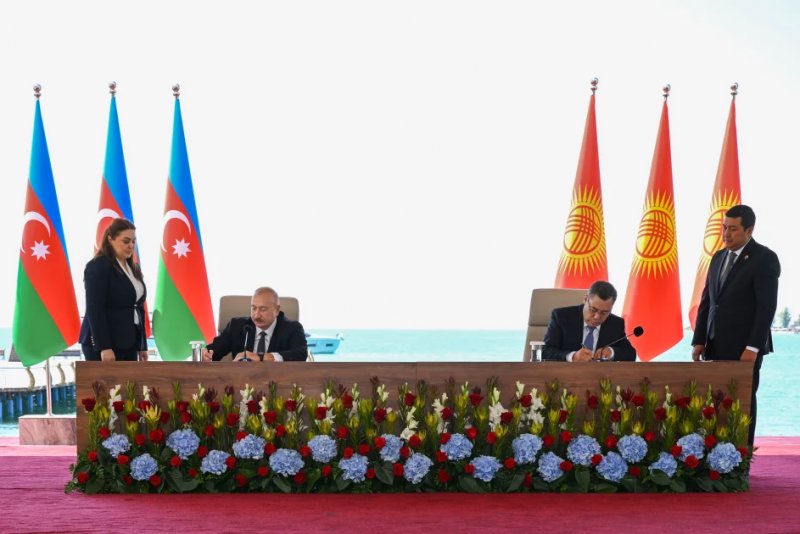
Credit: AZERTAC
Another important agreement concerns the Azerbaijan–Kyrgyzstan Development Fund, established in 2022. During the talks in Cholpon-Ata, the two leaders agreed to double the Fund’s capital to $200 million. Speaking to the press after the meeting, Ilham Aliyev expressed confidence that this would not be the final increase, noting that “the presentation we were shown on the Fund’s activities demonstrates that it is being filled with concrete substance.”
At present, the Fund is financing strategic initiatives with a combined value of $52.7 million, while around 10 additional investment projects are under consideration.
The agreements reached in the energy sector are of particular importance, especially for Kyrgyzstan. In Cholpon-Ata, the parties signed a Roadmap for Cooperation in the Energy Sector and a Memorandum on the Supply of Petroleum Products.
Energy security has become an increasingly important factor enhancing Azerbaijan’s strategic importance for Kyrgyzstan and the wider Central Asian region. Kyrgyzstan had previously asked Azerbaijan to consider supplying petrol and other petroleum products. Russia has traditionally been Kyrgyzstan’s main fuel supplier, but following a series of drone attacks on its oil infrastructure, Moscow was compelled to restrict fuel exports in order to prioritise domestic demand.
Under these circumstances, Azerbaijan is emerging not only as a key transport and logistics hub but also as an increasingly important energy partner for Central Asia, capable of contributing to the diversification of fuel supplies, including those destined for Kyrgyzstan.
As Kyrgyzstan’s Minister of Energy, Altynbek Rysbekov, said on the sidelines of the Azerbaijan–Kyrgyzstan Interstate Council meeting in Cholpon-Ata, the two countries are expected to develop a practical mechanism for oil and petroleum product supplies in the near future. Preliminary agreements have already been reached and a memorandum has been signed. The next step is to establish an implementation framework. According to the minister, these mechanisms are expected to be finalised within the coming days, most likely within a week.
The agreements on transport connectivity are equally important for Kyrgyzstan. Azerbaijan’s unique geographical position provides the Central Asian states with access to the Black Sea and European markets, modern Caspian port infrastructure, multimodal transport routes, as well as opportunities to participate in regional energy and digital projects. Kyrgyz experts place particular emphasis on the construction of the China–Kyrgyzstan–Uzbekistan railway, which, once completed, will connect with Azerbaijan’s transport network across the Caspian Sea. Freight traffic will then continue through Georgia and Türkiye to Europe, as well as via Iran to the Middle East. In this context, Azerbaijan is emerging as one of the key logistics hubs of Greater Eurasia.
Although the overall volume of bilateral economic cooperation remains relatively modest, it has been expanding rapidly. The most notable progress has been in bilateral trade. According to Kyrgyzstan’s National Statistical Committee, trade turnover between the two countries reached $13.67 million during the period from January to May 2026, nearly tripling from $4.63 million during the same period in 2025. This represented an increase of 194.9 per cent.

Credit: economy.gov.az
The main driver of this growth was the sharp increase in imports of Azerbaijani goods into Kyrgyzstan. During the first five months of 2026, imports reached $10.53 million, compared with just $988,900 during the corresponding period a year earlier. This pace of growth significantly exceeded the overall expansion of Kyrgyzstan’s foreign trade during the first half of the year.
Alongside economic cooperation, political dialogue and security cooperation have also continued to deepen. In early June, under the bilateral cooperation plan for 2026, a Kyrgyz military delegation visited Azerbaijan. The parties discussed domestic and military security, as well as prospects for expanding cooperation between their respective institutions. Such contacts demonstrate the gradual broadening of the bilateral agenda.
Humanitarian cooperation has also developed actively. This spring, an official Kyrgyz delegation headed by State Secretary Arslan Koichiev and Minister of Culture, Information and Youth Policy Mirbek Mambetaliev visited Azerbaijan. The highlight of the visit was the premiere of the musical Jamila, staged by the Kyrgyz National Philharmonic as part of events marking the 100th anniversary of Chingiz Aitmatov. It is worth recalling that a monument to the great Kyrgyz writer was unveiled in Baku in 2024.
A special dimension of Azerbaijan–Kyrgyzstan relations is Kyrgyzstan’s participation in the reconstruction of Azerbaijan’s liberated territories. At the same time, Azerbaijan has implemented a number of social and humanitarian projects in Kyrgyzstan, giving bilateral cooperation not only practical but also symbolic significance. With Azerbaijani support, Bishkek has seen the construction of Friendship Park, Nizami Ganjavi School No. 103, and the Heydar Aliyev School-Gymnasium Complex.
For its part, Kyrgyzstan built the Aikol Manas Secondary School in the village of Khydyrly in Azerbaijan’s Aghdam district. The modern school, with a capacity of 528 students, was officially inaugurated in July last year in the presence of the presidents of both countries.
In addition, Kyrgyzstan donated 225 yaks to Azerbaijan to support the development of livestock farming in the country’s liberated territories.
While economic cooperation has increasingly become the central pillar of bilateral relations, humanitarian and cultural exchanges are also expanding steadily, and the two countries continue to cooperate effectively on the international stage.
In conclusion, relations between Azerbaijan and Kyrgyzstan have long since evolved beyond the framework of traditional interstate cooperation. Today, they represent a mature model of allied partnership based on mutual trust, political understanding and the convergence of long-term national interests.
By Tural Heybatov