

Fox Business host Maria Bartiromo pressed Kevin Hassett, director of the National Economic Council, on Friday over weaker-than-expected U.S. economic growth, emphasizing an earlier forecast that the U.S. economy would grow at a 4 percent pace.
Economic growth slowed in the second quarter, with real gross domestic product (GDP) rising at a 1.5 percent annualized rate, compared with 2.1 percent in the first quarter, according to the Bureau of Economic Analysis (BEA).
“Last time we spoke, you told me you were expecting 4 percent growth in the second half of the year,” Bartiromo told Hassett on Mornings with Maria. “We got a growth number yesterday, but it was way lower than people expected. How would you assess the macro story today?”
Read More on News
Hassett argued that the headline number understated the strength of the economy, pointing instead to domestic demand.
The exchange comes as Trump and his administration argue the economy remains resilient despite concerns about inflation, tariffs and broader economic uncertainty. During his 2024 campaign, President Donald Trump frequently highlighted his business background and pledged to lower prices, reduce inflation and strengthen Americans’ financial well-being; however, many Americans have expressed concern and frustration with the current economy.
What to Know
In response to Bartiromo’s question, Hassett said that “final sales within the U.S. were about 4 percent actually, almost exactly the number we talked about, 3.9 percent.”
Hassett added that the top-line figure was lower because the U.S. “imported so many capital goods” while “building factories so fast, that the number was different than expected by a little bit.”
Manufacturing construction spending was $173.6 billion in May, down from $175.9 billion in April, according to Census Bureau data. It was down from $222.5 billion in May 2025, a 22 percent year-over-year decline, according to the data. Manufacturing employment has remained relatively flat in recent months, holding near 12.6 million workers, according to Federal Reserve Bank of St. Louis data.
GDP is at 1.5 percent for the second quarter, according to the BEA, compared to the first quarter when it was at 2.1 percent. The BEA attributed this to “a downturn in government spending and decelerations in investment and exports that were partly offset by an acceleration in consumer spending.”

Real final sales to private domestic purchasers, calculated as the sum of consumer spending and gross private fixed investment, increased from 1.7 percent in the first quarter to 3.9 percent. Imports, which are subtracted from GDP calculations, increased and reduced overall growth.
Hassett added that the “surging capital spending, which means there’s downward pressure on inflation because there’s upward pressure on supply, plus CPI [consumer price index] and PCE [personal consumption expenditures], those two reports were about as good as you hope to see if you’re a federal reserve governor.”
“It means the economy is really running on all cylinders,” he concluded.
The PCE price index, a measure of inflation, increased at a 5.1 percent annualized rate in the second quarter, while core PCE, which excludes food and energy prices, rose at a 3.4 percent annualized rate.
Another measure of inflation, CPI, is currently at 3.5 percent, according to the Bureau of Labor Statistics’ (BLS) June report. Energy shot up to 15.7 percent, according to the data.

The Federal Reserve generally targets inflation of about 2 percent over the long run, a level policymakers view as consistent with stable prices.
However, Jeffrey Frankel, James W. Harpel Professor of Capital Formation and Growth at Harvard University’s Kennedy School, told Newsweek in an email, “Contrary to what Kevin Hasset apparently said, this is clearly too high, whether from the perspective of American households or the Federal Reserve Governors.”
Some U.S. economic indicators remain relatively strong, such as the unemployment rate at 4.2 percent in June, according to the BLS. The stock market has also climbed during Trump’s second term.
Recent polls have also found Trump receiving mixed to negative marks from voters on his handling of the economy, with concern over inflation, tariffs and the Iran war.
Trump has repeatedly promoted his economic record, describing the U.S. economy as the strongest in the nation’s history in a Truth Social post last month. He pointed to gains in employment and the stock market as evidence that America was “winning like never before.”
Republicans have argued that Trump’s policies are boosting growth and investment, while Democrats have pointed to lingering concerns about inflation, consumer costs, the impact of tariffs, and the Iran war on Americans. The economy remains one of the top issues for voters heading into November’s midterm elections.
Voters’ View on the Economy
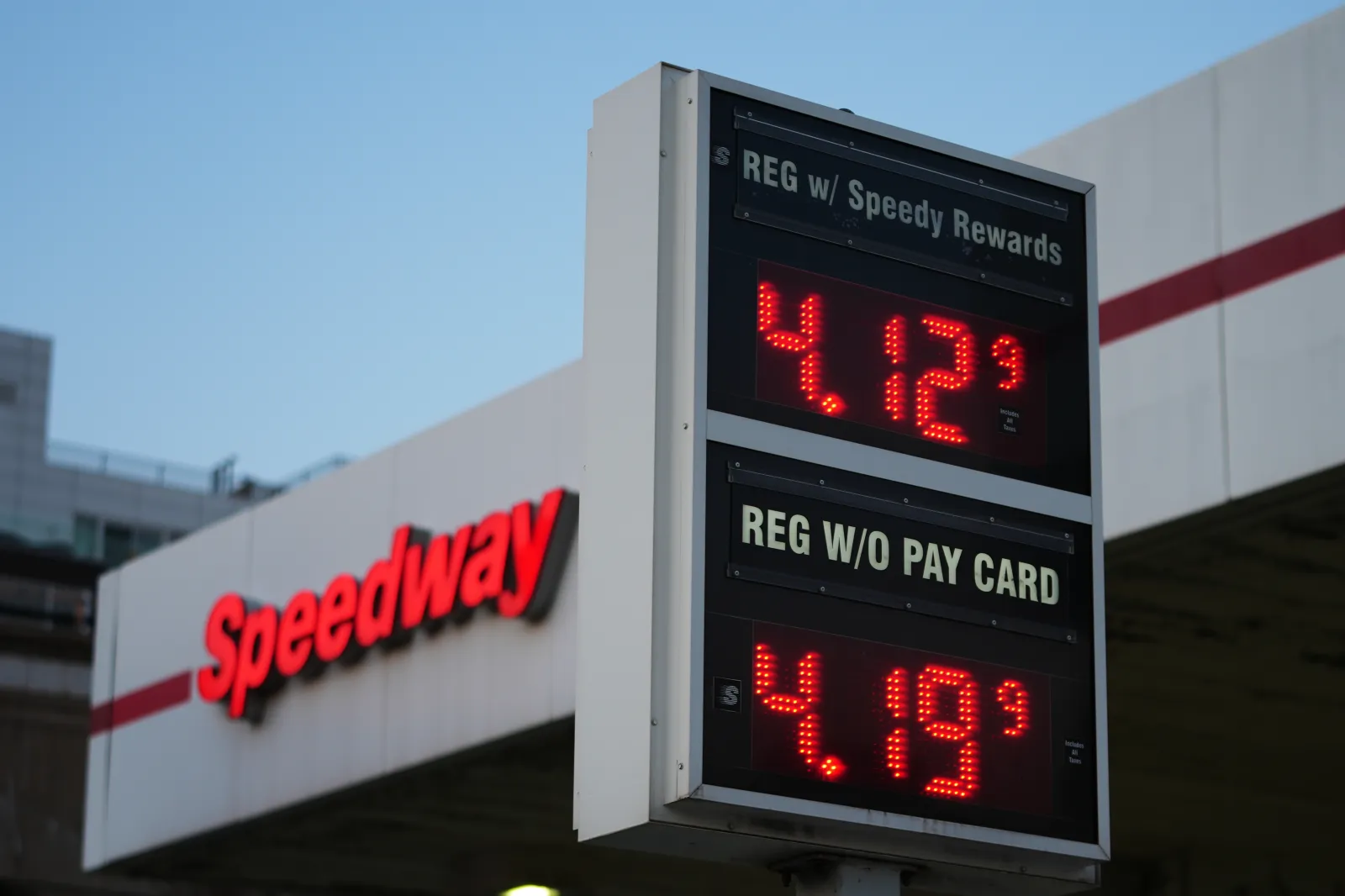
Many voters cite rising gas prices and steep grocery costs as concerns and indicators of the economy’s health, among other measures.
Gas prices have risen following the Iran war and disruptions affecting shipping through the Strait of Hormuz, with the AAA noting that the average regular gas price a year ago was $3.15 per gallon, with today’s current average $4.10 per gallon.
Ongoing instability around the Strait of Hormuz and the Red Sea’s Bab el-Mandeb chokepoint is likely to keep gasoline prices elevated and more volatile in the near term, as any disruption to these critical shipping routes can increase global oil transport costs and tighten energy supplies.
Public polling has shown growing dissatisfaction with Trump’s handling of the economy. A CBS News survey conducted June 17-19 among 2,519 adults found that 34 percent approved of Trump’s handling of the economy, while 66 percent disapproved. On inflation, his ratings were even lower, with 27 percent approving and 73 percent disapproving of his performance. The poll has a margin of error of plus or minus 2.4 percentage points.
A survey of 1,776 registered voters conducted by the Harvard CAPS/Harris Poll found that one in three voters, 33 percent, believe the economy is on the “right track,” with a clear partisan split on the matter. About 61 percent of Republicans think so compared to 22 percent of independents and 14 percent of Democrats.
Most Americans do not believe the economy is strong: 54 percent say it is weak, while 46 percent say it is strong, according to the poll. A majority, 58 percent, believe the economy is shrinking, while 42 percent say it is growing. The poll also found that 46 percent of participants say their personal financial situation is getting worse, while 30 percent say it’s improving, and 23 percent say it’s the same. The poll has a margin of error of plus or minus 2.3 percentage points.
An NPR/PBS News/Marist poll of 1,340 people found that 33 percent of Americans approved of Trump’s handling of the economy, the lowest economic approval rating Marist has recorded for him since it began asking the question in 2019. The poll found that 60 percent disapproved. The poll, conducted between June 8-11, has a margin of error of plus or minus 3 percentage points.
Hassett on the Economic Impact of Artificial Intelligence
While discussing the economy with Bartiromo on Friday, Hassett weighed in on the rapid growth of AI data centers, arguing they can provide an economic boost for smaller communities.
Hassett said data centers create jobs, attract higher-income workers and can spur local investment in housing and other development.
“Data centers are very good for towns, because they create so many jobs and bring people in with high incomes that can buy houses and stuff like that. So, if you take a sleepy town that hasn’t seen much in the last 30 years and put a data center there, there are gonna be a whole bunch of happy residents,” he said.
His comments come as the rapid expansion of data centers has sparked debate nationwide. Critics have raised concerns about their environmental impact, strain on power grids and effects on local communities.
An Emerson College poll, conducted between July 19-20 among 1,100 likely 2026 voters, found that Americans are generally more concerned, 63 percent, rather than excited, 14 percent, about AI, while 22 percent are neither concerned nor excited about it.
Sixty-three percent of U.S. voters oppose AI data centers being built in or near their community, according to the poll, up 21 percentage points from when the question was last asked in December 2025. Overall, only 27 percent of U.S. voters support AI data centers being built in or near their community, while 10 percent are neutral.
According to the Data Center Opposition Report, which is documenting the rapid rise in grassroots opposition to hyperscale AI data centers across the country, there are now at least 430 local data center opposition groups spanning 40 states that are organizing through Facebook. Of these groups, 192 were created in 92 days over the past three months, the group said.
Contact Newsweek editors for this story: Jason Lemon and Anthony Murray.