
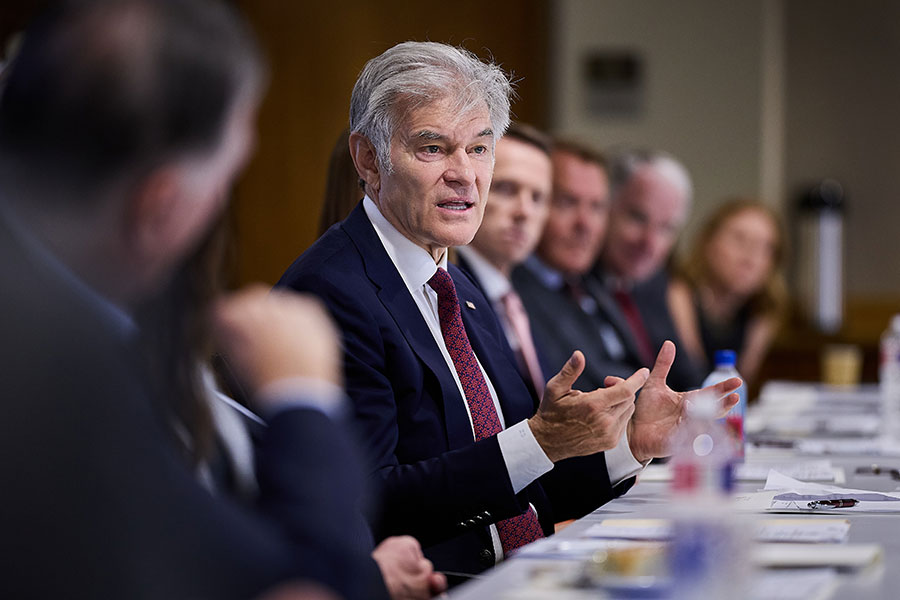
OKLAHOMA CITY – Dr. Mehmet Oz, administrator for the Centers for Medicare & Medicaid Services, visited the OU Health Campus on Saturday, Aug. 1 to learn more about the University of Oklahoma’s flagship academic health system and its efforts to improve health outcomes across the state. Oz was joined by members of the Oklahoma Congressional Delegation, OU leadership and tribal partners.
“We were honored to welcome Dr. Oz to the University of Oklahoma and share with him the impact the OU academic health system is having across the state,” said Gary Raskob, Senior Vice President and Provost, OU Health Campus. “Conversations like these are essential to advancing our work and research in cancer, diabetes, neurological diseases, and rural health access for Oklahomans and the nation.”
The visit comes as OU works to close a persistent gap — Oklahoma ranks 49th nationally in overall health outcomes. Since OU Health’s founding in June 2021, its annual revenue has more than doubled, growing from $1.4 billion to $3.6 billion today. That growth has come alongside a bigger healthcare workforce pipeline; OU now trains roughly 80% of the state’s healthcare workers and has doubled its nursing graduate output and increased MD enrollment by more than 20%. Research investment has led to the OU Health Campus earning its first-ever Top 100 national ranking in National Institutes of Health funding this year, placing it among the top 4% of institutions nationwide that receive NIH support, according to Blue Ridge Institute for Medical Research. Additionally, the Stephenson Cancer Center’s expansion into Tulsa, Norman and McAlester has nearly doubled its reach, with OU Health now treating one in four Oklahomans with cancer, up from one in six. That progress reflects a key priority of OU’s “Lead On, University: The Next Phase” Strategic Plan: lifting the health of Oklahomans statewide.
The day included a tour of the Stephenson Cancer Center and presentations on the academic health system, diabetes and obesity, and rural health care initiatives underway across the university. Together, the presentations reflected OU’s broader ambitions for the state, including cutting cancer mortality by 10% and reducing the cardiovascular complications and deaths from diabetes by 30% over five years.