
Once the world’s mining superpower, the United States is now dangerously reliant on Chinese mineral supply chains. Yet, as we race to reclaim our mineral security, we’re fighting blindfolded.
Unlike our peer nations, the United States has only just begun to use modern tools to map our mineral resources. In other words, our understanding of our own resource potential is but a fraction of what it should be.
Archaeology gives us an important clue as to what we might be missing. Over little more than a decade, archaeology has been upended by LiDAR aerial surveying, which uses laser sensors to see through jungle and forest canopy and create precise 3D maps of topography and features otherwise hidden to the human eye.
Entire civilizations have been hiding right under our noses. For example, LiDAR surveys have revealed sprawling road networks, pyramids, and cities hidden beneath Honduras’ and Guatemala’s dense rainforests. The scale of the discoveries is stunning. Researchers have identified more than 60,000 previously unknown structures in Guatemala’s Maya Biosphere Reserve alone.
Now, the very tools changing our understanding of history are being brought to bear in the modern treasure hunt to find America’s hidden critical minerals.
In 2019, the U.S. launched the Earth MRI program to use advanced technology—including LiDAR aerial surveillance—to map the nation’s mineral resources. Before the launch of this effort, just seven percent of the nation was covered by high-quality geophysical data. While progress has been made, roughly three-quarters of the country still remains unmapped.
The data, made publicly available to mining companies, is already greatly expanding our understanding of what resources we may have—and where exploration should be focused. That accelerates development, more efficiently allocates capital, and cuts the need for speculative drilling—reducing mining’s environmental footprint.
The Earth MRI program has backed 32 mapping projects that have contributed to an increase of roughly 100,000 new mineral claims on federal land—a first step to more in-depth exploration. Mapping has also greatly expanded our understanding of known resources. In Alabama, for example, mapping has confirmed high-grade flake graphite deposits with the potential for vanadium and barium co-production. Among a host of uses, graphite is essential to lithium-ion battery production—and China currently has near-complete control of graphite supply chains.
Earth MRI is also mapping historic mine waste and assessing those above-ground sites for critical minerals. More than 150 promising sites with concentrations of critical minerals have been mapped so far.
But for all the progress and promise, Earth MRI is only scratching the surface of what can be found with additional mapping. The program is now up for reauthorization from Congress, and doing so should be a no-brainer. Not only should Congress renew the program, it should double down and further invest in next-generation technology.
The United States has vast mineral resources, but we cannot develop what we haven’t yet found. Technology—from LiDAR aerial surveys to artificial intelligence able to comb through data at lightning speed—holds the potential to change the game. Now is the time to take the blindfold off, bring cutting-edge science and technology to our minerals challenge, and turn our mineral potential into the secure, responsible supply chains we so urgently need.
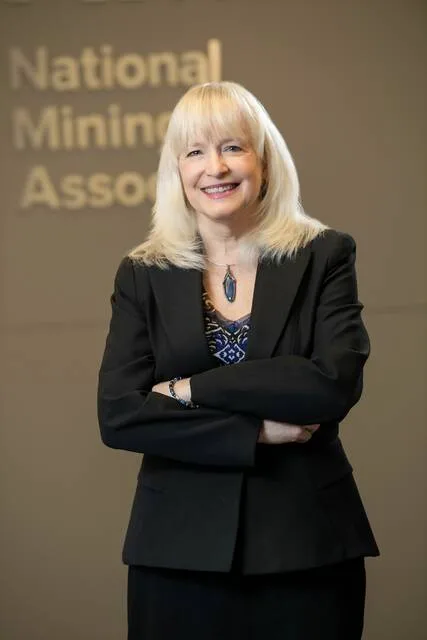
Katie Sweeney is the executive vice president and chief operating officer of the National Mining Association.

Local journalism matters, and your support makes it possible. You can help sustain this work by making a donation or choosing one of our subscription options. Subscribers enjoy valuable benefits, including full access to our e-edition, a reduced ad experience on timesleader.com, and more.
Your support helps ensure independent, high-quality local news remains available today and for future generations. Thank you for standing with local journalism.
Katie Sweeney is the executive vice president and chief operating officer of the National Mining Association.