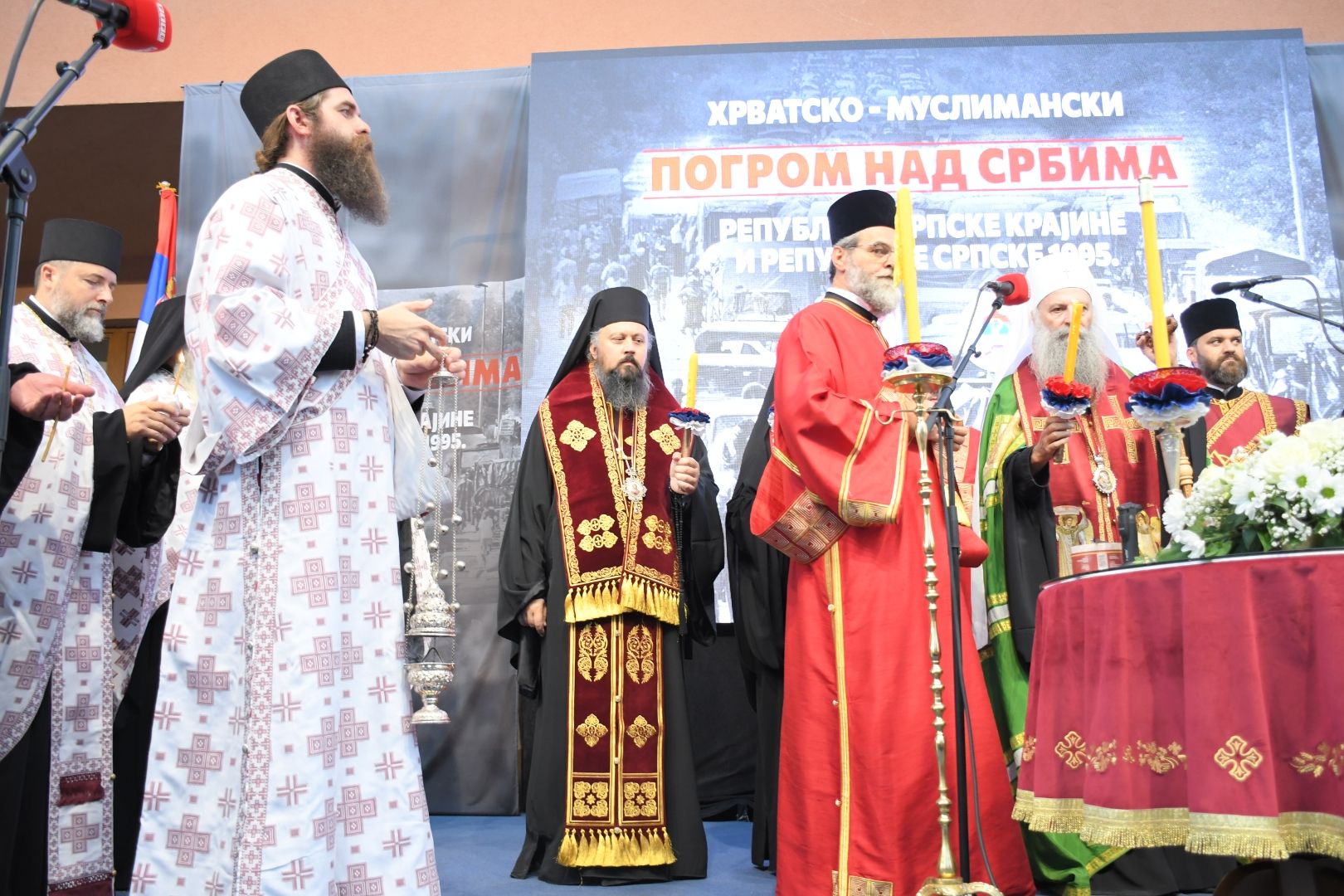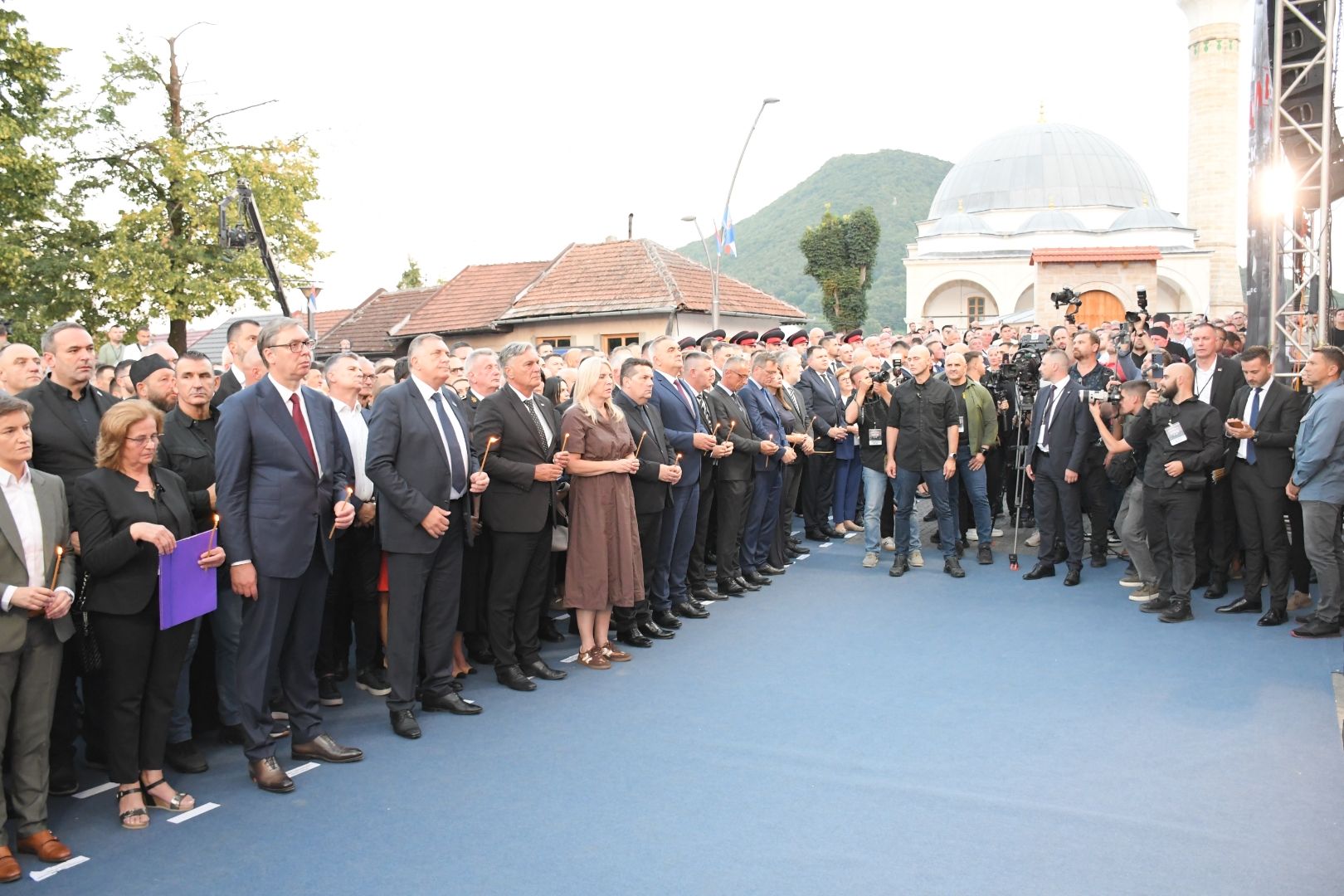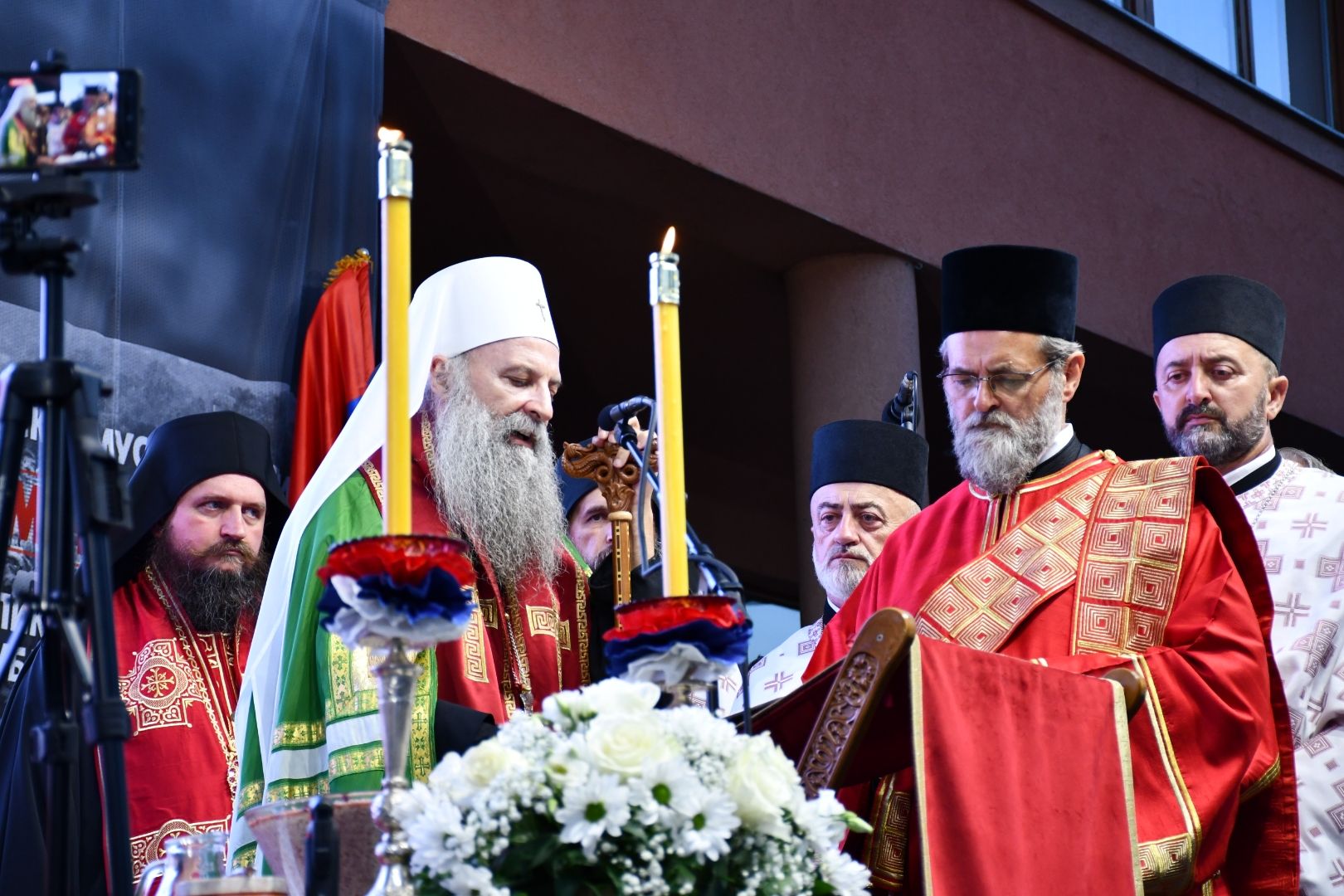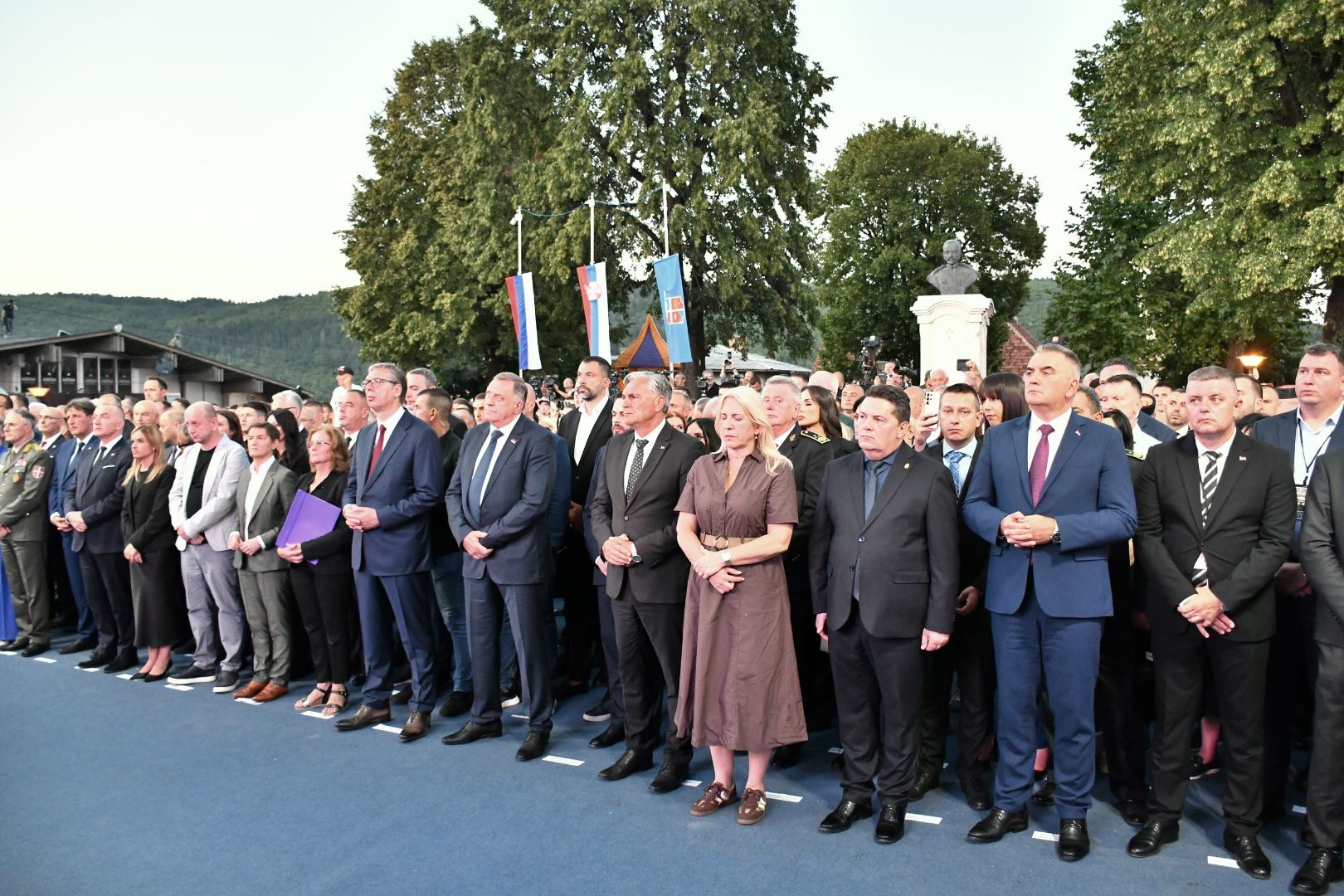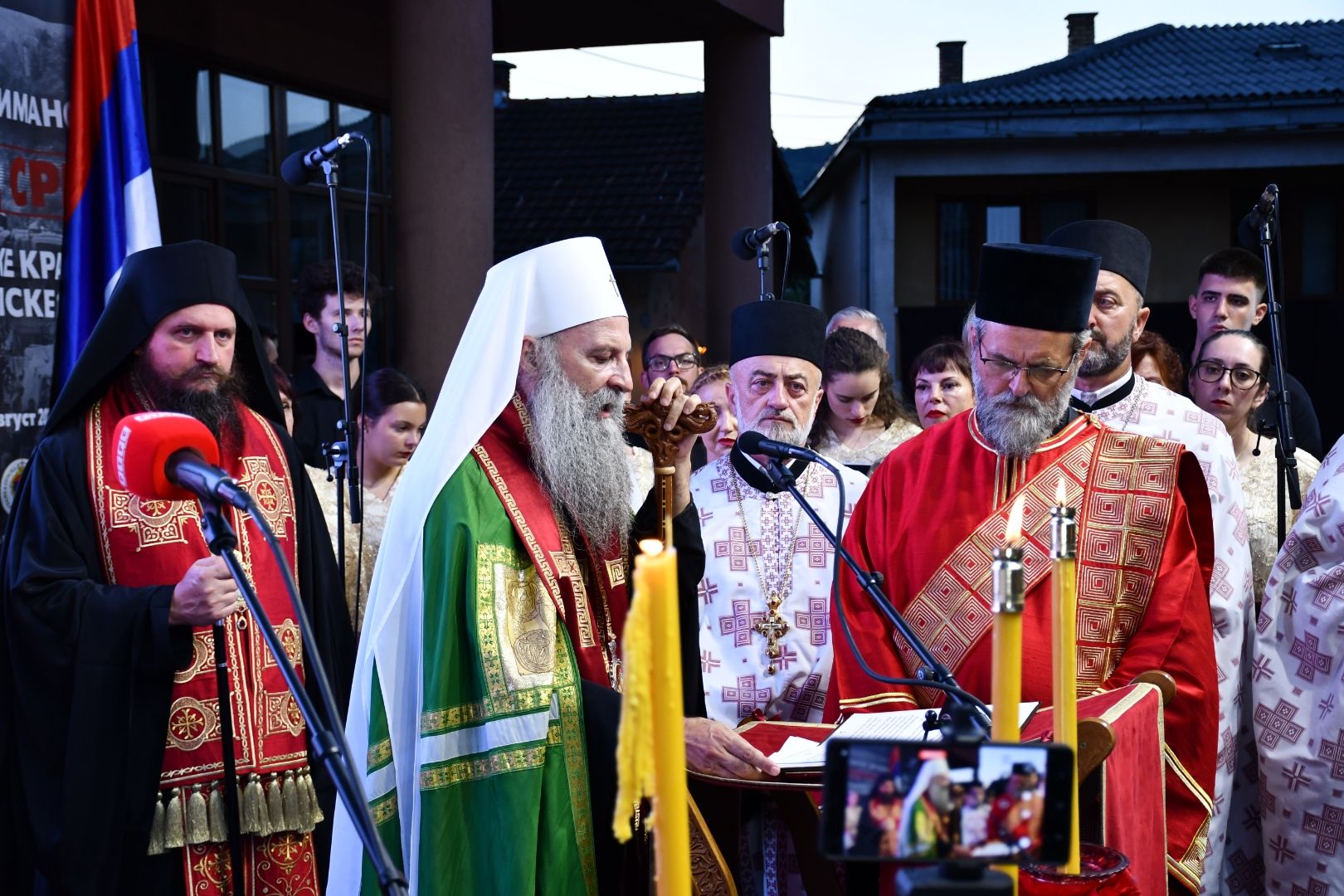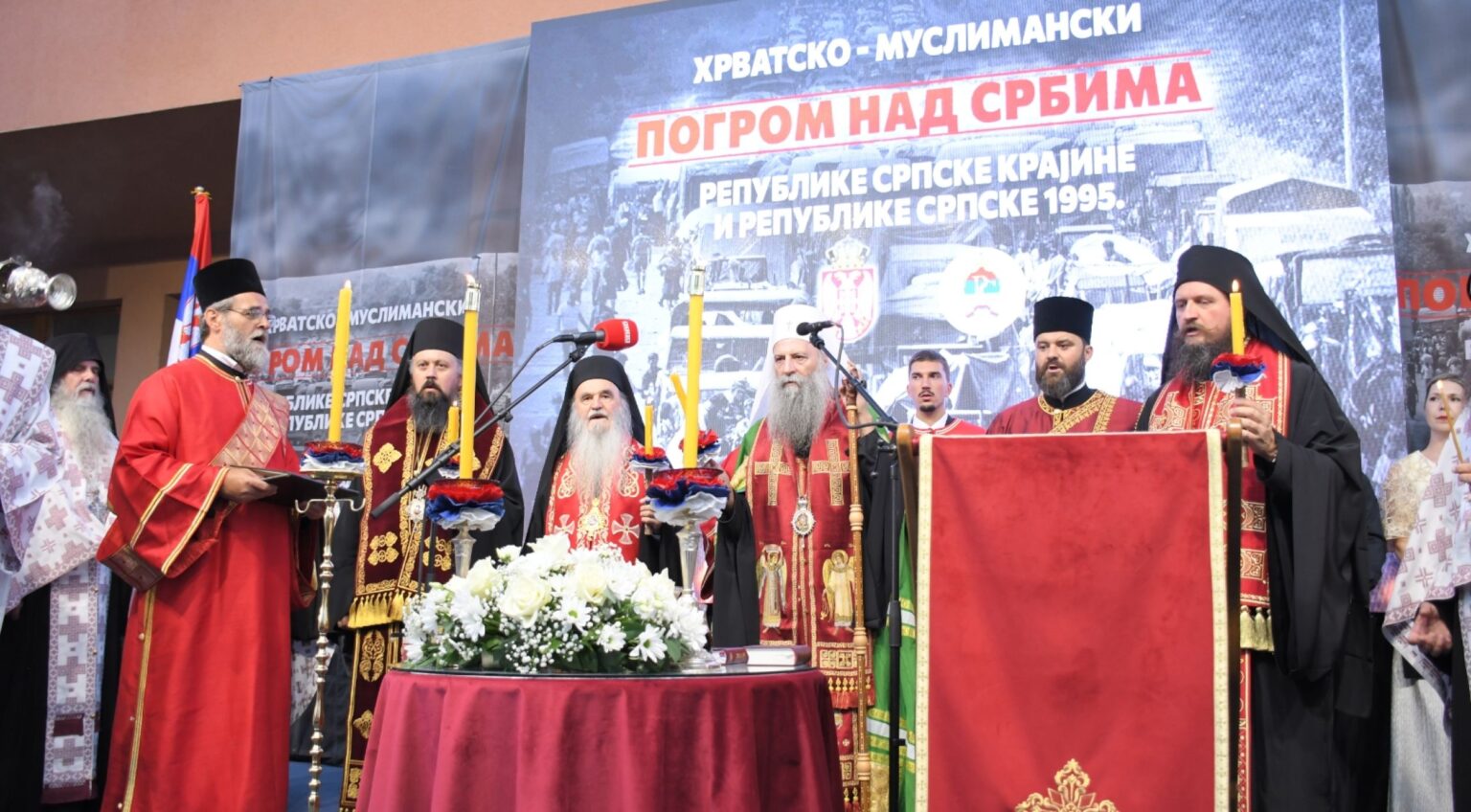
On August 4, 2026, Patriarch Porfirije of Serbia performed a memorial service (parastos) at King Petar I Karađorđević Square in Mrkonjić Grad for the innocent victims of the operation “Storm.”
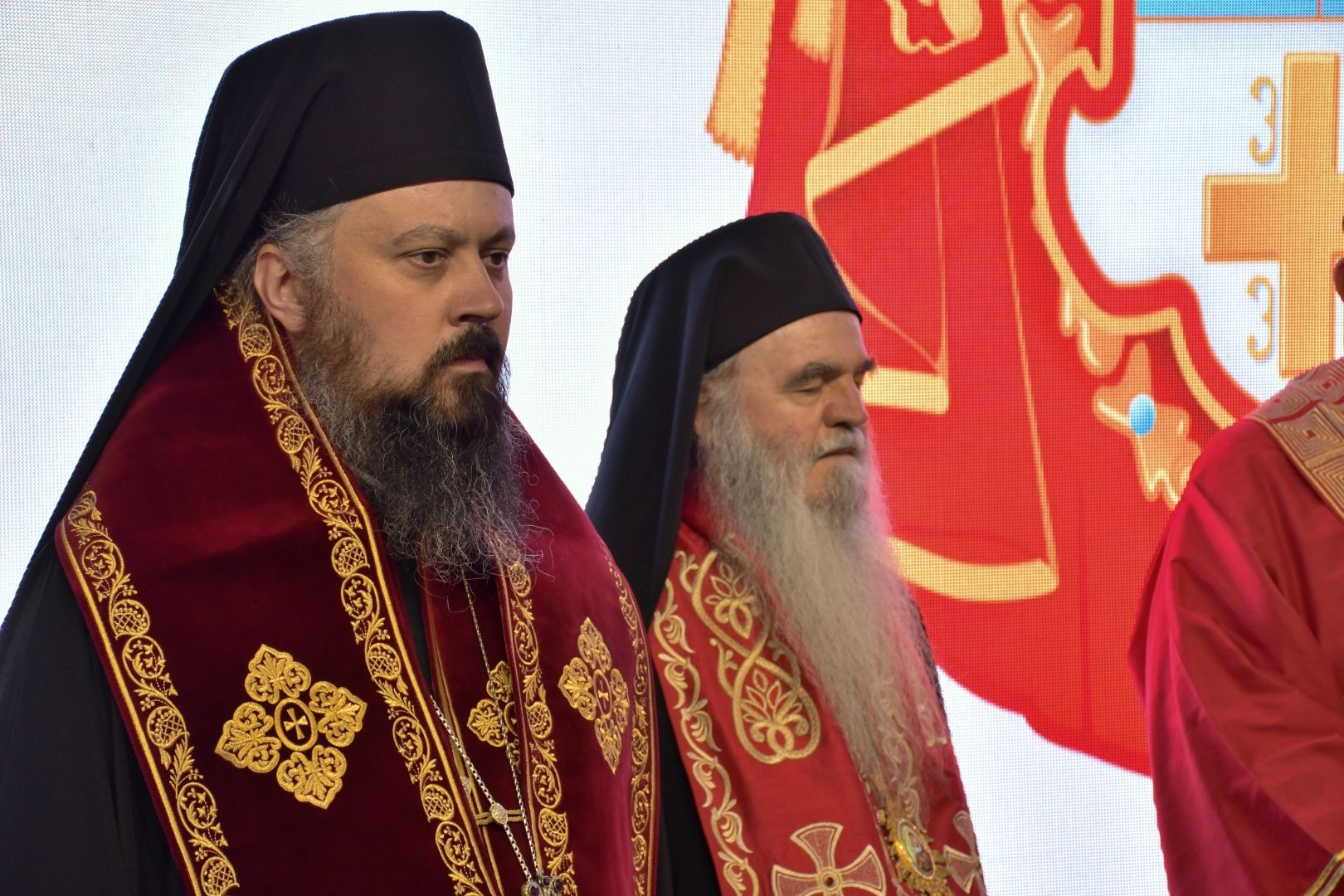
Concelebrating were: Metropolitan David of Kruševac; Bishops Sergije of Bihać-Petrovac and Sava, vicar bishop of Marča; Archimandrites Varnava (Damjanović), Vasilije (Rožić), and Jerotej (Vlajković); Protopresbyters-Stavrophores Dragan Škaljona, Nikola Peno, Savo Janković, Saša Crljić, and Miladin Samardžić; Protopresbyters Aleksandar Đurić and Savko Plavšić; Protodeacons Dragan Radić, Radojica Žagran, and Nemanja Reljić.
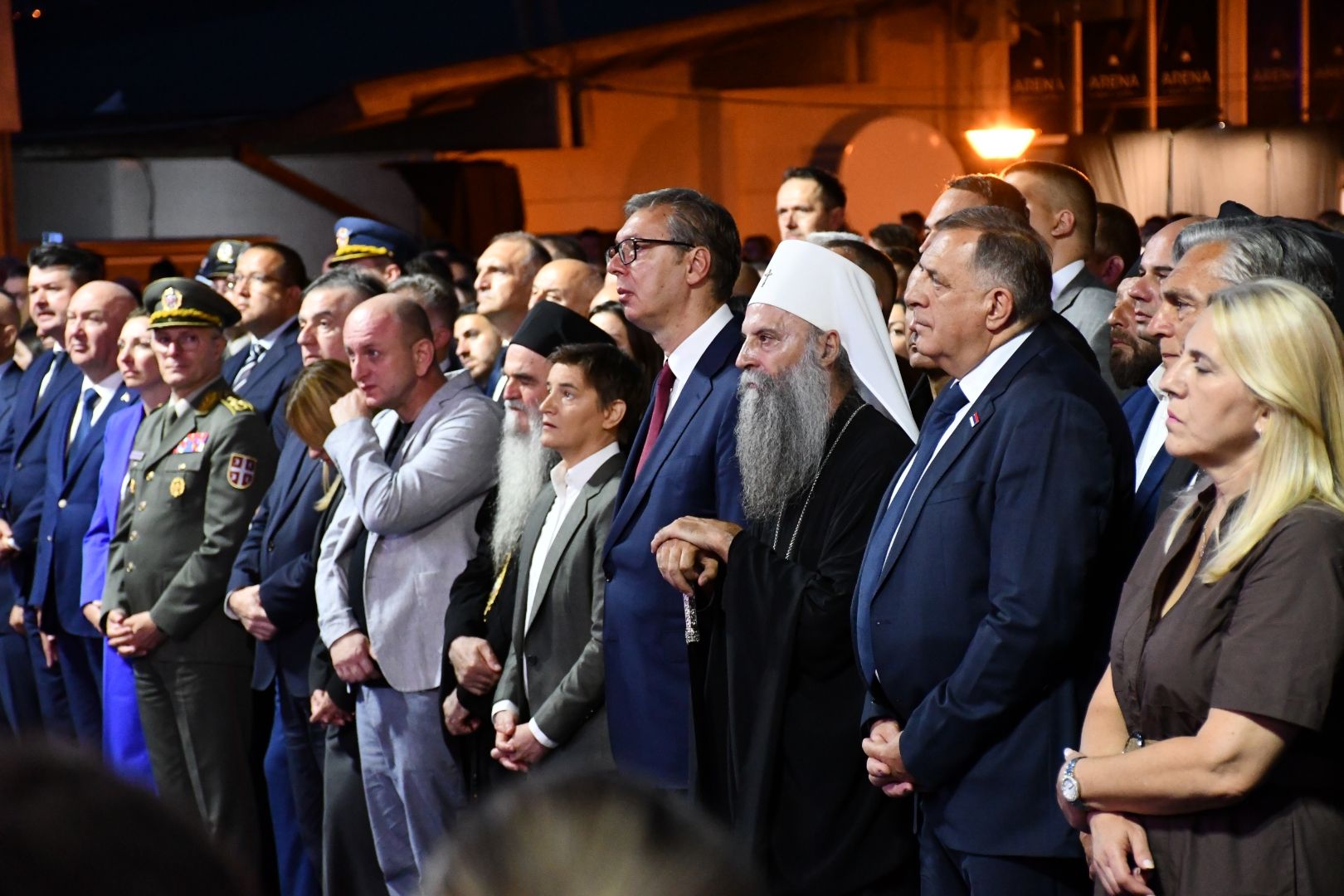
Following the addresses of the President of the Republic of Serbia, Mr. Aleksandar Vučić, President Mr. Milorad Dodik, and Mr. Milan Knežević, a program was held in remembrance of all those killed and expelled from their age-old hearths.
Read the address of Patriarch Porfirije of Serbia:
Right Reverend Brother, Bishop Sergije, host of this God-preserved eparchy; brother archpriests; esteemed President of the Republic of Serbia; esteemed President of Republika Srpska; esteemed member of the Presidency of Bosnia and Herzegovina; presidents of the National Assemblies of the Republic of Serbia and Republika Srpska; esteemed President Mr. Dodik, dear Mr. Knežević; dear spiritual children, children of St. Sava, glorious people of the Krajina, God help us all!
Year after year we gather in different places to prayerfully commemorate the innocent victims of the terrible persecution of our people from their age-old hearths, known as “Storm,” and to embrace all who to this day carry the wound of that unprecedented exile on European soil in the twentieth century.
Tonight, here in Mrkonjić Grad, I will not seek new words compared to those we have spoken before, for the truth remains the same, the pain does not cease with the passage of time, and our duty to remember our fallen kin before God remains permanent and unchanging.
Here in Mrkonjić Grad, which itself bears deep wounds of suffering, tonight we have been gathered by love for our martyrs, kin, neighbors, and countrymen who, during the horrific persecution from their age-old hearths in the region of Dalmatia, Lika, Kordun, and Banija, innocently lost their lives in August 1995. With particular pain we remember those who perished on the Petrovac road, where innocent people, the elderly, women, and children, died in the refugee column, on the road toward salvation.
In their suffering, but also in the perseverance of all who bore the cross of exile, the words of the Holy Apostle Paul were fulfilled: “We are troubled on every side, yet not distressed; we are perplexed, but not in despair; persecuted, but not forsaken; cast down, but not destroyed” (2 Corinthians 4:8–9). For even as they were left without homes and homeland, our exiled brothers and sisters carried within them the faith that the Lord had not abandoned them, and the hope that evil does not have the final word. Tonight we prayerfully remember all of them, praying to Christ our God — who Himself suffered on the Cross, yet conquered death by death, to grant them rest and eternal life. We also remember all those who, thirty-one years ago, left their age-old hearths and, in endless columns, set out toward Republika Srpska and Serbia, carrying in their hands only what was most necessary, and in their hearts their homes, their homelands, their holy places, and the graves of their ancestors.
We have been gathered here by the desire to prayerfully remember the innocent victims and sufferers of our people, for prayer is the deepest and most worthy form of remembrance. Prayer before the face of God lifts up both the pain of the victim and the wound of the one who remembers. It preserves the truth, while freeing the heart from the hatred that binds a person anew to evil.
These sufferings, like all the bitter episodes of our long-suffering history, should, as a baptized people, lead us back again to who we have always been, back to our roots, turned toward God, and directed toward one another as brothers and sisters, as a community, as one and the same people. They should lead us into a truer and deeper understanding of Christ’s words: “Love your neighbor as yourself” (Matthew 22:39), and further still: “Love your enemies” (Matthew 5:44).
And tonight we call this commandment of love into our memory and into our hearts. At the same time, we know that it is difficult for a person to love an opponent or an enemy. Only Christ-like people, saints of God, grow to the fullness of such love. Yet Christ’s commandment shows each of us the way and calls us to the unceasing struggle of purifying the heart from self-love and self-sufficiency, so that we may multiply within ourselves joy, love, and peace.
Therefore I feel it my duty and responsibility, at this moment, as always from the throne of St. Sava, to call on all of us, his spiritual descendants, not to allow hatred to overwhelm love for our neighbor; not to let it become normal, as unfortunately so often happens among us today, for a neighbor to be turned into a stranger, for a brother to become an opponent, and for difference to become a pretext for enmity, in other words, not to let hatred toward our neighbor, hatred among ourselves, become the only acceptable way of life.
God’s commandment of love has a very concrete content. It directs us toward the people with whom we live. We owe love to one another first of all within the family and in marriage: spouses to one another; we owe love to our parents and children, to our brothers and sisters; then to our neighbors, colleagues, fellow citizens; we owe love to our people.
By learning to love those with whom we directly share the gift of life, we become able, by God’s grace, to recognize in every person a brother and an icon of God. Only by loving our own, by loving our own people, do we become capable of loving others, of loving what is foreign to us, of loving and respecting other people and other nations.
Therefore, again and again I pray to the Lord and call on all of us to rise, as much as we are able, above narrow, selfish, and ideologically motivated particular interests, and, in the spirit of Christian and Orthodox conciliarity, to rise above divisions and discord. I call on you not with my own words but with those of the Apostle Paul, the great saint of God, who implored the Christians in Corinth: “Now I plead with you, brethren, by the name of our Lord Jesus Christ, that you all speak the same thing, and that there be no divisions among you, but that you be perfectly joined together in the same mind and in the same judgment. For it has been declared to me concerning you, my brethren… that there are contentions among you” (1 Corinthians 1:10–11).
Those words of the Apostle Paul are today still the word of the Church of Christ, the word of the Church of St. Sava, a word that calls us to recognize one another as brothers, to forgive and to seek forgiveness from one another, to open our hearts to one another, and to know that no one is superfluous, that everyone is needed by everyone, and that everyone is precious. We are called to preserve peace and harmony among ourselves, but also to live in peace, mutual respect, and good neighborliness with all the people and nations with whom we share this blessed land.
Let us recall the biblical account of the Jewish people, who once wandered lost through the desert for forty years, learning to remember one thing: to remember their Covenant, and to seek their strength in faithfulness to God. The desert was the school in which the people learned again and again who they were and whose they were, where they came from, what their goal was, and to what they were called. For a people, however terrible and unbearable it may be, does not perish first and foremost when it is left without land and home. The deepest fall of a people begins before that; it begins when that people forgets who it is, whose it is, what its goal is, and on what covenant it is founded.
Out of such forgetfulness discord is born, brother grows distant from brother, and the harmony and unity vanish without which little can be preserved, let alone built. That is why our prayerful remembrance is, at the same time, a preservation of our identity, our covenant, and our awareness of who we are and what we are. By remembering our martyrs and our homelands, we remember who we are, whose we are, and to whom we belong. And we belong to Christ, to His Church, to one another, to the Orthodox Serbian people of St. Sava. Only in this way are we gathered together even when we are scattered, spiritually rooted even when we are far from our hearths.
Having prayed once again for our brothers and sisters who perished during the tragic August days of 1995, as well as for all those who left their age-old hearths and set out on the road of exile, let us close our address once more with the prayerful supplication of the late-blessed Patriarch Pavle:
“Lord Jesus Christ, our God, accept this our fervent prayer and forgive us our sins. Help us, You who for the salvation of all went to the cross and suffered death, that among us and throughout the whole world hatred may give way to love, unrest to peace, sorrow to joy, that we may live a quiet and peaceful life as Your people and as brothers among ourselves. Lord of peace and love, help us to return to Your path. Preserve our land and our people from injustice, violence, mutual strife, and discord, and do not remove the lampstand of our Church from before You. For You are the God of mercy, goodness, and love for mankind, and to You we raise glory, to the Father, and to the Son, and to the Holy Spirit, now and forever, and unto the ages of ages. Amen.”
May there be eternal memory to all our brothers and sisters who innocently perished in the terrible persecution from their age-old hearths, the persecution known as “Storm.” Christ is risen! Indeed He is risen!