


Listen to this article
Estimated 3 minutes
The audio version of this article is generated by AI-based technology. Mispronunciations can occur. We are working with our partners to continually review and improve the results.
Russian missile and drone strikes on Kyiv and the surrounding region killed 17 people and wounded 44 others overnight into Wednesday, Ukraine’s President Volodymyr Zelenskyy said.
Russia fired 24 ballistic missiles, four other missiles identified as either hypersonic Zircons or supersonic Oniks, and 115 drones, many of them jet-powered, in the attack.
Zelenskyy said the strikes mainly targeted warehouses belonging to civilian businesses, as well as infrastructure and a railway station, hitting sites that he described as “with no connection to the war”— including a brewing company, building materials warehouses and civilian logistics facilities.
The attack was the latest in a series of large-scale Russian ballistic missile strikes that have become near-routine this summer.
Ukraine has a limited stockpile of interceptor missiles for the U.S.-made Patriot systems, the sole air defence system in its arsenal able to shoot down ballistic missiles, making large volleys like Wednesday’s hard to stop, even as Ukraine has stepped up deep strikes on Russian oil refineries and energy infrastructure.
“Ballistic interceptors are what could have saved the lives of those killed today,” Zelenskyy said in a statement on Telegram. “It is very important for our partners to understand that delays in supplying them, or a reluctance to hand over anti-ballistic systems, lead directly to such horrific casualties and destruction.”
In the wider Kyiv region around the capital, there were fires at multiple locations in Brovary, Bucha and Fastiv districts, Ukraine’s emergency service said.
Large warehouse fires burned in the city of Brovary and the villages of Velyka Dymerka, Kvitneve and Peremoha. A fire involving vehicles at an enterprise in Fastiv district was extinguished. In Bucha district, crews battled a warehouse fire in the village of Chaiky after putting out a separate fire at a logistics facility in Sofiivska Borshchahivka.
In the capital, emergency crews extinguished all fires sparked by the strikes in the Obolonskyi, Sviatoshynskyi, Holosiivskyi and Desnianskyi districts, the Kyiv City Military Administration said.

Large warehouse fires burned in the city of Brovary and the villages of Velyka Dymerka, Kvitneve and Peremoha. (Anatolii Stepanov/Reuters)
Serhii Beskrestnov, an adviser to Ukraine’s president on defence technology development, said the war of attrition has entered a new phase.
“The enemy is attacking everything indiscriminately — retail warehouses, food storage facilities, logistics hubs, enterprises, building materials warehouses,” he said on Facebook.
Large retail chain hit
One of the companies that came under heavy fire was the Epicentr, one of Ukraine’s largest retail and construction chains. It said in a statement on Facebook that “in minutes, Russian missiles destroyed what the company had built over decades.”
One employee was killed and three others were wounded. Russia hit two of the company’s key logistics hubs.
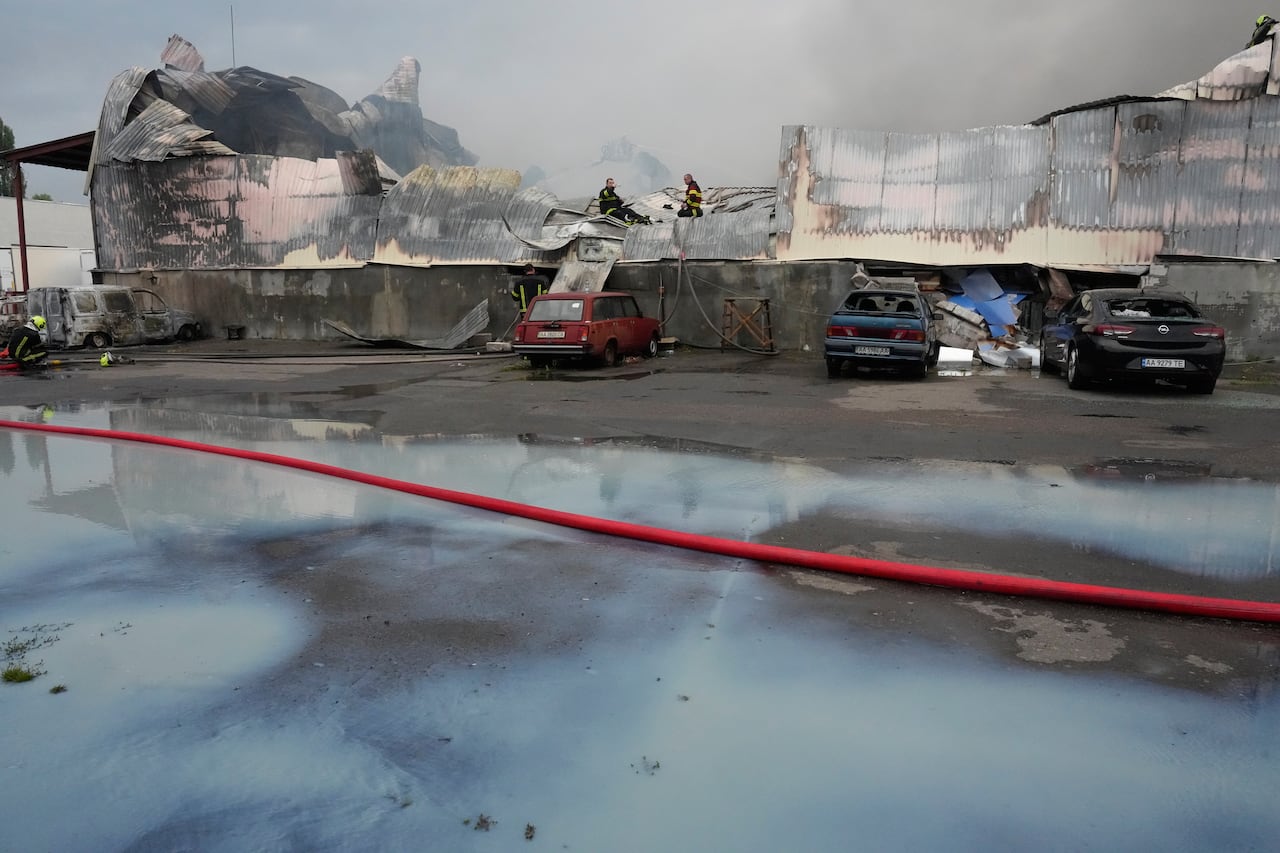
Firefighters put out a fire Wednesday after Russian missiles hit a food warehouse near Kyiv. (Efrem Lukatsky/The Associated Press)
A direct hit also destroyed the production floor of its ceramic tile factory, forcing the company to halt manufacturing there and shift production abroad, with full recovery expected to take up to two years, the company said.
Epicentr also voiced support for other Ukrainian businesses damaged in the attack, saying it understood “how many years of work, effort, faith and daily responsibility stand behind every enterprise.”
Ukraine has carried out its own campaign against Russian retail logistics, striking multiple warehouses belonging to Wildberries — often described as Russia’s answer to Amazon — as part of a broader effort to damage Moscow’s economy and confront Russians with the costs of the war.