
Kyiv could target North Korean support for Russia, leaving Pyongyang with several options in response.
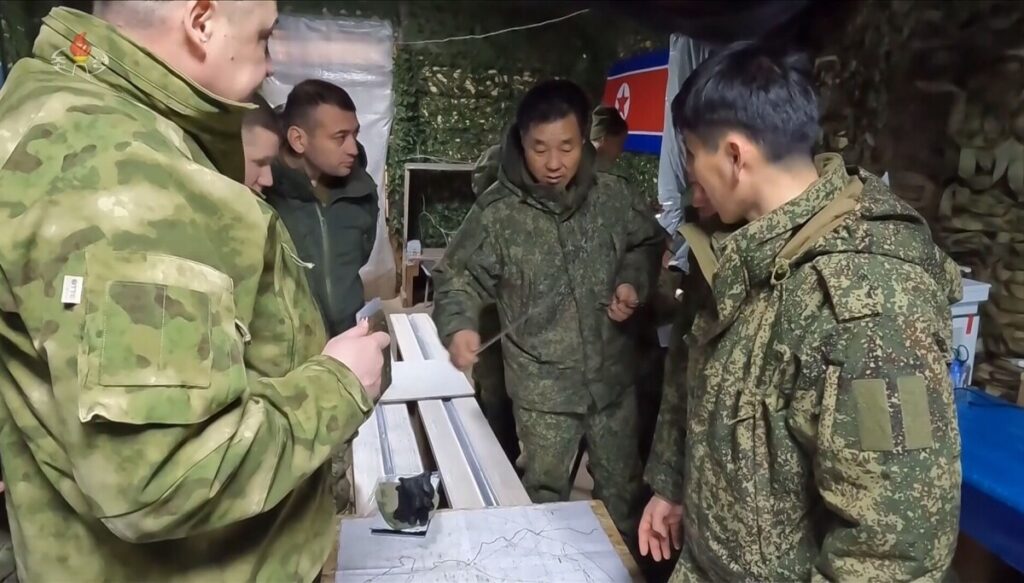
North Korean military officers are shown discussing tactics with Russian troops in Ukraine in combat footage released by Korean Central Television on Aug. 31, 2025.
Yonhap News

John Everad
The author is a former British ambassador to North Korea.
On July 25, Ukraine attacked an Iranian cargo vessel in the Caspian Sea, demonstrating that Ukraine is prepared to attack not just Russia but also its allies.
Might it now also attack Russia’s key ally, North Korea? Would it? Could it? And if it did, what might happen?
Would it? It has every reason to. Although the fighting in Russia’s Kursk region, where North Korea sent perhaps 14,000 troops to help its Russian ally repulse Ukraine, has largely finished, Pyongyang continues to provide Russia with battlefield missiles, artillery shells and other military supplies. On July 30, Ukraine claimed that a missile used against it was made in the North — the first North Korean missile used by Russia this year.
Politically too, North Korea has become hostile to Ukraine. Leadership speeches portray the country as a western stooge and glorify both Moscow’s aggression and Pyongyang’s part in it.
Moreover, on the very same day as the attack on the Iranian vessel, President Zelensky claimed that Russia had asked for 30,000 North Korean troops. Although some previous Ukrainian claims of Pyongyang’s involvement have proven wrong, President Zelensky’s claim is supported by reports that Russian President Vladimir Putin and North Korean Foreign Minister Choe Son Hui discussed a mass deployment on July 20. Such a deployment would represent a step change in the North’s support for Russia, especially if it is accompanied by additional transporter erector launchers for ballistic missiles. Even if these troops serve only in the rear, freeing Russian troops for the front, they would still represent a major boost for the Russian war effort.
So for Ukraine the possible rewards from an attack that disrupts or halts the North’s support for Russia would be immense. Forcing North Korea to abandon the deployment of 30,000 troops would cripple the planned Russian autumn offensive. Reducing North Korean munitions would accelerate Ukraine’s recapture of territory. Russia’s key ally would be humiliated.
Moreover, the escalation risks would be less severe than those associated with its attack on the Iranian vessel. Iran is not currently part of the war but has missiles that can strike inside Ukraine. After condemning Iran’s support for Russian aggression on July 27, Ukraine’s foreign minister quickly spoke with his Iranian counterpart to avoid escalation.
But short of threatening to use nuclear weapons — which would require Russian cooperation — there is little else that the North can do in retaliation. It is already sending everything it can to support Russia’s war effort and North Korean missiles are already being used in the conflict. The Comprehensive Strategic Partnership Treaty of June 19, 2024, makes attacks on North Korea easier to explain internationally than attacks on Iran. A successful attack would impress U.S. President Donald Trump who likes winners and with whom President Zelensky is striving to rebuild his relationship.
Could it? Over Iran, Ukraine acted carefully. It did not attack targets in Iran itself but only an Iranian vessel in Russian territorial waters. Might it do the same to North Korea? Because the North ships most of its munitions for Russia by sea, usually from Rason to ports near Vladivostok, there are many occasions when North Korean vessels are in Russian territorial waters. These are well out of range for Ukraine-based missiles and drones. But Ukraine could probably solve this problem. It could find a way to ship drones to a state with a Pacific port. It could then hire a vessel from which to launch its attack. As the latest Ukrainian drones have a range of over 3,000 kilometers (1,864 miles) the vessel would not need to come suspiciously close to the Korean Peninsula but could sink Pyongyang’s cargo ships from a safe distance. In contrast, striking a North Korean vessel would involve launching a drone from a ship somewhere in the Pacific Ocean across open and undefended water. If Ukraine decided to launch such an attack, it probably could.
If Ukraine did carry out such an attack, Pyongyang would be incandescent with fury. The immediate reaction would probably be bloodcurdling threats of retaliation. But North Korea would recognize quickly that Ukraine has escalation dominance. If Ukraine can hit one ship it can hit others, and it can also hit targets within North Korea. Despite many recent military advances, Pyongyang’s anti-drone defenses are not strong. Just as Iran did not want to escalate so too might the North well look for a way to avoid escalation. Ukraine would be careful to offer a diplomatic fig leaf and Pyongyang might well take it.
Then what? Kim Jong-un’s prestige would suffer a terrible blow because he is so closely associated with Russia. North Korea would be anxious to prevent further Ukrainian attacks, but also anxious to not be forced to end its lucrative military trade with Russia.
Typically, when frightened, the North negotiates. It is impossible to predict the outcome, but the most likely would be a shabby deal — perhaps canceling the troop deployment in exchange for a promise to halt attacks.
All this may seem far-fetched. But throughout the war, Ukraine has surprised its adversaries through technical and strategic innovation, from its expertise in drones to bold moves such as the invasion of Russia and the attack on the Iranian vessel. We cannot know what Kyiv is planning, but an attack on North Korea would fit this pattern.
This article was originally written in Korean and translated by a bilingual reporter with the help of generative AI tools. It was then edited by a native English-speaking editor. All AI-assisted translations are reviewed and refined by our newsroom.