
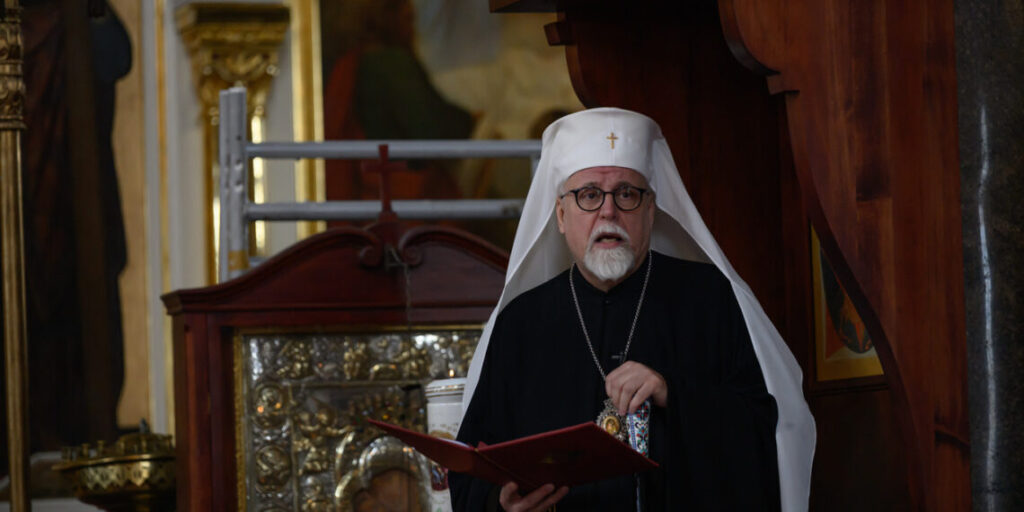
Archbishop Elia of Finland has strongly criticized Patriarch Kirill of Moscow over his recent sermon on St. Seraphim of Sarov, arguing that “the Church must not be used to legitimize weapons of mass destruction.”
In a public statement, the Primate of the Orthodox Church of Finland contrasted the life of St. Seraphim—devoted to prayer and peace—with the transformation of Sarov into the center where the Soviet Union developed its first nuclear weapon.
Referring to Patriarch Kirill’s sermon, delivered on August 1 at the Holy Trinity–St. Seraphim Monastery in Diveyevo, Archbishop Elia noted that the Patriarch claimed it was no coincidence that “the Soviet nuclear weapon was developed in the very place where the saint had prayed,” implying that the saint’s intercessions contributed to the creation of Russia’s nuclear program.
The Archbishop firmly rejected this interpretation, calling it a “political agenda” rather than an expression of Orthodox theology. He stressed that “it is appalling that he attaches the name of Seraphim of Sarov to the blessing of a weapon of mass destruction.”
Quoting St. Seraphim’s well-known words, “acquire peace of soul, and thousands around you will be saved” Archbishop Elia contrasted the saint’s message with the destructive power of nuclear weapons, pointing out that a single nuclear warhead can annihilate thousands of people.
He also recalled the history of the Sarov Monastery during the Soviet era. After its closure in 1927, he noted, the monks were persecuted and executed, the relics of St. Seraphim were desecrated, and the monastery was successively turned into a shelter for homeless children, a prison camp, and ultimately the secret nuclear research center known as Arzamas-16, where the Soviet Union’s first atomic bomb was developed.
According to Archbishop Elia, “the weapon did not come to Sarov because of holiness. It came there because holiness had first been cleared away.” He added that portraying the nuclear complex as the fruit of St. Seraphim’s prayers effectively places the Church’s “new martyrs have been made to vouch for the work of their killers.”
The Archbishop further argued that “When Kirill speaks of God in the language of politics, he is no longer proclaiming the message of the Gospel. He is proclaiming a position of state.” He reminded readers that the Orthodox Church prays at every Divine Liturgy “for the peace of the whole world,” not for the victory of any army.
“There is no such thing as an Orthodox nuclear weapon,” Archbishop Elia emphasized. “Let the state weigh the weapon and its use. It is not the task of the Church to bless a weapon of mass destruction,” he concluded.
Read the full statement below:
A saint cannot be conscripted
Two kinds of work have been done in the forest of Sarov. In the early nineteenth century a hermit lived there whose name was Seraphim: a man who lived alone in a cabin behind the monastery, fed a bear from his hand and received everyone who found the way to his door. He became the most beloved saint in Russia. A hundred years later, in that same forest and partly within the same walls, the Soviet Union’s first nuclear weapon was built.
On the first day of August 2026 these two were joined together.
The address given by Patriarch Kirill of Moscow at the Diveyevo monastery on the feast day of Saint Seraphim raises serious questions. The Patriarch claimed that it was no coincidence that the Soviet nuclear weapon was developed in the very place where the saint had prayed. In his account, the weapon came into being partly through Seraphim’s prayers. Among those listening sat leading figures responsible for the Russian state’s nuclear energy and nuclear weapons programmes. At the close of his sermon the Patriarch prayed for the protection of the land of Russia, of its Orthodox president and of its armed forces.
What the Patriarch expressed is not theology; it is a political agenda. It is appalling that he attaches the name of Seraphim of Sarov to the blessing of a weapon of mass destruction.
Seraphim’s best-known words run: “acquire peace of soul, and thousands around you will be saved”. The nuclear weapon is the exact mirror image of that sentence. One warhead, and thousands around you are destroyed. Between the two there is no difference of interpretation.
The Sarov monastery has a bloody history from the Soviet period. It was closed in 1927. The monks fell victim to the Bolshevik persecutions and many were executed. Seraphim’s relics were desecrated and taken away. The empty cells were used first to house homeless children gathered from across the country, after which the monastery became a prison colony. And finally, in 1946, a nuclear weapons design institute was established around it, for in a remote forest one could detonate without anyone hearing, and the walls were already standing.
Sarov itself was erased from the maps. In place of the name came Arzamas-16 – a fenced city that officially did not exist and that no one could enter without a permit. There the country’s first atomic bomb was built, and Russia’s nuclear weapons are developed there still.
The weapon did not come to Sarov because of holiness. It came there because holiness had first been cleared away.
Now Kirill gives it to be understood that an institution raised on the graves of the Church’s own monks is the fruit of their prayers. The new martyrs have been made to vouch for the work of their killers.
When Kirill speaks of God in the language of politics, he is no longer proclaiming the message of the Gospel. He is proclaiming a position of state.
In its liturgy the Orthodox Church always prays for the peace of the whole world, not for victory for the weapons of one country.
There is no such thing as an Orthodox nuclear weapon. Let the state weigh the weapon and its use. It is not the task of the Church to bless a weapon of mass destruction.
Seraphim of Sarov is not the saint of Russia alone; he is a saint of the whole Church. He is commemorated in the services of the Orthodox Church of Finland as well, and his icons are in our churches. He is a saint very dear to the faithful of our church.
Seraphim of Sarov greeted everyone he met with the words “Christ is risen, my joy”. Everyone. Including the robbers who struck him with an axe and left him stooped for the rest of his life. Seraphim asked the judge not to punish them. Seraphim’s humility and his broken, stooping back are the true inheritance of the Russian church. Not Arzamas-16.
A saint cannot be conscripted. His name can be borrowed, his image can be hung on the wall of a missile silo, and a speech can be given on his feast day. But I am certain that he does not consent to this.
Elia
Archbishop of Helsinki and All Finland