
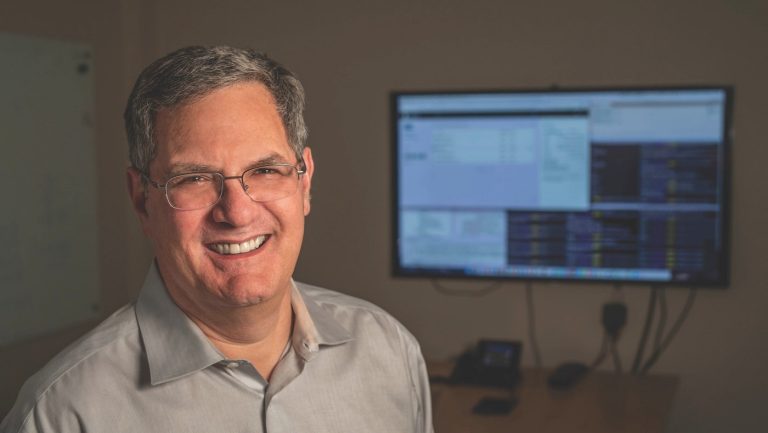
The National Science Foundation has awarded a $20 million grant to a collaboration led by Mark Musen, MD, PhD, professor of computational medicine, to help develop a network of artificial intelligence-driven, remotely operated labs.
The award is part of a $400 million endeavor to build a national network of 20 such facilities, known as programmable cloud laboratories. Able to run autonomously based on instructions sent remotely from scientists and engineers, these laboratories could expedite research and innovation while also accomplishing something else unique: the democratization of access to high-end lab equipment, ultimately lowering costs and redundancy while improving the reliability and reproducibility of experiments.
“The way we have set up labs in the life sciences, chemistry, materials science and other fields is that everybody needed to have one of everything, basically, to do significant research,” said Musen, director of the Stanford Center for Biomedical Informatics Research. “That’s like saying every astronomer needs their own telescope to look at the sky.”
“Through this initiative,” Musen added, “we’re looking to efficiently transform how a vast swath of science is done, and we are proud to be a part of the effort.”
Known formally as the NSF Test Bed: Toward a Network of Programmable Cloud Laboratories (NSF PCL Test Bed), the initiative is funding awardees to test, scale and demonstrate new methods and tools. The goal is for the initiative to empower PCLs to conduct automated hypothesis generation and experimentation, thus serving as “self-driving laboratories,” Musen said. The NSF PCL Test Bed supports the Genesis Mission, a U.S. government program to leverage AI for promoting scientific discovery.
A critical element of the PCL enterprise will be translating laboratory methods intended for human technicians into clear instructions that machines can follow. On behalf of all 20 NSF-funded groups, Musen’s team is spearheading the crafting of shared standards that will enable networked PCLs to seamlessly accept input from human users.
“We want to do natural language analysis of descriptions of research protocols and translate them into the kinds of procedures that can then be executed by a cloud lab,” Musen said. “The problem is that natural language is inherently ambiguous. When you read a protocol, it’ll say things like ‘stir thoroughly.’ What does that mean exactly? How do you quantify that?”
The team has christened their project GEMSTONE, for generalizable experimental methods and standards for transparent, open, networked execution. Project collaborators hail from Purdue University, Morehouse College and Emerald Cloud Lab, which operates a remote laboratory in Texas.
“We think there’s a great possibility here to unify what people do in cloud labs with a common language,” Musen said. “PCLs show an immense level of promise, and we look forward to helping them deliver on that promise.”